Home
» 🎮 Esports
»
Valorant map veto explained: pick order, side selection and deciding maps
Valorant map veto explained: pick order, side selection and deciding maps
A VALORANT map veto is more than a pre-match formality. It is a constrained draft in which teams trade map comfort, opponent denial, starting-side control, and series depth. The important detail is that those advantages are distributed differently depending on whether a team is designated Team A or Team B, and they change again between best-of-three and best-of-five matches.
For the 2026 season, Riot Games lists the VCT Official Competition Ruleset (2026) in its Competitive Operations library. Riot says that ruleset was last updated December 18, 2025, and the library also lists event-specific documents, including the September 16, 2026 ruleset for Champions Shanghai. That distinction matters: the global process is the baseline, but an event-specific ruleset can change details, so the current event document should always be the final reference.
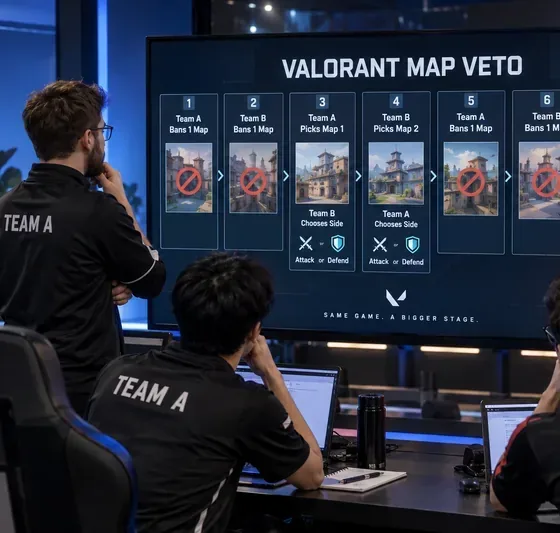
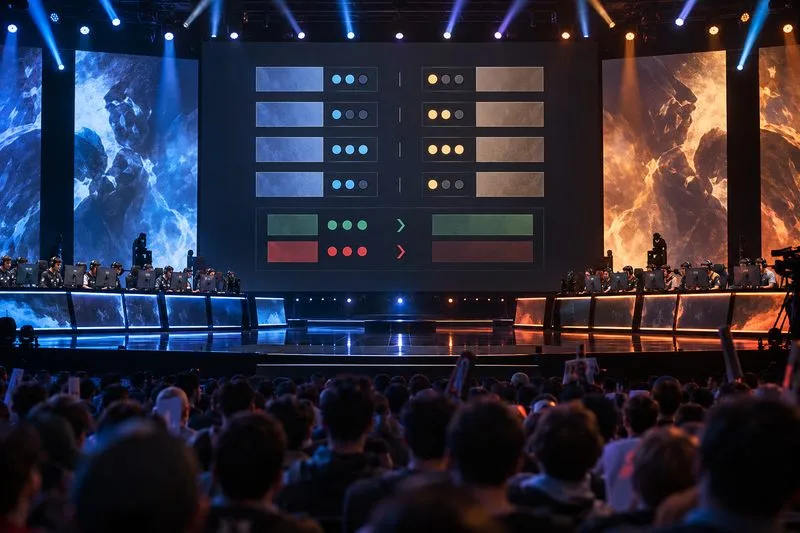
Teams reviewing the early stages of a best-of-three veto: opening bans narrow the pool, each team gets a map pick, and the opponent chooses the starting side on that picked map.
What a map veto actually decides
The veto determines three things before the match begins: which maps are removed, which maps are selected in a defined order, and which team gets to choose the starting side on each map. In Riot's standard seven-map framework, bans progressively shrink the pool until the required number of maps remains.
That creates a useful trade-off. Picking a map gives a team control over where the series is played, but it normally gives the opponent the side choice on that map. A ban removes risk, but every ban also leaves other maps available. The final deciding map is therefore not an extra pick; it is the map left over after the required picks and bans are complete.
Standard best-of-three veto order
Under the 2026 VCT baseline, the better-seeded or home team chooses whether it will act as Team A or Team B. If the competition has no predetermined seeding, the relevant rules can use a random determination. Team A then starts the veto.
Step
Action
Practical trade-off
1
Team A bans one map
A gets first removal and can immediately protect itself from a bad matchup or target an opponent strength.
2
Team B bans one map
B answers after seeing A's first removal.
3
Team A picks Map 1
A controls the first played map, but gives up starting-side choice there.
4
Team B chooses the starting side on Map 1
B can select Attack or Defense according to its plan for the opponent's pick.
5
Team B picks Map 2
B gets its own preferred map after seeing A's pick.
6
Team A chooses the starting side on Map 2
A gets the side-choice benefit on B's map.
7
Team A bans one remaining map
A makes the first final-stage removal.
8
Team B bans one remaining map
B makes the last map removal.
9
The only remaining map becomes Map 3
No team directly picks the decider; it is created by the earlier decisions.
10
Team A chooses the starting side on Map 3
A receives the side decision on the leftover map.
This distribution explains why the better seed does not have one universally superior Team A/Team B choice. Team A receives the first ban, the first map pick, and the side choice on the decider. Team B receives the second map pick and the side choice on Map 1. Which bundle is more valuable depends on each team's map pool and matchup.
When Team A can be attractive
Team A can suit a roster that wants to make the first strong statement in the veto. The first ban can remove a severe weakness before the opponent gets to act, while the first map pick can secure a prepared comfort map. Team A also controls the starting side on the decider, which can matter if the team already expects a particular map to survive the veto.
The trade-off is information. Team B sees the first ban before making its own, and it gets the starting-side choice on Team A's pick. A team that relies heavily on a particular opening half may therefore need to weigh map comfort against surrendering side control.
When Team B can be attractive
Team B can suit a roster that values response and counter-positioning. It gets to see Team A's first ban, chooses the starting side on Map 1, and then selects Map 2. That sequence can be useful when a team has several playable maps rather than one must-have pick.
The cost is that Team B does not control the opening action or the final side choice on the standard Bo3 decider. If its pool has one dangerous weakness that the opponent can exploit immediately, giving away the first ban may be uncomfortable.
Side selection is a strategic resource, not a prize
In VALORANT, side selection means choosing whether to start on Attack or Defense. It is tempting to treat the side perceived as stronger on a map as automatically better, but that is too simple. Map balance changes with patches, agent compositions, team styles, pistol-round plans, and recent preparation.
A team may prefer to start on the side where its set plays are deepest, where it has a rehearsed pistol, or where it expects to build early economy. Another team may prefer to finish regulation on its stronger side so that late-round pressure lands in a familiar structure. Because those preferences are team-specific and meta-dependent, recent match data and the active patch are more useful than old assumptions about a map being permanently Attack- or Defense-sided.
For viewers, a practical way to read side selection is to ask: did the team choose the side that best fits its own strengths, or the side that disrupts the opponent's preferred opening? Those are different objectives, and the answer can explain why a team accepts a map that looks less comfortable on paper.
How the deciding map is created
In a standard Bo3, the deciding map is the only map left after two opening bans, two map picks, and two final bans. It is not randomly selected and it is not an extra choice made after the series reaches 1-1.
That makes the decider a useful test of map-pool depth. A team can often protect one strong pick, but reaching Map 3 means it must also be ready for a map neither side chose as its first preference. The trade-off during the final bans is therefore important: removing the opponent's strongest remaining map may force you onto a decider you dislike, while protecting your preferred decider may leave the opponent a more comfortable option.
What changes in a best-of-five
The standard Bo5 process spreads control across a longer series. Team A bans one map, Team B bans one map, then the teams alternate map picks: A picks Map 1, B picks Map 2, A picks Map 3, and B picks Map 4. The fifth map is the only remaining map. Side choices alternate with the opposing team choosing the starting side on each picked map; under the baseline process, Team B chooses the starting side on Map 5.
The strategic emphasis changes because there are fewer opportunities to hide a weak map. In a Bo3, a shallow pool can sometimes survive if the weakest maps are removed. In a Bo5, teams need more playable territory because four maps are actively picked before the fifth is left over.
Team profile
Priority in Bo3
Priority in Bo5
One elite comfort map
Secure or protect that map while minimizing exposure elsewhere.
Broaden preparation; one standout map cannot carry a five-map pool.
Deep, flexible pool
Use bans to target the opponent rather than only cover weaknesses.
Lean into depth and force the opponent to play multiple uncomfortable maps.
Strong side-specific openings
Value Team A/Team B assignment based on which maps are likely to be picked.
Plan side choices across several maps instead of treating each in isolation.
Why grand finals can use a different veto
Riot's rules framework also provides for a separate best-of-five process in double-elimination grand finals, where the upper-bracket team can receive a stronger veto benefit, including a two-map ban before the remaining picks proceed. This is exactly the kind of situation where copying a generic Bo5 sequence can be wrong.
Before analyzing a specific final, check the event-specific rules document in the Riot Games Competitive Operations library. Tournament formats, map pools, and bracket advantages can be specified there even when the global ruleset provides the general model.
A current 2026 example: Champions Shanghai
Riot's official Champions Shanghai event overview, published September 11, 2026, states that group-stage matches are best-of-three and that most playoff matches are also best-of-three, while the lower final and grand final are best-of-five. The 2026 VCT League Handbook gives the same high-level format split.
For a viewer, that means the same team may face different veto pressures within one event. Early and mid-bracket Bo3 matches reward protecting two playable maps and surviving a decider. A late Bo5 demands broader preparation and gives map-pool depth much more room to matter.
How to evaluate a veto without overreading it
Start with the first bans. They show what each team refuses to risk, but they do not prove fear or weakness by themselves. A ban can be matchup-specific.
Separate map pick from side choice. The team that selects a map does not necessarily control the starting side on it.
Track the final bans. These determine the shape of the decider and often reveal which remaining matchup each team is willing to accept.
Check the active event rules. The global ruleset is the baseline; event-specific documents can modify the process.
Use current data carefully. Recent map records, agent compositions, and patch context are more relevant than season-old stereotypes about which side or map favors whom.
The key trade-off
A good VALORANT veto is not simply about getting a favorite map. It is about distributing limited control across bans, picks, side choices, and the decider. Team A and Team B each receive different advantages; a Bo3 rewards targeted protection and matchup management, while a Bo5 exposes more of the full map pool.
The most useful question is therefore not “Who won the veto?” in the abstract. Ask what each team was trying to protect, what it was willing to concede, and whether the resulting map order fits its preparation. That approach explains the veto without pretending there is one universally best choice for every roster or every event.