Home
» 🎮 Esports
»
LAN Server Selection, Ping and Side Choice: How Tournament Organizers Keep Esports Matches Fair
LAN Server Selection, Ping and Side Choice: How Tournament Organizers Keep Esports Matches Fair
The short answer: fairness comes from controlling the network and separating it from strategic choice
At a well-run esports tournament, organizers do not try to make every variable identical. Instead, they control the variables that should be neutral—such as the match server, network path, hardware environment and technical procedures—and use published rules for variables that are intentionally strategic, such as map choice, starting side or draft order.
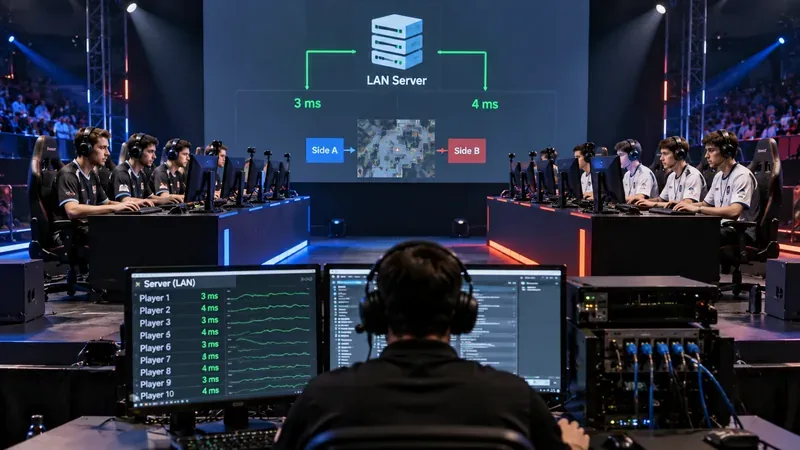
On a true LAN event, the preferred setup is usually a local competition server or another tightly controlled server environment close to every player station. That keeps round-trip latency low and, more importantly, similar for both teams. When a tournament is online or uses remote infrastructure, officials may compare ping across candidate server locations and choose the option that produces the fairest practical result rather than simply giving one team its closest server.
Side choice is handled separately. Depending on the game and event, the right to choose a starting side may come from seeding, the map-veto process, a coin toss, the result of the previous game, or another pre-announced rule. The important point is that the procedure is known before play begins and applied consistently.
On a tournament LAN, organizers try to give both teams the same controlled network path while handling map or side choice under a published ruleset.
What does “LAN server” actually mean?
LAN stands for local area network. In tournament language, a LAN match generally means that players are physically present at the event and connected through venue-controlled networking rather than playing over ordinary home internet connections.
That does not automatically mean “zero ping.” Ping is the round-trip time, usually measured in milliseconds, for data to travel from a player’s computer to the game server and back. Even inside a venue, packets still pass through network interfaces, switches, operating-system queues and the game server itself. A local setup can make that delay extremely small, but the competitive goal is not a magical zero. It is a stable, predictable and comparable connection for everyone.
Valve’s current Counter-Strike Major supplemental rules describe the Major as a LAN competition and require tournament organizers to publish and reconcile event rules before play. That illustrates an important distinction: the publisher can set global competition requirements, while the tournament organizer still has to implement the local technical environment and event procedures. See the Valve Counter-Strike Major Supplemental Rulebook.
Why similar ping matters more than simply finding the lowest ping
Imagine Team A would get 8 ms to Server East and 31 ms to Server Central, while Team B would get 42 ms to Server East and 29 ms to Server Central. Server East gives one team the lowest number, but Server Central produces a much smaller difference between teams. For a cross-region online match, an organizer may prefer the more balanced option even though neither team gets its personal best connection.
This principle appears explicitly in tournament rules. Ubisoft’s Rainbow Six Asia League rules stated that if teams could not agree on an online server, the server with the best average match ping should be used, with administrators retaining authority to select the server to preserve the competitive environment. The exact server list in that 2023 document is historical and should not be treated as a current 2026 server map, but the rule is a useful official example of how organizers can resolve a ping dispute. See the Ubisoft Rainbow Six Asia League rulebook.
Officials should look beyond one ping snapshot
A single number can hide an unstable connection. A fair technical check may also consider jitter—the amount latency varies over time—packet loss, sudden routing changes and whether one side is experiencing spikes that the other is not. A player sitting at 18 ms with severe spikes to 100 ms may have a worse practical connection than a player at a steady 28 ms.
For an on-site LAN, organizers can reduce those variables by using identical or standardized station networks, managed switches, controlled routing and pre-match testing. For remote play, they have less control over the public internet, so the rulebook normally gives officials more discretion to test candidate servers or intervene when conditions become abnormal.
Does a small ping difference automatically make a match unfair?
No. Network latency exists on a continuum, and tournament rules rarely promise that both teams will have numerically identical ping. What matters is whether the event has used a reasonable, pre-defined process to avoid a meaningful one-sided network advantage.
For example, a 2 ms versus 4 ms split on the same local tournament server is not the same situation as one team playing at 12 ms while the other is forced to play at 90 ms. The first is a tiny difference inside an otherwise shared environment; the second may justify a different server, technical investigation or another remedy if the rules allow it.
Players should therefore distinguish between “my ping is not identical” and “the network conditions are materially asymmetric or unstable.” Tournament staff make that distinction through testing, logs and the event’s technical rules rather than by reacting to whichever team complains first.
How is side choice kept fair?
Side choice can matter because maps and game systems are not always perfectly symmetrical in practice. In a tactical shooter, attacking and defending may demand different resources or timing. In a MOBA, map geometry and draft order can affect strategy. Organizers therefore need a neutral method for assigning the right to choose.
Common methods include:
Higher seed gets first choice. This rewards prior performance and makes seeding meaningful.
The opponent of the map picker chooses the starting side. This creates a trade-off: one team gets its preferred map, while the other gets an initial side choice.
Coin toss or random assignment. This is useful when teams enter on equal footing and there is no ranking-based reason to favor either one.
Previous-game loser chooses next. Some series formats use this to rebalance choice from game to game.
No single method is universally correct. The key is that the method is specified in the event rules before the teams know how a particular game will unfold.
Why side selection can change even within the same esport
Side-selection systems evolve. Riot Games announced a notable change for the 2026 League of Legends esports season: the traditional concept of side selection became “First Selection.” A team that earns First Selection chooses either its map side—blue or red—or whether it drafts first or second; the opposing team then chooses the remaining option. Riot said the system would roll out across regions at the start of the 2026 season. See Riot’s Season Start 2026 LoL Esports announcement.
This is a good reminder not to assume that “side choice” has the same meaning in every title or every year. A rule learned from an older tournament can become outdated even if the basic fairness goal stays the same.
A concrete example: how an organizer might handle a best-of-three
Consider a hypothetical best-of-three tactical-shooter series at an on-site event. The teams are seated on identical PCs connected to the same competition network. The organizer hosts all three maps on the same local server environment and completes a pre-match network check.
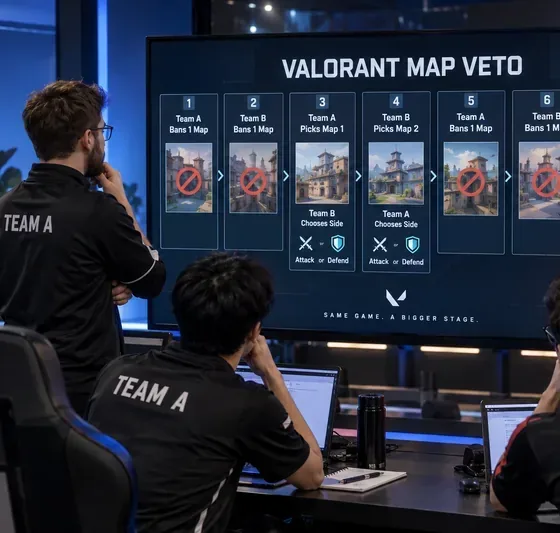
The rules say Team Alpha, as the higher seed, chooses whether to act as Team A or Team B in the veto. Team Alpha picks Map 1, so Team Beta receives the starting-side choice on that map. Team Beta picks Map 2, so Team Alpha receives the starting-side choice there. The decider map uses the event’s published rule—perhaps a coin toss, perhaps a pre-defined Team A/Team B entitlement.
In that scenario, the network is neutralized technically, while strategic choices are distributed procedurally. Team Alpha’s seeding advantage is real, but it is an earned tournament benefit specified by the format rather than an accidental technical advantage.
What should happen if players report high ping during a match?
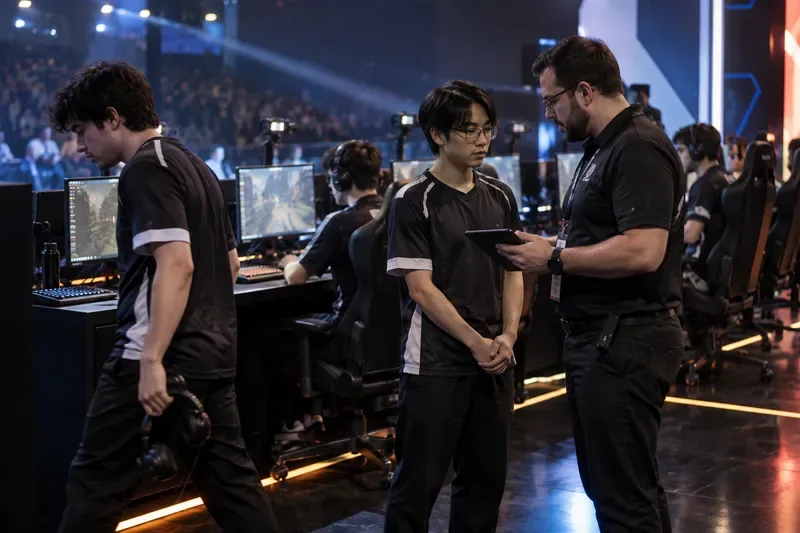
The correct response depends on the rulebook. A typical event distinguishes between an individual player-side issue, a team-wide issue, and a server or venue-wide failure. Officials may pause, check whether the problem is reproducible, compare both teams’ conditions, inspect server health and decide whether a restart, rehost or continuation is appropriate.
Players should report a problem immediately through the official referee or admin channel and avoid taking unilateral action unless the rules specifically permit it. Leaving the server, restarting equipment or changing network settings without authorization can make the incident harder to diagnose and may itself violate tournament procedure.
What fairness can—and cannot—guarantee
A tournament can standardize servers, equipment, station networks and selection procedures. It cannot make every human or strategic condition identical. One team may have a preferred side, better preparation on a map or a stronger draft plan. Those are competitive differences, not necessarily fairness failures.
Likewise, a published advantage such as higher-seed choice is not the same as favoritism. It is part of the competition design if every participant knew how it would be earned. Conversely, an unexplained mid-series server change that benefits one team, or an ad hoc side ruling that contradicts the published procedure, would raise a legitimate competitive-integrity question.
How to evaluate a tournament’s setup as a viewer or player
Before deciding that a match setup is unfair, check four things:
Server rule: Is the event on a local LAN server, a hub server or a remote public server, and who has authority to select it?
Connection quality: Are both teams seeing reasonably comparable latency and stability, not just a single favorable screenshot?
Side-selection rule: Is choice based on seed, veto order, a toss, previous-game result or another published mechanism?
Dispute procedure: Does the rulebook explain pauses, rehosts, technical checks and who makes the final ruling?
If those pieces are defined in advance and applied consistently, the tournament has addressed the main controllable sources of server and side-selection advantage. The exact mechanics still vary by title, organizer and stage, so the event-specific rulebook should always be the final reference.
Bottom line
Competitive fairness on LAN is not created by one magic ping number. It comes from a stack of controls: a common server environment, stable networking, pre-match checks, consistent technical escalation and a transparent method for allocating strategic choices.
For players, the practical lesson is simple: know the event’s server and side-selection rules before match day, test during the permitted window, and report abnormalities through officials as soon as they appear. For viewers, remember that a low-latency LAN reduces network asymmetry, while side choice remains an intentional part of competitive strategy governed by the tournament format.