Home
» 🎮 Esports
»
Dota 2 Buyback Explained: Cooldown, Gold Cost and Strategic Risk
Dota 2 Buyback Explained: Cooldown, Gold Cost and Strategic Risk
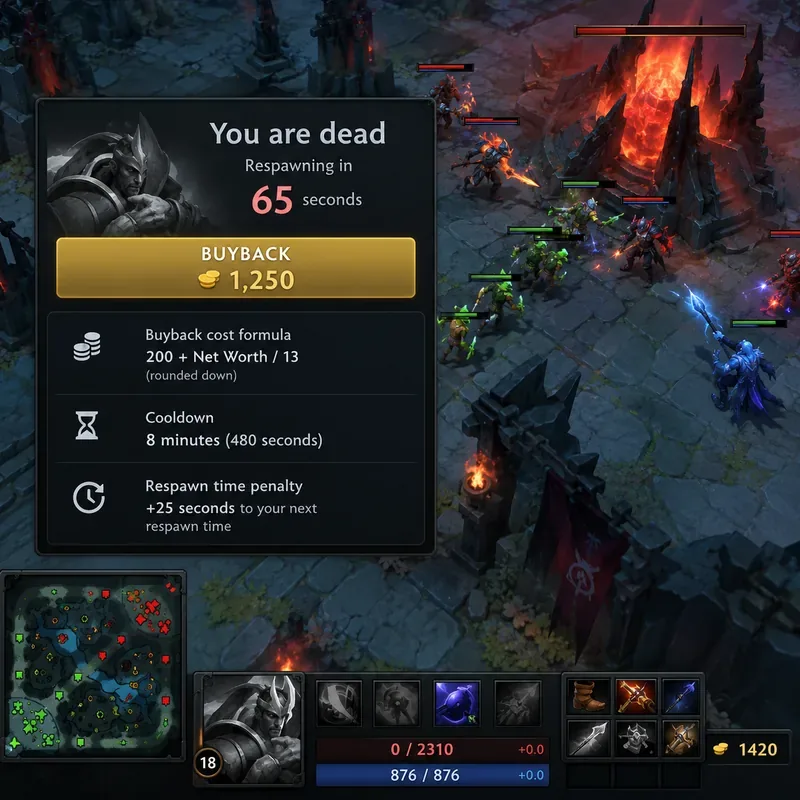
You die in a late-game fight, your respawn timer says more than a minute, and the enemy team is already moving toward Roshan or your high ground. The BUYBACK button is available. The mechanical question is simple: can you press it? The harder question is whether pressing it actually improves your chance to win.
Buyback is one of Dota 2's most punishing resource decisions because it converts gold into time immediately, then leaves a long window in which a second death can be far more costly. As of Valve's current 7.41f gameplay patch, released September 15, 2026, the core buyback rules covered here remain in effect. Valve's older official patch records are still useful for tracing the major rule changes: 7.06 increased the cooldown to eight minutes, while 7.29 changed the cost divisor to net worth divided by 13. You can also check the 7.41f patch notes for the latest official update context.
A buyback decision becomes urgent when a long respawn timer overlaps with an enemy push; the important comparison is not only gold versus time, but also what happens if you die again before buyback returns.
What buyback does in Dota 2
When your hero is dead and buyback is available, you can spend gold to respawn immediately at your team's fountain instead of waiting for the normal death timer. This lets you rejoin a defense, teleport toward an objective, reconnect with surviving teammates, or turn a fight that the enemy expected to continue as a five-versus-four.
That immediate tempo is the benefit. The cost is threefold: you spend a large amount of gold, buyback goes on cooldown for eight minutes, and your next normal death timer receives a flat 25-second increase. Those penalties are why buyback should be treated more like an emergency strategic resource than a normal purchase.
First check: is buyback actually ready?
The easiest mistake is to think of buyback as something you automatically have whenever you can afford it. You need both enough gold and an available cooldown. The current cooldown is 480 seconds, or eight minutes. If you used buyback recently, having 6,000 spare gold does not matter until the cooldown finishes.
Your interface shows buyback status while dead, and teammates can also use the top-bar information to judge whether a hero has buyback available. In coordinated games, this matters before committing to a major objective. A core with buyback ready can take a different level of risk from a core whose buyback still has several minutes remaining.
Why the eight-minute window matters
Eight minutes is long enough to cover multiple waves, one or more major fights, and potentially an entire Roshan-to-high-ground sequence. If you buy back for a low-value skirmish and survive, the decision can still hurt later because the enemy can deliberately force another objective while your safety net is unavailable.
A useful habit is to think beyond the current fight. Ask, “What important event is likely to happen before my buyback cooldown returns?” If the answer is Roshan, Tormentor, a high-ground defense, or a decisive item timing, spending buyback now has a meaningful opportunity cost.
Second check: calculate the gold cost correctly
The current standard formula is:
Buyback cost = floor(200 + net worth / 13)
“Floor” means the game rounds the result down to the nearest whole gold. Net worth includes the value represented by your hero's economy, so richer heroes pay more.
Hero net worth
Approximate buyback cost
10,000
969 gold
20,000
1,738 gold
30,000
2,507 gold
50,000
4,046 gold
For example, a 20,000-net-worth hero pays floor(200 + 20,000/13), which is 1,738 gold. A 50,000-net-worth carry pays more than 4,000. This scaling is important late in the game: “saving buyback” can mean delaying a luxury item by several minutes.
Do not confuse spare gold with safe-to-spend gold
If your buyback costs 2,500 and you have 3,100 gold, you technically have 600 gold of spending room. That does not mean you should immediately consume the entire margin. Your buyback cost can rise as your net worth increases, and you may need extra gold for a Town Portal Scroll, a situational consumable, or a post-buyback item purchase.
The simple approach is to hover or check the live buyback indicator rather than relying on a remembered number from two minutes earlier. In high-stakes late game, the interface's current requirement is more useful than mental arithmetic.
Third check: understand the hidden cost of the next death
Buying back does not merely spend gold and start a cooldown. Your next standard respawn time is increased by 25 seconds. Valve changed this in patch 7.19b from an older percentage-based penalty to a flat 25 seconds. The practical result is straightforward: a second death after buying back can create an extremely long period in which your team has no access to your hero and no buyback fallback.
This is the core strategic risk. A successful buyback often looks valuable because you return instantly. A failed buyback can lose the game because the second death removes both your hero and your emergency respawn option.
What a “dieback” really means
Players often call it a dieback when a hero buys back and then dies again soon afterward. Not every dieback is automatically a mistake. If your second life secures the enemy Ancient, prevents your own Ancient from falling, or trades your hero for multiple critical enemy buybacks, the exchange may be correct. The term describes the sequence, not the quality of the decision.
The mistake is buying back without a realistic plan for the second life. If you are about to teleport into the same dangerous area with no vision, no major cooldowns, and no surviving teammates, the extra life may simply turn one death into two.
Fourth check: decide what the buyback is actually buying
A strong buyback usually purchases something concrete. “I want to be alive” is not enough. Before clicking, identify the objective or swing you expect the second life to create.
Defend the Ancient or barracks: the most obvious emergency. If waiting for the normal respawn likely means losing the game or irrecoverable structures, buyback can be mandatory.
Rejoin a fight your team can still win: especially when you can teleport to a nearby building, outpost, or teammate-related position and arrive before the fight ends.
Secure Roshan or another decisive objective: worthwhile when your return changes the numbers immediately and the reward matters more than the gold spent.
Force enemy buybacks: in late game, buying back after winning part of a fight can create a window to push and compel several enemies to spend their own buybacks.
Protect a timing: sometimes your hero's presence with a major ultimate, aura, save, or siege tool is worth more than the next item you were saving for.
If you cannot state the expected payoff in one sentence, waiting is often safer.
Fifth check: can you re-enter safely?
Buyback value depends heavily on your route back into the action. Respawning instantly at the fountain is not the same as instantly appearing in the fight. If you have no fast teleport target and the fight is ending across the map, the enemy may disengage before you arrive. In that case you paid thousands of gold for little practical tempo.
Also check your resources. Are your major spells available? Do you have enough mana after respawning? Is your Black King Bar or defensive item ready? Did your team use the disables or saves you need to survive? A buyback with key cooldowns unavailable can be strategically weaker than waiting through the original timer and returning with a complete toolkit.
When holding buyback is better than buying an item
Late-game inventory decisions often become a choice between immediate power and insurance. Suppose you are 2,000 gold short of a major item but already have enough for buyback. Spending down to near zero may raise your combat strength right now while removing your ability to re-enter a decisive fight.
There is no universal answer. Holding buyback is more attractive when death timers are long, your hero is essential to base defense, the enemy can quickly convert kills into buildings, or Roshan is about to become contestable. Spending for an item is more attractive when the item itself dramatically reduces your chance of dying, creates a decisive initiation window, or allows your team to end the game before the buyback safety net is likely to matter.
The strongest players continually update this tradeoff rather than following a rigid “always save buyback after minute X” rule.
Common buyback mistakes and how to correct them
Buying back from frustration
A death that feels unfair can trigger an instant click. The correction is simple: spend two seconds looking at the map. Count living heroes, identify the nearest objective, and check whether you have a teleport route. That short delay often prevents an emotional dieback.
Buying back into a lost fight
If three teammates are already dead without buyback and the enemy is healthy, your return may not change the outcome. Instead of asking whether the fight is important, ask whether your second life changes the numbers enough to make the fight playable.
Forgetting future objectives
Winning a medium-value fight can still be a bad trade if your buyback is unavailable for the next Roshan or high-ground defense. Track the eight-minute cooldown as part of your team's objective schedule.
Saving buyback forever
The opposite error also exists. Gold held for buyback has no combat value until you die. If your team has a clean timing to end the game, refusing a decisive item because you are mechanically hoarding buyback can reduce your winning chances. Insurance is valuable only when the insured event is plausible.
A practical late-game buyback sequence
Use this order from easiest to hardest when you die:
Confirm that buyback is off cooldown and affordable.
Check whether the enemy can immediately take a critical objective before your normal respawn.
Count how many teammates and enemies are alive and whether either side has other buybacks available.
Check your teleport route and estimate how quickly you can affect the fight.
Check major spell and item cooldowns for your second life.
Identify the concrete payoff: save base, win fight, secure Roshan, force enemy buybacks, or end the game.
Before committing, consider what happens if you die again with an extra 25 seconds on your next respawn and eight minutes before buyback returns.
How to self-check whether your buyback decisions are improving
After a match, review only the deaths where buyback was available. For each one, ask three questions. First, what objective did the buyback protect or secure? Second, did you reach the relevant fight early enough to matter? Third, what happened during the eight-minute cooldown that followed?
A good pattern is not “I never die after buyback.” Some correct buybacks end in death. The better sign is that your buybacks consistently create measurable value: a defended Ancient, a won fight, a secured Roshan, forced enemy buybacks, or a game-ending push. A warning sign is repeated buybacks that produce no objective, no favorable trade, and a second death before the cooldown is close to returning.
If that warning pattern appears, change the decision process before changing your mechanics: delay the click, check the map, name the payoff, and verify your re-entry route. Buyback is powerful because it compresses time. It is dangerous because Dota 2 makes you pay for that time twice—first in gold, then in strategic exposure if the second life fails.