Home
» 🎮 Esports
»
League of Legends Swiss Stage Explained: How Teams Advance, Get Eliminated, and Avoid Rematches
League of Legends Swiss Stage Explained: How Teams Advance, Get Eliminated, and Avoid Rematches
The League of Legends Swiss stage is a short, record-based route to the knockout bracket. At Worlds, teams are paired with opponents who have the same series record, then keep playing until they earn three match wins or suffer three match losses. A team that reaches three wins advances; one that reaches three losses is eliminated. The process takes no more than five rounds for a 16-team Swiss field.
For Worlds 2026, Riot’s event listing confirms a 16-team, five-round Swiss stage, with the eight teams that finish with three wins advancing to Knockouts. Riot has also said the 2026 Worlds format will largely mirror 2025, while changing the Play-In format and regional seeding. The detailed examples below explain the Worlds version; first-round seeding and draw procedures should be checked against the current event’s final rules when Riot publishes them.
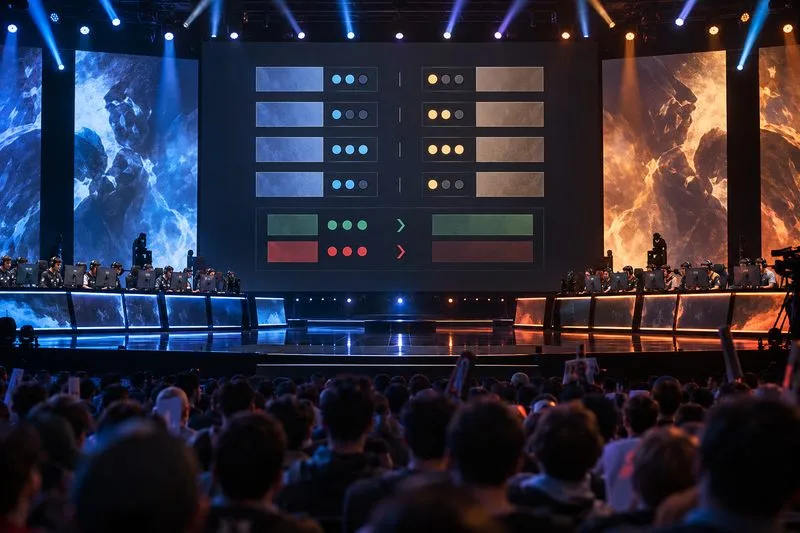
Separate record groups on the arena display represent Swiss pairings: teams meet opponents with the same match record as the rounds progress.
What does “Swiss stage” mean in League of Legends?
A Swiss stage is a tournament format in which teams do not all play every other team. Instead, after each round, the draw groups teams by their current win-loss record. A team that is 1-0 is paired with another 1-0 team; a team at 0-1 is paired with another 0-1 team. The same principle applies to later records such as 2-1 or 1-2.
In Worlds’ 16-team version, the first round starts everyone at 0-0. Each round produces a new match record, and the tournament stops for a team as soon as it reaches three match wins or three match losses. Riot’s current Worlds 2026 overview lists 16 teams, five Swiss rounds, and eight places in Knockouts. Its 2026 format update says the event will largely mirror Worlds 2025.
How do teams qualify or get eliminated?
The key number is the team’s series record, not its map score. Best-of-three (BO3) means the first team to win two games wins that match; the series counts as one match win for the winner and one match loss for the other team. A 2-1 score in games is not the same thing as a 2-1 Swiss record.
Swiss record
What the next win or loss means
2-0
Win a BO3 to reach 3-0 and advance; lose and continue at 2-1.
0-2
Win a BO3 to stay alive at 1-2; lose and finish 0-3, eliminated.
2-1
Win a BO3 to reach 3-1 and advance.
1-2
Lose a BO3 to finish 1-3, eliminated; win and move to 2-2.
2-2
Win the final BO3 to reach 3-2 and advance; lose and finish 2-3, eliminated.
That produces eight advancing teams: typically two teams finish 3-0, three finish 3-1, and three finish 3-2. The other eight teams stop after a third loss, with records such as 0-3, 1-3, or 2-3. There is no fourth win requirement and no path back after a third loss.
Which matches are best-of-one and which are best-of-three?
In the Worlds format described in Riot’s 2025 primer, matches that are not immediately qualifying or eliminating are BO1. A match that can give a team its third win or third loss is BO3. That makes the early rounds quick while giving teams a longer series when the result directly decides their Worlds survival.
Round and records
Series format
Why it matters
Round 1: 0-0 teams
BO1
Everyone begins the record ladder.
Round 2: 1-0 and 0-1
BO1
Teams move to 2-0, 1-1, or 0-2.
Round 3: 2-0 and 0-2
BO3
The winner at 2-0 advances; the loser at 0-2 is eliminated.
Round 3: 1-1
BO1
Both teams remain in contention at 2-1 or 1-2.
Rounds 4 and 5
BO3
Every remaining match is a qualification or elimination match.
The pattern gives Worlds 20 BO1s and 13 BO3s across the Swiss stage under the established 16-team structure. Always check the event’s official rules for a particular year: Riot’s regional leagues and other tournaments can call a stage “Swiss” while using different series lengths, team counts, or advancement thresholds.
How are opponents selected, and can teams meet twice?
The record determines the pool, but it does not automatically determine a unique opponent. A draw selects a pairing from the teams with the same record. Therefore, two 1-1 teams can face one another even if their paths through earlier rounds were different.
Worlds has also used a no-rematch rule during Swiss. Riot’s 2025 primer says teams with the same record are paired, teams do not meet an opponent they have already faced, and a duplicate matchup in the draw is redrawn into the next available slot. Under those rules, later-round opponents can come from the same region; the first-round regional restrictions were part of that year’s seeding procedure, not a permanent property of every Swiss tournament. The official Worlds 2025 primer details that draw.
Riot’s public Worlds 2026 overview confirms the number of teams and rounds, but its summary does not reproduce the full draw procedure. Treat the 2025 no-rematch mechanics as the most recent detailed Worlds reference, and verify the 2026 draw announcement or rulebook before assuming every exception or seeding detail is identical. The broader concept remains simple: same record first, then an opponent draw subject to the event’s published restrictions.
How can a viewer read the standings correctly?
Use the record shown beside the team, then ask how close it is to either threshold. A 2-0 team is one series win from qualification. A 0-2 team is one series loss from elimination. A 1-1 team is in the middle of the field: one win puts it at 2-1, while one loss puts it at 1-2. Neither result immediately ends that team’s run.
Read the two numbers as match wins and match losses, not games won and lost within a BO3.
Check whether the pairing is a BO1 or BO3; the series length signals whether a berth or elimination may be decided.
Follow the round’s draw after results settle. Teams with identical records can face different opponents depending on the draw and prior meetings.
Use Riot’s live standings and official rules for the tournament year if you need the exact remaining path.
For instance, if a team enters a round at 1-2, winning a BO3 does not qualify it yet. It moves to 2-2 and must win one more BO3. Losing at 1-2 ends the run immediately. That distinction is useful when a broadcast says “elimination match”: it means that a loss ends the team’s tournament, even though the opposing team may still need another win to qualify.
What Swiss does well—and what it does not guarantee
Swiss pairing gives teams several chances to recover from an early loss and creates matches between teams with comparable records. It also makes late matches easy to interpret: at 2-2, both teams know the winner advances and the loser is out. Riot introduced the Worlds format to increase meaningful matches and best-of series; its format explainer describes those goals.
The format does not guarantee that teams face identical schedules or that a stronger team always qualifies. Draws shape opponent difficulty, and a BO1 can still produce an upset. The no-rematch rule reduces repeated pairings, but it cannot erase differences in opponents or match-day form. Swiss is a structured route through a limited field, not a promise that every team gets the same test.
To judge a team’s result, track the complete match record, the quality and format of its remaining series, and the exact rules for that event. Three wins are the advancement threshold; three losses are the elimination threshold. Everything between those points is a changing path through opponents with the same record.