Home
» 🎮 Esports
»
Double-Elimination Brackets: Upper Finals, Lower Finals, and Grand-Final Advantage
Double-Elimination Brackets: Upper Finals, Lower Finals, and Grand-Final Advantage
A double-elimination bracket gives each entrant a route back after one loss: a first defeat moves a team or player into the lower bracket, while a second eliminates them. That structure creates an important question at the end. The upper-bracket finalist arrives without a loss; the lower-bracket finalist arrives with one. A grand-final reset preserves the two-loss rule most literally, while a starting game or map advantage is a shorter alternative. Some events use one final series without either. The event rulebook decides which format applies.
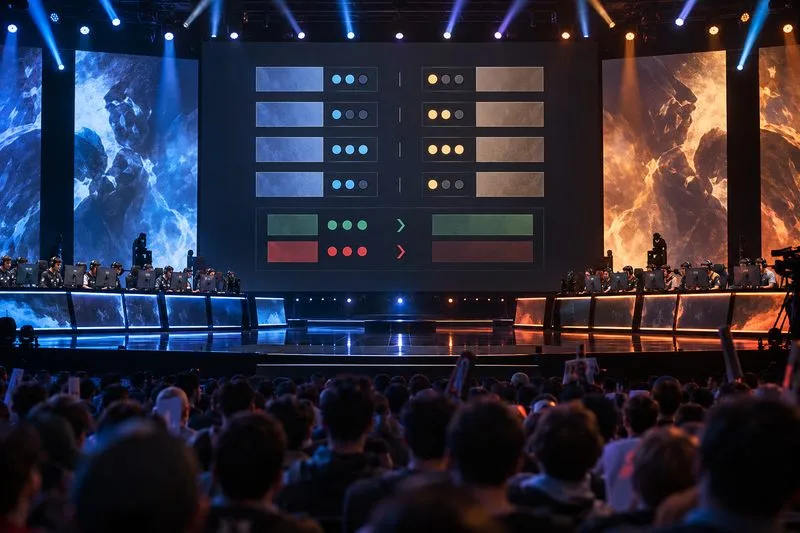
Two players sit at gaming PCs under blue and amber stage lights as the audience blurs behind them, the kind of setting where a grand-final format determines the champion.
Quick reference: bracket terms
Term
What it means
Upper bracket
The main route for entrants who have not yet lost a match in the elimination stage.
Upper final
The match that decides which entrant reaches the grand final from the upper bracket.
Lower bracket
The route for entrants after their first loss; another loss normally eliminates them.
Lower final
The last lower-bracket match; its winner advances to the grand final.
Bracket reset
A second grand-final series played if the lower-bracket finalist wins the first series.
Grand-final advantage
An event-specific benefit, such as a reset opportunity, a game/map lead, or a choice advantage.
How the upper final and lower final connect
In a standard double-elimination layout, everyone begins in the upper bracket. Win there and keep advancing. Lose once and drop into the lower bracket, where you must keep winning. Lose again and your tournament is over. The bracket therefore has two linked paths that eventually produce one finalist each.
The upper final is the last match on the upper path. Its winner qualifies directly for the grand final and has not lost a match in the elimination bracket. The upper-final loser is not eliminated: that team drops into the lower final. The lower final is the last chance for a team or player coming through the lower path. Its winner earns the second grand-final place, usually after already taking one loss.
Here is a simple hypothetical example. Team A wins the upper final and reaches the grand final undefeated. Team B loses the upper final, then wins the lower final. Team B has one loss; Team A has none. Both have earned the championship match, but they do not enter it with the same margin for error.
What happens in a grand final with a bracket reset?
In a reset format, the grand final is effectively two possible series. First, the finalists play the scheduled series, such as a best-of-five. If the upper-bracket finalist wins, that team is champion and the event ends. If the lower-bracket finalist wins, the undefeated team has now taken its first loss. The bracket resets, and the finalists play a second series to decide the title.
In the example, if Team A wins the first best-of-five, Team A is champion. If Team B wins it, Team A now has one loss, just like Team B. A second best-of-five follows; its winner is champion. If Team A loses that reset series, it takes a second loss and is eliminated. If Team A wins it, Team B takes its second loss.
This format gives the upper-bracket finalist a real competitive benefit: one loss is available before elimination, and the lower-bracket finalist must win two series in a row to take the title. The trade-off is time. The event must reserve enough broadcast and venue time for a second full series, and players may need to prepare for a much longer final day. The FACEIT tournament-format guide describes the reset as another grand-final matchroom when the lower-bracket team beats the undefeated upper-bracket team. The SNK World Championship 2026 rulebook also specifies double elimination with a bracket reset for listed game events.
How a game or map advantage changes the final
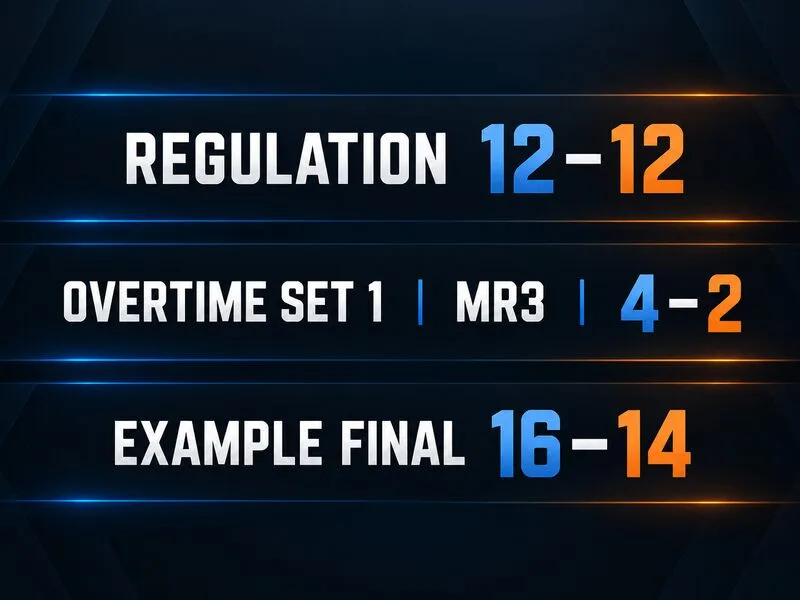
Some organizers keep one grand-final series but give the upper-bracket finalist a head start. The advantage can be a game, map, or other unit that counts toward the series score. For example, the eFIBA World Finals 2026 regulations make the grand final a best-of-five and start the upper-bracket team with a 1–0 game lead. The upper-bracket team then needs two more game wins; the lower-bracket team needs three.
ESL has published similar arrangements for particular Counter-Strike competitions. Its 2025 Challenger League overview says the upper-bracket team starts the best-of-five grand final with a 1–0 lead. These are examples of event rules, not a universal double-elimination standard.
A game/map advantage is easier to schedule than a possible reset because the event plans for one final series. It also gives the upper finalist measurable protection from a single loss. The lower finalist still has a possible path to win, but must take more in-series wins. Before comparing team performance, check whether the advertised best-of-five begins 0–0 or with an advantage already recorded.
What if the final is one series with no reset?
Some events send the upper- and lower-bracket winners into one ordinary grand-final series, with no second series if the lower-bracket entrant wins. In that case, the upper finalist’s earlier undefeated run may earn a slot in the final without producing an in-match head start. If the upper finalist loses that one final series, it is eliminated after a single loss in the bracket.
This choice is simpler for scheduling and easier for viewers to understand. It also means the final does not apply the two-loss principle to both finalists in the same way. The organizer may compensate with a game advantage, map pick, side choice, or another seeding benefit, but those are not the same thing as a bracket reset. A choice can matter strategically without granting another chance after losing the series.
Do not infer a reset from the words “double elimination” alone. FACEIT’s organizer guide notes that its double-final option can be enabled or disabled. That makes the rulebook or tournament configuration essential: the bracket’s name tells you how teams move through earlier rounds, but not necessarily how the final is decided.
Compare the options before a tournament starts
Final format
What the upper finalist receives
Main trade-off
Bracket reset
One loss before elimination; a second series follows if the lower finalist wins the first.
Most closely preserves two-loss elimination, but the final can take much longer.
Game/map head start
A score advantage toward the series win condition.
One planned series, but the head start may strongly shape the final.
One series, no reset or score lead
Possibly a choice or seeding benefit only.
Fastest to schedule, but the upper finalist can be eliminated after one final loss.
Practical checklist for reading a bracket
Find the upper final and note whether its loser continues into the lower final.
Confirm whether the lower final winner advances to one grand-final series.
Search the rulebook for “bracket reset,” “double final,” “game advantage,” “map advantage,” and “grand final.”
Check the series length and whether the score begins at 0–0 or with a game/map already awarded.
Ask what happens if the lower-bracket finalist wins the first grand-final series.
Check whether the upper finalist has a side, map, or pick choice; keep that distinct from an extra life.
Plan for the possible duration if a reset can trigger, including player breaks and broadcast scheduling.
Bottom line for competitors and viewers
The upper final determines who reaches the championship match without a loss. The lower final determines who survives the lower path and joins them. The grand-final rule then decides how much the upper path is worth: a reset gives the lower finalist a second series only after winning the first; a game/map advantage starts the upper finalist ahead in one series; and a single final with no reset offers the least direct protection.
Check the current event rules rather than relying on a format label or a past tournament. For examples of how organizers specify the mechanics, compare the eFIBA World Finals 2026 regulations, the linked SNK World Championship 2026 rulebook, and ESL’s event-specific Challenger League overview. These documents show that the upper-bracket benefit can be implemented in materially different ways.