Home
» 🎮 Esports
»
Minecraft “442 Version” Error: Check Version Mismatches and Fix Launch Problems
Minecraft “442 Version” Error: Check Version Mismatches and Fix Launch Problems
Minecraft “442 Version” Error: Check Version Mismatches and Fix Launch Problems
If Minecraft or a launcher displays a “442 Version” message, start by checking the exact text and where it appears. The label by itself does not tell you whether the problem is a game-version mismatch, a mod loader, a server rule, or another launcher issue. In the current Minecraft support material I reviewed, I could not verify “442 Version” or “Number Nightmares” as a Mojang-defined error code. Treat it as an unverified label until the full message or crash report identifies the cause.
This guide focuses on the practical issue implied by the title: Minecraft refuses to launch or connect because the selected game release, installation, or mod setup does not match what the game needs. The steps below work from the least risky checks to deeper diagnosis. They do not assume that every player needs a new Java installation, more RAM, or a world-file repair.
Before troubleshooting: note your edition and protect your world
Write down whether you use Minecraft: Java Edition or Bedrock Edition, plus the game version shown by your launcher or platform.
Copy the complete error text. Note whether it appears at launch, while loading a world, or only when joining one server. Include your launcher and mod loader if applicable.
For Java single-player worlds, make a backup before changing installations or opening a world in a different release. Minecraft’s official Java world-backup instructions show how to create and locate a backup.
Java and Bedrock troubleshooting are not interchangeable. The profile, mod-loader, and crash-log checks below are for Java Edition. On Bedrock, update the game through the platform where you own it and use the exact platform or in-game error text; Java JVM arguments and Java mod folders do not apply.
How to troubleshoot the Minecraft “442 Version” error
1. Compare the selected game version with the version you need
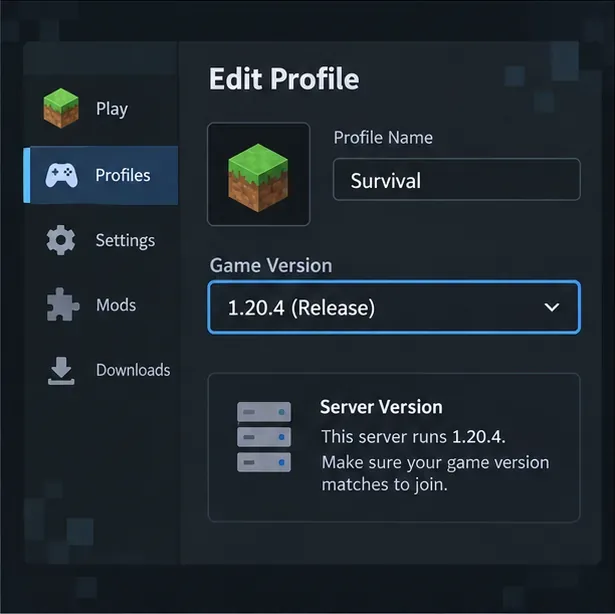
Open the installation or profile you actually use and note its Minecraft release. If the message appears when joining multiplayer, ask the server owner which client release and modpack the server supports. Select that release in your launcher instead of switching blindly to the newest version. A world, modpack, or server may be tied to a specific release.
Use the official Minecraft update instructions for the supported update path. If you use a snapshot or pre-release, test with a separate profile and a disposable world; do not downgrade your only save to see if it fixes the message.
Illustration: compare the profile release with the version the server expects.
2. Test a fresh vanilla installation
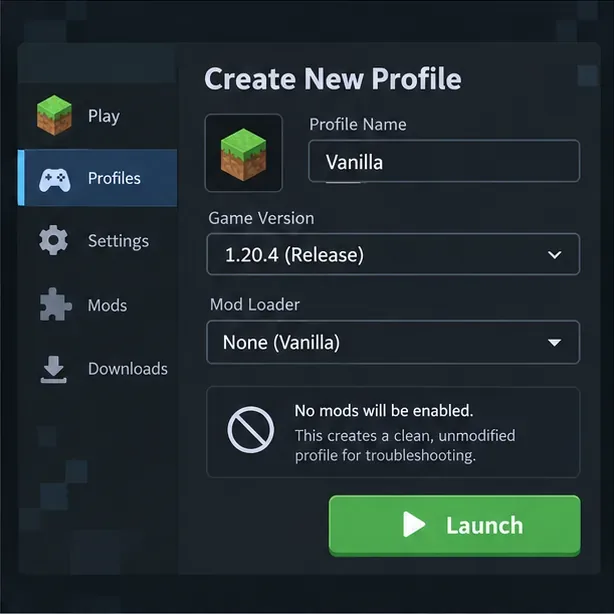
Create a separate Java installation using the same game version, with no mods or custom settings, and start a new test world. This checks whether the base game launches without disturbing your existing profile. Minecraft Support recommends creating a new Java installation when troubleshooting launcher crashes; see its new-installation troubleshooting steps.
If the clean profile works, the original installation, mod set, or custom runtime is a stronger lead than the “442” number. If it fails too, save the new crash report and test the launcher’s update or repair path before reinstalling. Back up worlds first. Avoid deleting the entire Minecraft data folder as an early step because that folder can contain saves and settings.
Illustration: launch the same release in a clean profile to test the base game.
3. Check mod, loader, and dependency compatibility
For a modded profile, verify that each mod is built for the exact Minecraft release and the loader you installed. Fabric and Forge files are not interchangeable, and a mod may also require a separate dependency. Compare the versions in the modpack’s own instructions instead of assuming that “latest” is compatible. Fabric’s official mod-installation guide specifically says to use mods that match the Minecraft version and Fabric loader.
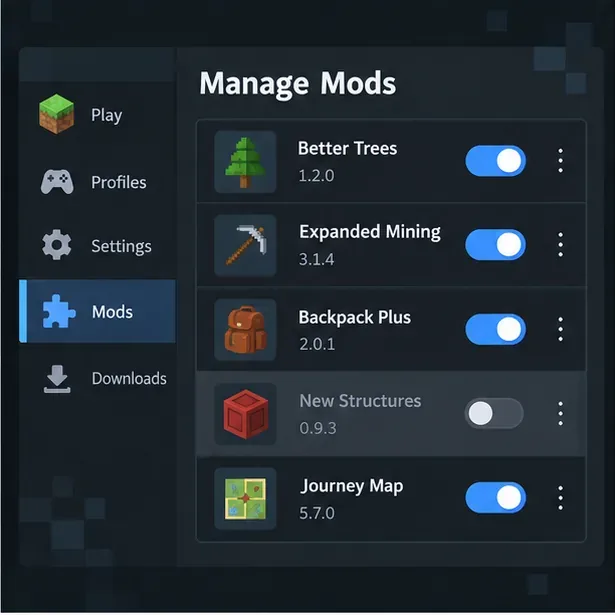
To isolate a conflict, duplicate the profile or pack first. Temporarily remove the newest or most recently updated mod from the test copy, then launch again. Repeat one change at a time. Start with recent gameplay, world-generation, rendering, or shader changes if those were the last things you added. If removing one file changes the result, check that mod’s release notes and dependencies before adding it back. Do not delete world folders or dimensions to test a mod conflict.
Illustration: disable one recently added mod in a test copy, then retry.
4. Read the first useful error in the crash report
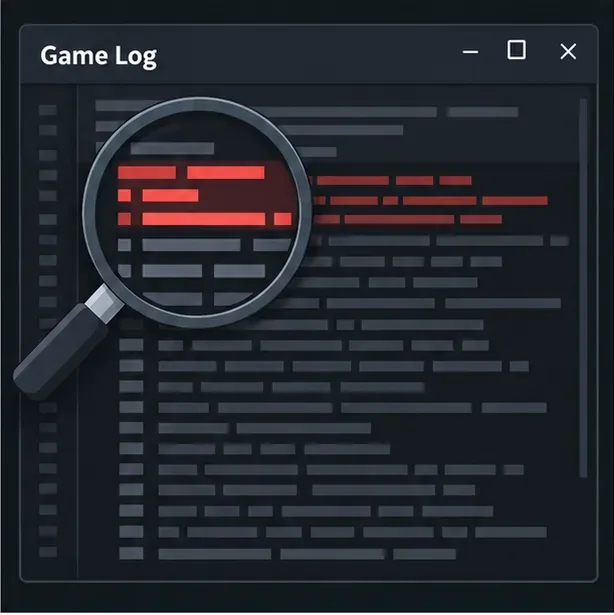
For Java Edition, open the log and the newest crash report from the game directory used by that installation. Third-party launchers may keep a separate directory for each instance. Look for the first specific exception and the lines around it, especially a named mod, a missing dependency, an unsupported class version, or OutOfMemoryError. Later lines often repeat the failure rather than reveal a new cause.
A Java message such as NumberFormatException is a clue about one failed value conversion; it does not prove that Minecraft has a universal “442” number error. Share the complete relevant section, your game release, loader, and mod list when asking for help, but remove account tokens or other private data from logs first.
Change memory only when the report or symptoms point to memory pressure. Minecraft’s current memory-allocation guidance warns that allocation should match both the game’s needs and the RAM available on your system; blindly adding an -Xmx8G flag is not a universal fix. Likewise, change a custom Java executable only when the launcher or the exact modpack instructions identify a Java-runtime mismatch. Requirements vary by game release, so “install Java 21” is not a safe blanket answer for every version.
Illustration: inspect the first specific error in the crash log before changing settings.
Quick diagnosis by symptom
What you see
Best first check
Protect your data
Disconnects only on one server
Confirm the client release and required modpack with the server owner.
Keep your single-player profile unchanged.
Vanilla launches, modded profile fails
Match game, loader, mod, and dependency versions; remove one recent mod from a copy.
Test a duplicated profile and backed-up world.
Only one world fails to load
Keep the crash report and test a backup copy with the intended game version.
Do not delete the Nether, End, or region folders.
Bedrock shows a platform error
Use the exact Bedrock error message and update through the device’s store or platform.
Back up or sync the world according to your platform’s instructions.
Keep version problems from returning
Keep separate profiles for stable releases, snapshots, and modpacks so their versions and settings do not overlap.
Back up important worlds before changing game releases, loaders, or world-affecting mods.
Install mods only after checking both the Minecraft release and loader they support.
When reporting a supposed “442” error, include the exact message and the first relevant crash-report lines. That evidence is more useful than the number alone.
The safe fix depends on what your launcher or log actually says. First match the game release, then test a clean profile, isolate mods, and use the crash report to choose any deeper change. That approach avoids destructive “fixes” such as deleting world data or changing Java and RAM settings without evidence.