Home
» ⚽ Football
»
UEFA Nations League October 2026: Promotion, Relegation and Tiebreakers Explained
UEFA Nations League October 2026: Promotion, Relegation and Tiebreakers Explained
Why October’s Nations League table can be misleading
A team can sit level on points with a rival and still hold the wrong end of a promotion or relegation line. In October 2026, the issue is even harder to read: Matchdays 3 and 4 are being played, but the league phase is not complete. The final standings depend on the November matches as well as the head-to-head tiebreakers and, for some positions, a separate comparison across groups.
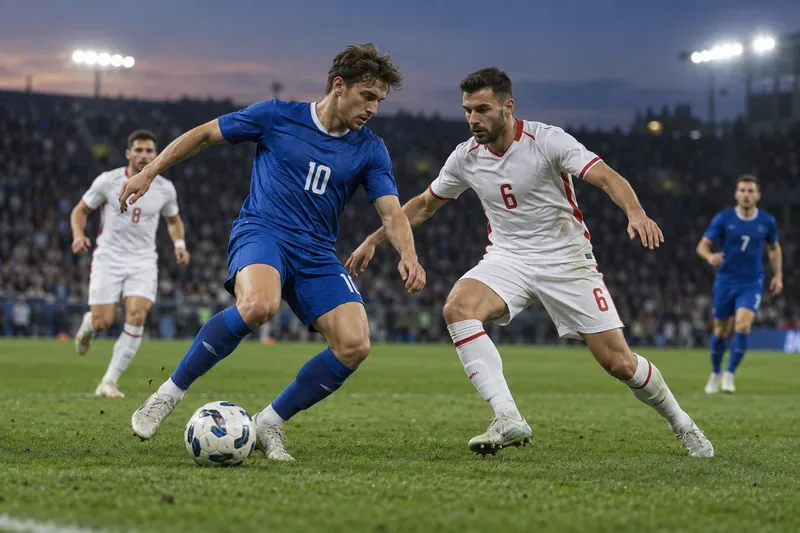
Players challenge for possession during an international match under floodlights.
The 2026/27 UEFA Nations League runs across four leagues, A through D. Each team earns three points for a win, one for a draw and none for a loss. Teams play home and away within their group. For most groups, that means six matches; League D groups contain three teams, so each team has four fixtures. The league phase dates are September 24–October 6 for Matchdays 1–4, then November 12–17 for Matchdays 5–6. UEFA’s 2026/27 schedule and format guide was last updated September 29, 2026.
That makes the October table a live snapshot, not a final verdict. A team can improve its position in November, and a goal scored in an earlier match can matter later if points are level. Here is how to read the rules in the right order.
Step 1: Read the group table before comparing leagues
Start with the points column. UEFA’s league-phase system awards three points for a win and one for a draw; group positions are compiled from each team’s points total. Do not jump directly to overall goal difference: within a group, UEFA checks matches between the tied teams first. The full scoring rule appears in Article 14 of the 2026/27 regulations.
Because this article is being prepared during the October match window, use the live group table to understand current possibilities, but wait for the November fixtures to finish before calling any placement final. UEFA lists Matchdays 5 and 6 for November 12–17, 2026.
Step 2: Apply the group tiebreakers in order
If two or more teams finish the league phase level on points, UEFA’s 2026/27 rules apply these criteria in sequence:
Points earned in matches among the tied teams.
Goal difference in those matches.
Goals scored in those matches.
If a subset of teams remains tied after those tests, repeat the same three tests using only matches among that remaining subset.
Overall goal difference in all group matches.
Overall goals scored in all group matches.
Overall away goals scored.
Overall wins, then overall away wins.
Lower disciplinary-points total: a yellow card is one point, a red card is three, and an expulsion for two yellows in one match is also three.
Higher position on the 2026/27 Nations League access list.
This is a head-to-head-first system. For example, if two sides finish level on points and one earned more points in their two meetings, that team ranks higher even if the other has a better overall goal difference. The overall goal-difference comparison only comes later. If three sides are tied, build the mini-table from their matches against one another; if the first three tests separate one team but leave two tied, restart those tests for the remaining pair. UEFA publishes the complete order in Article 15, Equality of points.
Step 3: Separate group position from cross-group ranking
Promotion and relegation are not decided only by who finishes third or fourth in a group. Several 2026/27 places depend on ranking teams that finished in the same position across separate groups. UEFA first sorts by group position, then compares points, goal difference, goals, away goals, wins, away wins, disciplinary points and finally the access-list position. When groups have different numbers of teams, results against fourth-place teams are excluded when comparing first-, second- and third-place teams; all matches count when comparing fourth-place teams. This cross-group calculation is in Article 19 on league and overall rankings.
This matters in League A, where the highest-ranked third-place teams stay up while the lowest-ranked third-place teams enter a playoff, and in League A and B, where the relative ranking of fourth-place finishers distinguishes direct relegation from a playoff place. A live table that shows only a team’s group position cannot tell the whole story.
Step 4: Map each league’s route
League
What the group finish means in 2026/27
League A
Group winners and runners-up reach the quarter-finals. The two highest-ranked third-place teams stay in A. The two lowest-ranked third-place teams and two highest-ranked fourth-place teams enter the A/B playoffs. The two lowest-ranked fourth-place teams drop directly to B.
League B
Group winners move up to A. Runners-up enter the A/B playoffs. Third-place teams remain in B. Fourth-place teams enter the B/C playoffs.
League C
Group winners move up to B. Runners-up enter the B/C playoffs. Third- and fourth-place teams remain in C.
League D
All six League D teams move into League C for 2028/29 as UEFA transitions to a three-league format.
The A/B playoffs pair four League A teams—the two lowest-ranked third-place finishers and the two highest-ranked fourth-place finishers—with the four League B runners-up. The B/C playoffs pair the four League B fourth-place teams with the four League C runners-up. Each playoff is a two-leg tie, home and away; the lower-league team hosts the first leg. UEFA’s September 2026 format update explains the transition-year structure and is more useful here than older summaries that describe the previous season’s movement rules. See UEFA’s current league-by-league breakdown and the formal playoff rules in Article 16.
Step 5: Know what happens after the league phase
League A’s top two from each group qualify for quarter-finals in March 2027. The eight teams contest home-and-away ties, with the four winners advancing to the final tournament scheduled for June 9–13, 2027. The A/B and B/C promotion/relegation playoffs are also scheduled for March 25–30, 2027. League C/D playoffs do not apply in this edition: all League D teams move to League C as the competition moves from four leagues to three for 2028/29.
In a two-leg playoff or quarter-final, the team with more goals across both matches advances. If the aggregate score is tied after the second leg, the rules provide for two 15-minute extra-time periods and then a penalty shoot-out if still level. The regulations do not use an away-goals tiebreaker. Check Article 18 on extra time and shoot-outs.
Common mistakes to avoid
Using overall goal difference too early: head-to-head points, goal difference and goals are checked first when group points are tied.
Treating an October position as final: the league phase continues in November, so a live table can still change.
Assuming every fourth-place team is automatically relegated: League A has direct relegation and playoff places decided by cross-group ranking; League B fourth-place teams enter a playoff.
Confusing promotion with a final-tournament berth: promotion changes a team’s league for the next edition. The Nations League final tournament is reached through the League A knockout path.
Using last edition’s movement rules: the 2026/27 season is a transition year. All League D teams move up for the three-league 2028/29 edition.
How to check your reading of the table
After each October match, confirm the points total and number of matches played; then inspect the tied teams’ head-to-head results before looking at overall goal difference. If a third- or fourth-place team’s fate depends on another group, compare the official interim overall rankings and apply the cross-group rules. Recheck after Matchdays 5 and 6 conclude on November 17, then consult UEFA’s final standings and the 2026/27 regulations for confirmed quarter-final, promotion, playoff and relegation outcomes. The rules explain the pathways, but they cannot settle any team’s fate before the remaining matches are played.
Rules and schedule checked against UEFA’s 2026/27 competition regulations (enforcement date September 15, 2026) and UEFA’s format guide updated September 29, 2026.