In international football, added time is the referee’s allowance for playing time lost during each half. The fourth official shows a minimum, not a guaranteed end time: the referee can extend play if more time is lost after the board goes up, but cannot reduce the displayed allowance. Under the IFAB Laws of the Game 2026/27, there is no universal formula that assigns a fixed number of seconds to each substitution, injury, goal, or review. The referee judges the time actually lost, with help from the other match officials.
This guide follows the current IFAB 2026/27 materials, checked September 30, 2026. It explains what to watch for, how the calculation works, and why a match clock showing 90 minutes does not necessarily mean the final whistle is immediate.
Start with the basic terms
Added time, also commonly called stoppage time or injury time, is time played after the scheduled 45 minutes in a half to account for playing time lost. “Injury time” is an incomplete nickname: injuries are only one possible cause. Law 7 says a standard match has two equal 45-minute halves, subject to any permitted pre-match agreement and the competition rules.
Additional time is the term used in the IFAB Laws. The word “extra time” means something different: in some knockout competitions, extra time is a separate period after the regular match ends level. Each half of extra time can also have its own allowance for time lost. A penalty shoot-out is different again; it is the method used to decide a match after the playing periods and is not another timed half.
What does the referee count?
Law 7 lists the main sources of lost playing time. The referee allows for time lost in each half through:
- Substitutions.
- Assessing or removing injured players.
- Time-wasting.
- Disciplinary sanctions, such as cautions or sending-offs.
- Medical stoppages allowed by the competition, including drinks breaks and cooling breaks.
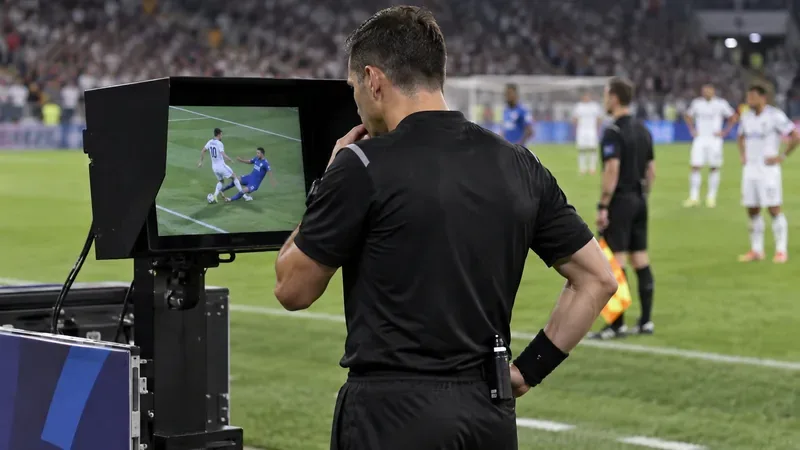
- VAR checks and reviews. VAR means video assistant referee; a “check” is a review of an incident by the video team, while a “review” involves the referee assessing an incident under the VAR protocol.
- Goal celebrations.
- Other causes, including significant delays to a restart.
Not every moment when the ball is out of play is automatically added. IFAB’s guidance says ordinary stoppages, such as routine throw-ins and goal kicks, are part of the game; allowance is made when the delay is excessive. A player taking an unusually long time to restart, for example, may create time that the referee should account for.
The principle is to restore playing time that was lost, not to add a standard bonus for each event. A quick substitution may cost little time; several slow substitutions may cost more. One long injury assessment may matter more than multiple brief stoppages. The Laws give the categories and authority, but they do not prescribe a universal seconds-per-event table.
How the match officials work out the minimum
- Keep time throughout the half. The referee is responsible for timekeeping. The assistant referees and fourth official can assist with records and communication.
- Note meaningful delays as they happen. Officials account for stoppages that remove playing time, such as a VAR review, an injury assessment, or a prolonged restart. They consider the actual delay rather than applying a fixed tariff.
- Assess the total near the end of the half. The referee decides the minimum additional time. The fourth official communicates that figure, normally by displaying the number of minutes on the electronic board.
- Continue tracking after the display. The board is not a countdown promise. Any further time lost during the allowance can lead the referee to play longer.
- End the half when the referee decides time is complete. Once the required time has been played, the referee may blow the final whistle while the ball is in play. There is no general rule that the referee must wait for the next stoppage, finish an attack, or allow another corner kick.
For example, imagine the referee announces a minimum of five minutes. If another lengthy injury assessment or VAR review occurs during that period, the final whistle may come after the five-minute mark. If play continues without further significant lost time, the referee can end the half once the minimum has been played. The five minutes are not a fixed ceiling.
What does the number on the fourth official’s board mean?
The displayed number is the minimum additional time the referee intends to play. It is not an exact forecast of when the whistle will sound. The fourth official indicates the figure; the referee makes the decision. IFAB is explicit that the referee may increase the allowance but may not reduce it.
That means “+4” signals at least four minutes of additional time, not exactly four minutes and not a promise that the match will stop at 94:00 on a broadcast clock. If a stoppage occurs during those minutes, the actual end can move later. Match clocks on television may also round or display elapsed time differently, so use the official board and referee’s whistle to understand the decision.
Two end-of-half situations that often confuse viewers
A long stoppage right before 90 minutes
IFAB’s Law 7 FAQ addresses an injury stoppage lasting five minutes just before normal time ends when the referee has decided on three minutes of additional time. In that example, the referee shows and plays the original three-minute allowance after play restarts; the five-minute stoppage does not replace those three minutes. The key point is that the board reflects the minimum playing time still to be provided, not simply the wall-clock length of the most recent delay.
A penalty awarded as time expires
If a penalty kick must be taken or retaken at the end of a half, Law 7 requires the half to be extended until the kick is completed. Under Law 14, the kick is completed when the ball stops moving, goes out of play, or the referee stops play for an offence. When the half has been extended for the penalty, the ball can also be played by a player other than the defending goalkeeper before the kick is complete. If a defending player commits an offence and the kick is missed or saved, it may have to be retaken. This is a specific exception, not a rule that every attack or corner must be allowed to finish.
What to know about the 2026/27 time-control protocols
The current IFAB 2026/27 materials include protocols intended to reduce delays around certain restarts and substitutions. Under the time-limited substitution protocol, a substituted player is generally required to leave within ten seconds after the board or referee’s signal; if not, the substitute cannot enter until the first stoppage after one minute has elapsed following the restart, subject to the stated exceptions. Under the throw-in and goal-kick countdown protocol, when the referee determines that a team is deliberately delaying, a five-second countdown can apply; if the ball is not in play at the end, the restart is awarded to the opponents.
The off-field treatment and assessment protocol also sets a one-minute period before an outfield player who has received an on-field assessment can return, with exceptions including serious injuries and certain other cases. These procedures affect how particular incidents are managed; they do not create a fixed number of minutes to add. The referee still applies Law 7 to the actual time lost. Check the competition’s current regulations and the corresponding IFAB protocol pages when analyzing a specific tournament.
Common mistakes to avoid
- Assuming all stoppages count equally. Routine restarts do not automatically add time; excessive delay is the relevant factor.
- Calling all added time “injury time.” Substitutions, reviews, celebrations, discipline, and time-wasting can also be included.
- Treating the board as the exact finish. It shows a minimum and can be extended.
- Assuming added time is capped. The Laws do not set a maximum number of minutes.
- Expecting the referee to finish an attack. There is no general “one last play” rule. The special extension for a penalty kick is different.
- Blaming the fourth official for the decision. That official displays the minimum; the referee retains the final decision.
A quick way to read added time while watching
When the board appears, treat the number as a floor. Remember which major stoppages have occurred, especially a late injury, VAR review, or prolonged delay. If the match continues beyond the number, that does not by itself mean the referee has changed the rules; more time may have been lost. If the whistle comes right at the minimum, the referee may judge that no further allowance is needed. The referee’s decision on time is part of match control, and the Laws do not require a public running calculation for every stoppage.
For the authoritative wording, see IFAB Law 7: The Duration of the Match, Law 6: The Other Match Officials, Law 14: The Penalty Kick, and IFAB’s guidance on allowance for time lost. For the new time-control procedures, consult the 2026/27 time-limited substitution protocol, off-field treatment and assessment protocol, and throw-in and goal-kick countdown protocol.