Home
» ⚽ Football
»
International Football Travel in October 2026: Avoid the One-Hour Daylight-Saving Mistake
International Football Travel in October 2026: Avoid the One-Hour Daylight-Saving Mistake
The safest rule for international football travel in October 2026 is simple: never convert a kickoff by memorizing a fixed time difference. Check the match in the venue’s local time, then convert it for the exact date you will travel or watch. October is unusually easy to get wrong because daylight-saving changes do not happen on the same weekend worldwide.
That matters even more in 2026 because FIFA’s men’s international match calendar includes a 16-day window from September 21 through October 6, allowing up to four matches per team. Fans may be flying across several time zones for national-team matches just as some Southern Hemisphere locations are moving onto summer time, while Europe does not move back to standard time until later in the month. The official FIFA calendar is available at FIFA’s International Match Calendars.
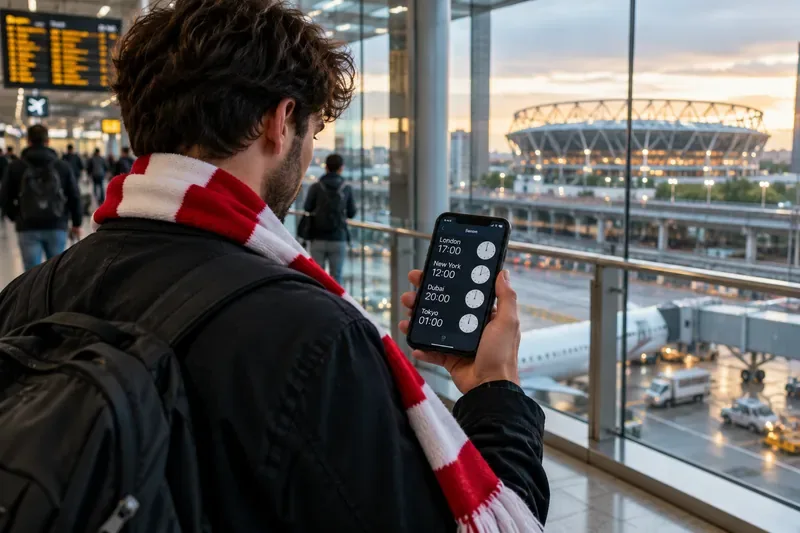
A football traveler checking several city times at an airport. In October 2026, the correct time difference can change during the month, so the match date matters as much as the cities.
Why the one-hour mistake happens in October 2026
The problem is not that time-zone conversion is difficult. The problem is that people often remember a familiar gap — “London is five hours ahead of New York,” for example — and assume that gap stays constant all month. It does not.
European Union countries continue to use the existing seasonal-clock system in 2026. Under the current EU rules, member states switch back to standard time on the last Sunday in October. In 2026 that date is October 25. The European Commission explains the legal framework at its summertime information page. The United Kingdom also moves its clocks back on October 25, 2026; the official UK schedule is published at GOV.UK’s clock-change page.
The United States is different. In 2026, U.S. daylight saving time remains in effect until November 1 at 2:00 a.m. local time in the areas that observe it. That means Europe and most of the United States are out of sync for one week, from Europe’s October 25 change until the U.S. change on November 1. The U.S. rule is documented by the National Institute of Standards and Technology.
The practical consequence: familiar time gaps temporarily shrink
Consider a supporter following a match scheduled in London while staying in New York. Before October 25, London is on British Summer Time and New York is on Eastern Daylight Time, so London is five hours ahead. After the UK changes its clocks on October 25, but before New York changes on November 1, London is only four hours ahead.
Route or comparison
Through Oct. 24, 2026
Oct. 25–31, 2026
What changed?
London vs. New York
London +5 hours
London +4 hours
UK has returned to GMT; New York remains on EDT
Paris vs. New York
Paris +6 hours
Paris +5 hours
France has returned to CET; New York remains on EDT
London vs. Los Angeles
London +8 hours
London +7 hours
UK changes before U.S. Pacific Time does
This is exactly the kind of one-hour error that can cause a traveler to leave a hotel too late, book the wrong train, or think a televised match starts an hour later than it really does.
October can change in the opposite direction in the Southern Hemisphere
Europe is moving out of summer time in late October, but parts of Australia are moving into it near the beginning of the month. In New South Wales, daylight saving starts on Sunday, October 4, 2026, when clocks move forward from 2:00 a.m. to 3:00 a.m. The official dates are listed by the NSW Government.
That does not mean all of Australia follows the same clock rule. Australia has multiple time zones and daylight-saving participation differs by state and territory. For football travel, use the specific host city rather than “Australia” as the time zone.
New Zealand is another useful example. Its daylight saving period begins on September 27, 2026, so by the time October international matches are played, New Zealand is already on New Zealand Daylight Time. The dates are published by the New Zealand Government.
Use the stadium city, not the team name, to determine the kickoff time
A national team does not define a time zone. The venue does. A match involving a European team could be played in another country, at a neutral venue, or in a city whose clock rules differ from what you associate with the team.
When an organizer lists “20:45 local time,” treat the word local as referring to the match venue unless the competition page says otherwise. Then confirm the city and date before converting. This is especially important for friendlies, tournament hubs and neutral-site fixtures.
The same principle applies when a broadcaster lists a time in a home-market time zone. A U.S. broadcaster may show Eastern Time even if the match is elsewhere, while an association website may show venue local time. Read the label rather than assuming the number is local.
A reliable three-check method before you travel
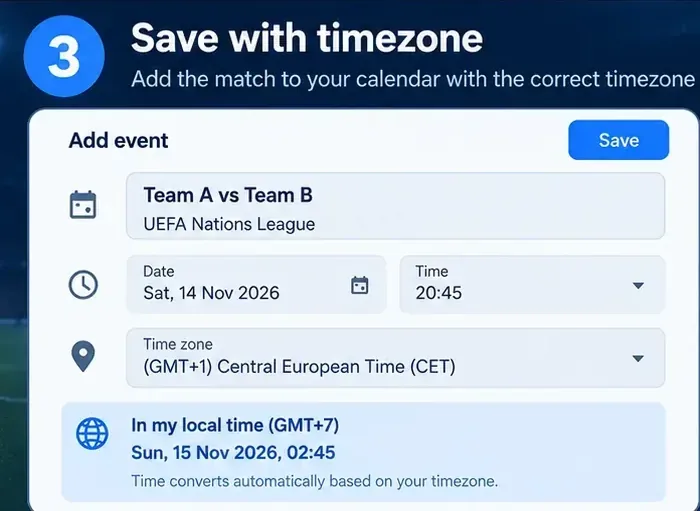
1. Save the official kickoff in venue local time
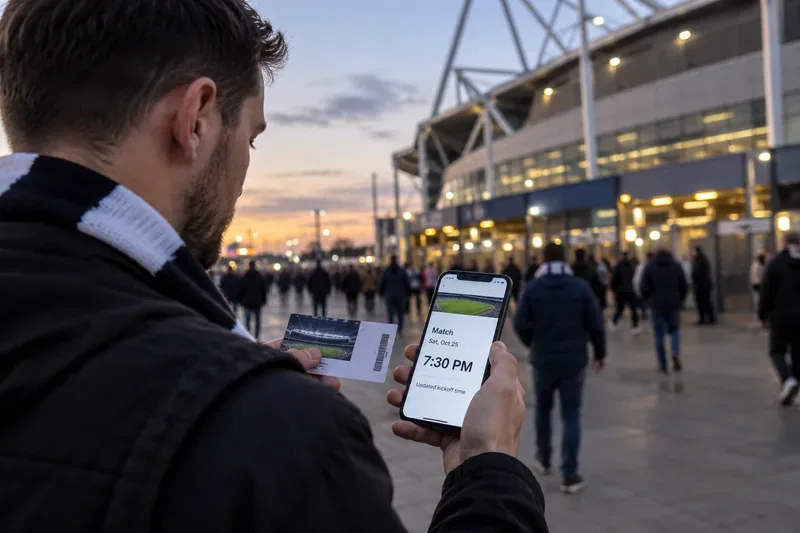
Use the competition organizer, confederation, FIFA match center or the national association as the primary source. Take a screenshot or save the fixture page, including the city and date. Do not rely only on a search-result preview or an old calendar entry because kickoff times can be revised.
2. Recheck the exact date after any clock-change weekend
If your trip crosses October 4 in parts of Australia, October 25 in Europe and the UK, or November 1 in most of the United States, recalculate the time difference. Do not simply reuse the conversion from the previous match.
This matters even when two matches are only a week apart. A 7:45 p.m. London kickoff on October 20 and the same 7:45 p.m. London kickoff on October 27 do not map to the same New York clock time. The venue kickoff is unchanged; the international offset changed.
3. Keep travel times and match times in their original local zones
Airline departure and arrival times are normally displayed in the local time of each airport. Match tickets and venue instructions are usually based on venue local time. Store those local times first, then add converted reference times separately. This reduces the risk of “correcting” a time that was already local.
Do not assume every U.S. destination changes clocks
Most of the United States observes daylight saving time, but there are important exceptions. NIST notes that Hawaii, most of Arizona and several U.S. territories do not observe DST; the Navajo Nation in Arizona does. If your football trip includes a connection, training venue or side trip in one of these places, a generic “U.S. time change” rule can be wrong.
The safer method is always city-by-city verification. “Mountain Time” is not enough when comparing Phoenix with Denver in the daylight-saving season because their clock behavior differs.
What if your phone updates automatically?
Automatic time-zone updates are helpful, but they should be treated as a convenience, not the only source of truth. A phone can be set to a fixed time zone, automatic time-zone detection can be disabled, or a travel eSIM and network configuration can behave differently from what you expect. A calendar event can also have been created in the wrong zone weeks earlier.
Before match day, open the event and check whether it is attached to the venue’s time zone or simply stored as a floating local time. Then compare it with the official fixture page. The point is not to distrust the device; it is to verify which time zone the device is using.
Example: a Europe-to-U.S. football trip in the last week of October
Suppose a traveler spends October 24 in London and flies to New York on October 26. On October 24, London is five hours ahead of New York. Overnight into October 25, the UK returns to GMT. New York remains on daylight time until November 1. When the traveler arrives on October 26, the difference is four hours, not five.
If that supporter had memorized the normal five-hour gap and converted a 7:30 p.m. London-based broadcast by subtraction, they would expect 2:30 p.m. in New York. During the October 25–31 mismatch week, the correct conversion is 3:30 p.m. New York time. That is the classic one-hour October error.
Example: London and Sydney can shift twice in the same month
Now consider London and Sydney. New South Wales moves forward on October 4, while the UK moves back on October 25. As a result, the gap between the two cities changes twice during October. A traveler who checked the time difference at the start of the month and never checked again could be one or even two transitions behind by late October.
This is why fixed “X hours ahead” notes are fragile for international football travel. Date-aware conversion is the reliable method.
Match-day checklist
Confirm the fixture date, venue city and official local kickoff time.
Check whether either city changes clocks between the day you planned the trip and match day.
For Europe and the UK, remember October 25, 2026.
For most DST-observing U.S. locations, remember November 1, 2026.
For New South Wales, remember October 4, 2026; verify the specific Australian state or territory for other cities.
For New Zealand, remember that daylight saving has already started by October 2026.
Keep flight and rail times in the local time printed by the operator.
Reopen the official fixture page within 24 hours of departure in case the kickoff changes.
Set an alarm using the destination time zone rather than doing a mental conversion at the last minute.
Final self-check: can you answer these four questions?
Before leaving for the airport, station or stadium, you should be able to answer four things without guessing: Where is the match? What is the official local kickoff time? Does that city observe daylight saving on that exact date? Does my departure city change clocks on a different date?
If all four answers are clear, the one-hour October mistake becomes much less likely. The key is not memorizing more time zones. It is using the match date and venue as the anchor, then verifying each city’s clock rule for that date.