Home
» ⚽ Football
»
VAR at International Matches: What Can Be Reviewed and When Play Restarts
VAR at International Matches: What Can Be Reviewed and When Play Restarts
The short answer: at an international match using VAR, the video team cannot review every disputed call. Under the 2026/27 Laws of the Game, VAR assistance is limited to specific categories: goal/no goal, penalty/no penalty, red-card situations, mistaken identity, and—if the competition has adopted the option—a clearly incorrectly awarded corner kick that can be corrected immediately without delaying the restart. The referee keeps the final decision. Once play has restarted, the window for a normal VAR review is generally closed, with only narrow exceptions.
That framework matters because the rules changed for 2026/27. Effective from July 1, 2026, a red card resulting from a clearly incorrect second caution can now be reviewed, and competitions may opt in to immediate VAR correction of a clearly wrongly awarded corner. Those additions are set out in the current IFAB 2026/27 law changes and the current VAR protocol.
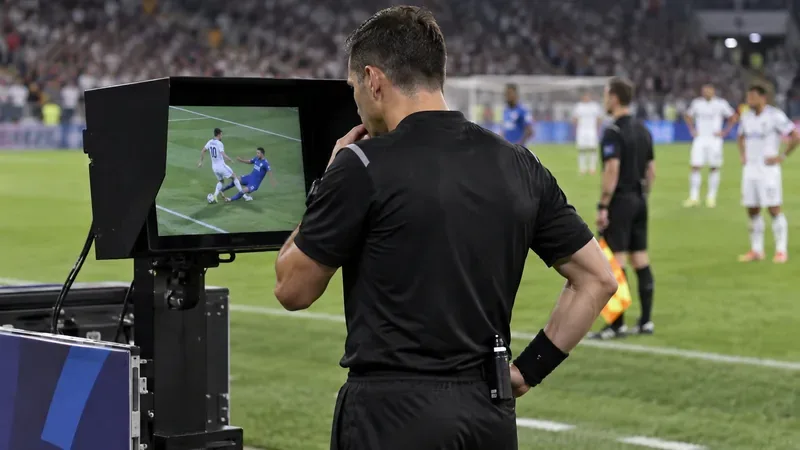
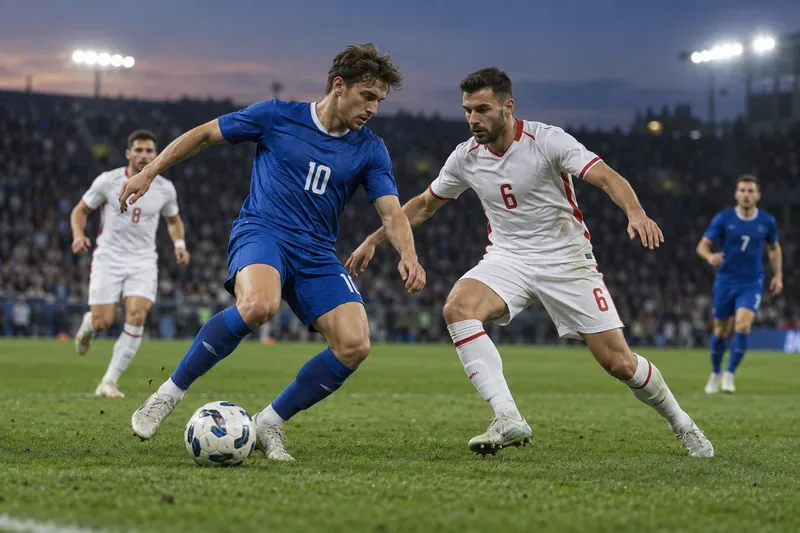
A referee studies a pitchside replay while players wait. VAR can assist only with incidents covered by the protocol, and the referee remains responsible for the final decision.
What decisions can VAR review in an international match?
The first thing to check is whether the competition is actually using VAR. The technology is not automatically present at every international fixture. The match or competition organizer must meet the implementation requirements and have the necessary FIFA permission. Competition rules can also matter because the new corner-kick review is optional.
Where VAR is in use, the current protocol organizes reviewable incidents into five categories.
1. Goal or no goal
VAR can check whether a goal should stand. That can include more than whether the ball crossed the line. The reviewable attacking phase can include an offside offense, a foul or handball by the attacking team, or the ball going out of play before the goal.
Example: a striker scores, but an earlier pass in the same attacking phase went to a teammate who was offside and became involved in play. VAR can check the offside and, if the evidence meets the protocol's standard, the goal can be disallowed.
This is why a stadium may appear ready for the kickoff after a goal while the referee waits. The VAR is checking whether the scoring sequence contains a reviewable error before play restarts.
2. Penalty or no penalty
VAR can intervene over a penalty decision when there may have been a clear and obvious error or a serious missed incident. Relevant questions can include whether there was an offense at all, whether the offense occurred inside or outside the penalty area, whether the attacking team committed an offense in the buildup, and whether the ball had already gone out of play.
Example: the referee awards a penalty after a defender appears to trip an attacker. Replays show that the contact occurred just outside the penalty area. The final decision can be changed from a penalty kick to a direct free kick.
A different example is simulation. If the referee awards a penalty but an on-field review clearly shows that the attacker was not touched and deliberately went down, the penalty can be canceled. The restart and any disciplinary action then follow the Laws of the Game.
3. Red-card situations, including a clearly incorrect second caution
The 2026/27 rules expanded this category. VAR can assist with red-card incidents such as denying an obvious goal-scoring opportunity, serious foul play, violent conduct, biting, spitting, and offensive, insulting, or abusive actions. It can also intervene when a player is sent off because of a clearly incorrect second yellow card.
That new second-yellow provision has an important limit: VAR does not generally search for missed ordinary cautions. IFAB's current examples make the distinction clear. If a player who already has one caution commits another cautionable offense that the referee completely misses, VAR does not step in merely because that would have become a second yellow. The new rule addresses a clearly incorrect second caution that has actually been shown and has produced a red card.
Example: a player already on a yellow is judged to have fouled an opponent, receives a second yellow, and is sent off. Replays clearly show no contact and that the opponent simulated the foul. VAR may recommend a review, after which the second caution and resulting red card can be canceled.
4. Mistaken identity
VAR may correct the identity of the player punished when the referee has clearly identified the wrong player for the offense. Under the 2026/27 wording, the focus is on correcting who committed the penalized offense.
Example: two defenders are close together when a foul occurs and the referee shows the yellow card to the wrong defender. VAR can help identify the actual offender.
This category does not turn every yellow-card decision into a reviewable incident. The video check is about mistaken identity, not a general appeal mechanism for routine cautions.
5. A clearly incorrectly awarded corner kick, if the competition has opted in
This is another 2026/27 addition. A competition may allow VAR to correct a corner kick that was clearly awarded incorrectly, but only if the correction can be made immediately and without delaying the restart. If the corner is taken quickly, the decision cannot then be changed.
This is a narrower process than the familiar lengthy VAR review. Fans should not assume that every throw-in, goal kick, or corner is now reviewable. The specific new option concerns a clearly incorrect corner award and depends on the competition adopting it.
Situation
Normally reviewable?
Key condition
Goal/no goal
Yes
Clear and obvious error or serious missed incident within the reviewable phase
Penalty/no penalty
Yes
Includes location and relevant buildup offenses
Red card
Yes
Includes clearly incorrect second caution under 2026/27 rules
Routine first yellow card
No, generally
Unless the issue falls under mistaken identity or another reviewable category
Mistaken identity
Yes
The wrong player has been identified for the penalized offense
Clearly wrong corner award
Competition option
Must be corrected immediately, before the restart is delayed or taken
Ordinary throw-in or goal-kick dispute
No, generally
Restart decisions are not a general VAR category
What is the difference between a VAR check and a VAR review?
A useful distinction for spectators is that VAR automatically checks relevant incidents. Players and coaches do not need to request a check. A formal review happens when the referee is advised that the incident may require a decision to be reconsidered, or the referee initiates a review.
The referee may make the final decision from factual information supplied by the VAR, or may go to the referee review area for an on-field review. The protocol says only the referee can initiate a review, and the final decision remains with the referee.
There is also no fixed maximum time for a review. IFAB's protocol explicitly prioritizes accuracy over speed. That does not mean officials are free to delay indefinitely; the process is expected to be completed as efficiently as possible, but complex incidents can require multiple angles and checks.
When does the referee delay the restart?
The practical boundary is simple: if VAR is checking an incident that could still change the decision, the officials may delay the restart so the review window is not lost. An assistant VAR can communicate with the referee when a check is in progress, including to ensure that play does not restart prematurely.
For fans, the most visible clues are a referee holding the restart, touching the earpiece, or signaling that players should wait. Those actions do not necessarily mean the decision will change. They can simply mean the video team has not finished the check.
Once a review is complete, the referee communicates the final decision, applies or changes any disciplinary sanction as appropriate, and restarts play according to the Laws.
What happens after play has restarted?
This is where many VAR arguments become easier to understand. Under the current Law 5 and VAR protocol, if play has stopped and then restarted, the referee generally cannot go back and conduct a normal VAR review of the previous incident.
There are narrow exceptions. After a restart, a review may still take place for mistaken identity or for a potential sending-off offense involving violent conduct, spitting, biting, or extremely offensive, insulting, or abusive actions. Those exceptions exist because the misconduct is sufficiently serious or the identity issue needs correction.
Example: the referee awards a throw-in, play restarts, and video later shows the ball actually came off the opposite team. That ordinary restart decision is closed. VAR does not rewind the match to change the throw-in.
Likewise, the optional 2026/27 corner correction must happen immediately. IFAB specifically notes that if the corner is taken quickly, it cannot be changed afterward.
How does play restart after VAR changes a decision?
There is no single “VAR restart.” The restart depends on what the referee ultimately decides under the normal Laws of the Game.
If a goal is disallowed for an offside offense, play restarts with the appropriate indirect free kick for offside.
If a penalty is changed because the foul happened outside the area, the restart can become a direct free kick from the correct location.
If an awarded penalty is canceled because the attacker simulated a foul, the defending team can receive an indirect free kick and the attacker can be cautioned.
If a goal is confirmed, the normal restart is a kickoff by the team that conceded.
If an incorrectly awarded corner is corrected under a competition's optional VAR procedure, the restart becomes the restart the officials determine should actually have been awarded.
The important point is that video review changes the underlying decision; it does not create a separate restart procedure.
Does VAR use the same rules at every international match?
The core protocol comes from IFAB, but the exact match setup can still differ. A competition must be authorized to use VAR, and organizers decide whether to adopt optional elements such as the 2026/27 clearly incorrect corner-kick review.
There can also be competition-specific trials or clarifications. For example, IFAB approved a clarification for the 2026 FIFA World Cup concerning certain attacking-team offenses committed before the ball was in play at a corner kick or free kick when those offenses directly affected a goal, penalty, or disciplinary sanction. IFAB said that clarification would be reviewed after the tournament. Fans should therefore avoid assuming that a World Cup-specific trial or clarification automatically applies to every later international fixture unless the governing competition confirms it.
For a particular national-team match or international club competition, the safest sequence is to check the competition regulations first, then the current IFAB protocol.
What should spectators remember during a live VAR delay?
Not every controversial call is reviewable. VAR is restricted to defined categories.
A check is not proof that the referee made an error. Relevant incidents are checked routinely.
The referee makes the final decision. The VAR advises; the referee decides.
The restart matters. Once play has restarted, most previous incidents can no longer be reviewed.
Second-yellow red cards changed in 2026/27. A clearly incorrect second caution that causes a dismissal can now be reviewed.
Corner-kick review is optional. It applies only where the competition has adopted the provision and only before a quick restart closes the window.