The Best Fast-Growing Shade Trees for Your Yard
The best fast-growing shade trees are the ones that suit your climate, soil, and available space at maturity. For many temperate yards, a red maple, river birch, or hackberry can form a useful canopy; a tuliptree is an option for a much larger site. These are examples, not a universal ranking: growth varies with species, cultivar, weather, and care, and a fast tree still takes time to shade a yard.
This guide focuses on large canopy trees. Flowering ornamentals and compact trees such as Japanese maples, dogwoods, redbuds, and serviceberries can be excellent landscape plants, but many are too small to provide broad, overhead shade. The trees below are North American examples, and each should be planted only where it is locally adapted. Elsewhere, check regional native-plant and invasive-species guidance before buying.
Fast-growing shade trees at a glance
Compare mature size and site conditions before comparing growth rate. The measurements below are approximate references from extension sources; local cultivars and growing conditions can change a tree’s final size and performance.
| Tree | Typical mature size | Best fit | Trade-off to know |
|---|---|---|---|
| Red maple (Acer rubrum) | About 60 feet tall and wide in Virginia Tech’s reference | Fast-growing medium-to-large canopy; full sun to partial shade; adaptable to several soil textures and moisture levels | Cultivars vary. High-pH soil can cause iron chlorosis, surface roots may complicate lawn mowing, and storm damage is possible. |
| River birch (Betula nigra) | Roughly 40–70 feet tall; often 35–50 feet wide | Fast growth for a sunny site with reliable moisture; tolerates moist or wet soils and has peeling bark | Not a good match for hot, dry summers or a yard where regular water is unavailable. |
| Common hackberry (Celtis occidentalis) | About 50–70 feet tall and up to 50 feet wide | Medium-to-fast growth; a practical urban shade tree where heat, drought, wind, salt, or variable soils are concerns | Some trees develop witches’ broom growths, which are usually a cosmetic issue. |
| Tuliptree (Liriodendron tulipifera) | About 80–100 feet tall and 30–50 feet wide in UF/IFAS’s reference | A tall canopy for a large, open property in a suitable region; growth can be moderate to rapid on good sites | Its eventual size rules it out for many small yards. Fallen leaves and fruit add seasonal cleanup. |
These descriptions come from Virginia Cooperative Extension’s red maple profile, Penn State Extension’s river birch guide, University of Minnesota Extension’s hackberry profile, and UF/IFAS’s tuliptree profile. Their recommendations are regional; use them to compare traits, then confirm the right species and cultivar for your own location.
A four-step plan for choosing and planting a shade tree
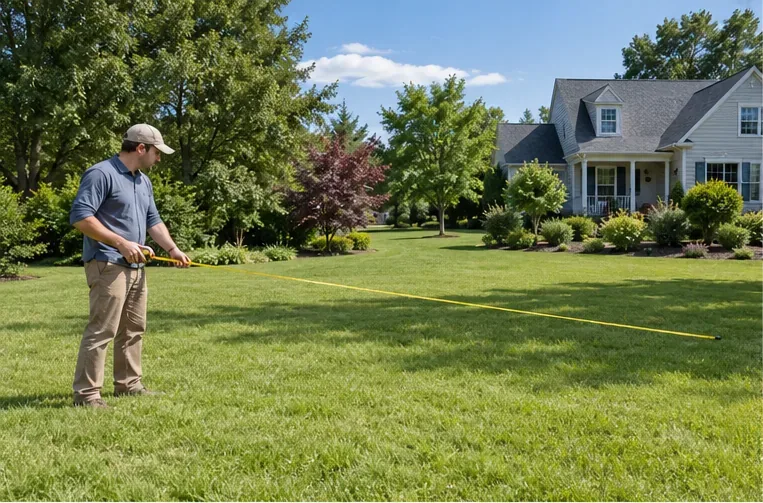
1. Map sun, soil, and mature-tree clearance
Watch the planting area through the day and note how many hours of direct sunlight it gets. Check whether water drains away after rain or sits on the surface, and consider summer heat, wind, and nearby pavement. A site that looks spacious around a sapling may be crowded once the crown and roots expand.
Measure away from the house, garage, sidewalks, fences, septic systems, and other trees. Look up for roof edges and overhead wires, and contact the local utility-marking service before digging. The Arbor Day Foundation’s planting-site guide recommends planning around a tree’s mature height, crown spread, and root space—not the size of the nursery plant.
2. Match the tree to the conditions you actually have
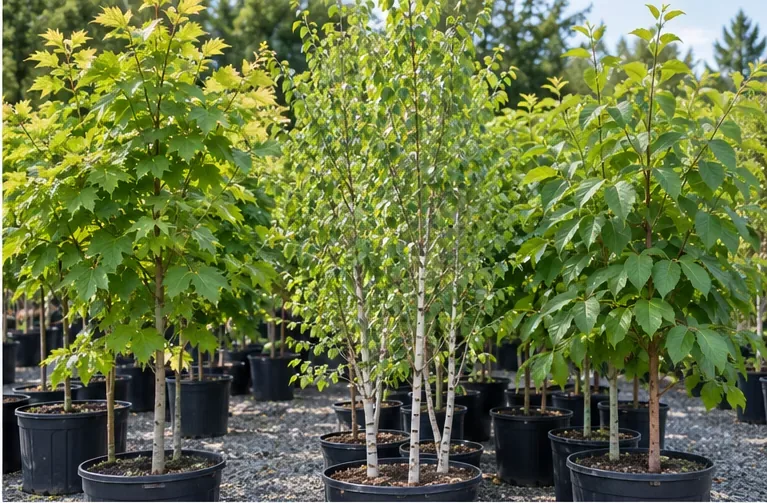
Use the table as a shortlist, not a shopping list. A river birch is a better candidate for a moist site than a dry, exposed yard; hackberry is more forgiving in many urban conditions; red maple offers a broad canopy when its soil and cultivar needs fit; and tuliptree needs room to become a very large tree. If your yard is small, choose a smaller, locally recommended tree and accept that it will provide a more limited patch of shade.
Ask a local nursery, botanical garden, or cooperative extension service which species are native or well-adapted in your area, which cultivars have sound branch structure, and whether any candidates are invasive nearby. Check the tree’s mature height and width on the plant label or a reliable regional profile. For a planting meant to shade a particular room or patio, consider where the afternoon sun falls and where the mature canopy will cast shade.
3. Plant at the root flare, not too deep
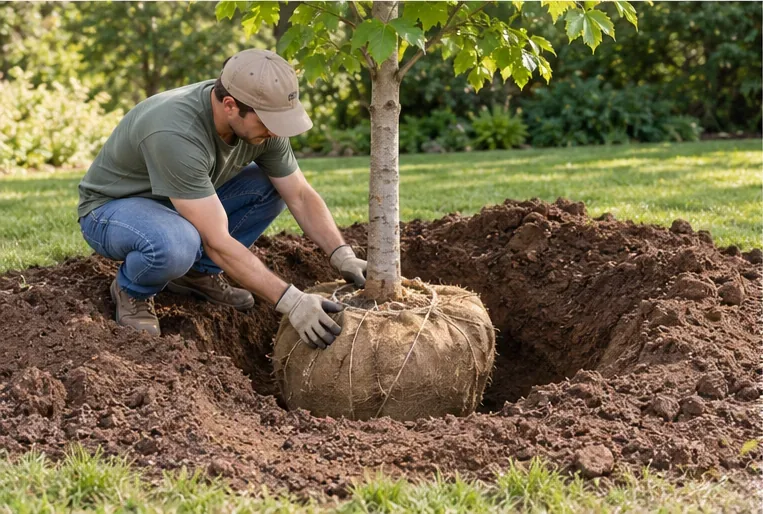
Spring or fall is often suitable for planting, but the right season depends on local climate and the tree’s nursery stock. Dig a hole two to three times wider than the root ball and no deeper than its height. Find the root flare—the point where the trunk widens into the first major roots—and set it at or slightly above the surrounding grade. A hole that is too deep can leave the trunk buried and restrict oxygen around the roots.
Backfill with the soil removed from the hole and water slowly to settle it around the root ball. Skip fertilizer at planting unless a soil test or local expert recommends it; extra fertilizer is not a shortcut to a larger canopy. For more detail, see the Arbor Day Foundation’s tree-planting answers.
4. Water and mulch through establishment
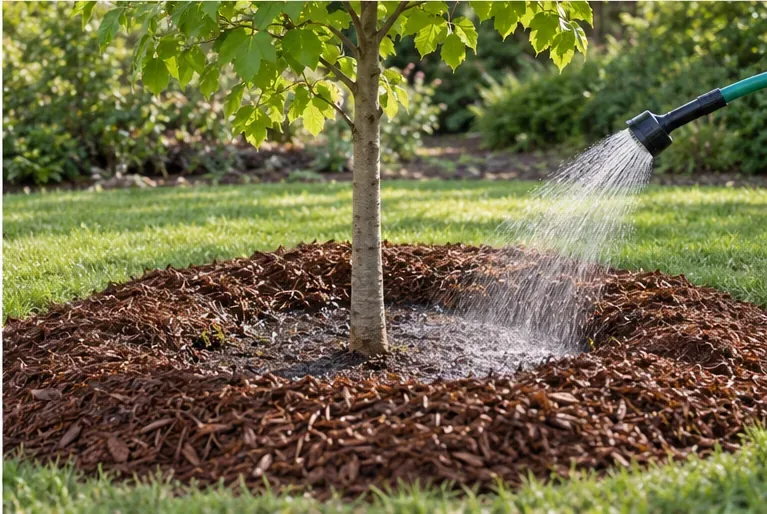
Water immediately after planting, then check moisture at the root ball and nearby soil. Keep the root zone evenly moist while the tree establishes, adjusting for rainfall, temperature, soil type, and local watering restrictions. A fixed daily schedule can overwater heavy or poorly drained soil and underwater a fast-drying site. Larger nursery trees may need care over multiple growing seasons; the University of Minnesota Extension’s watering guide explains how watering and establishment vary with tree size.
Spread a shallow layer of organic mulch over the root area to reduce weeds and slow moisture loss. Keep it several inches away from the trunk so the root flare remains visible; piled mulch holds excess moisture against bark and can interfere with healthy roots. Check the tree regularly during dry spells, remove broken or damaged branches with clean cuts, and ask an arborist or local extension service for major structural pruning.
Mistakes that delay shade
- Choosing by growth rate alone: a fast-growing tree can outgrow the site or demand more water than the yard can provide.
- Planting too close to structures or wires: future pruning conflicts and restricted roots are difficult to fix later.
- Expecting instant shade: a young tree needs time to establish roots and build a canopy; a larger transplant may take longer to settle in.
- Fertilizing or pruning aggressively: neither should be used to force rapid height. Start with correct placement, root-flare depth, water, and mulch.
- Ignoring local suitability: hardiness, heat, rainfall, pests, and invasive-species rules differ by region. Confirm advice with a local horticultural authority.
Frequently asked questions
What is the fastest-growing shade tree?
There is no single best answer for every yard. Red maple and river birch are described as fast-growing by extension sources, while hackberry is rated medium to fast and tuliptree can grow quickly on favorable sites. Choose by local suitability, expected mature size, and the conditions you can provide—not by a fastest-tree claim on a tag.
How soon will a newly planted tree provide shade?
A small nursery tree will not shade a large area right away. Growth depends on species, cultivar, climate, water, and establishment. A larger tree may offer more immediate canopy, but it can take longer to establish than a smaller one. Plan for a long-term improvement rather than an instant screen.
Can I plant a fast-growing tree in a small yard?
Only if the mature crown and roots fit the available space. Some fast-growing shade trees become very large, so a compact ornamental or a smaller locally recommended species may be safer near a home, sidewalk, or utility line. Check mature dimensions and local planting guidance before you buy.
The most reliable way to get useful shade sooner is to choose a tree that fits the site, plant it at the correct depth, and support it while its roots establish. Compare fast-growing shade trees by mature canopy and care needs, then confirm the final choice with a trusted local source.









