Home
» 🎮 Esports
»
Best Marvel Rivals Button Layout for Faster Wall Climbing and Mobility
Best Marvel Rivals Button Layout for Faster Wall Climbing and Mobility
Fast wall climbing in Marvel Rivals is less about finding a hidden “pro” preset and more about removing one physical bottleneck: taking your right thumb off the aiming stick every time you need to jump, attach to a wall, or chain movement. As of October 8, 2026, Marvel Rivals officially supports full controller remapping on PlayStation 5, and the game has also added controller-configuration saving and sharing. That means you can build a layout around mobility instead of accepting the default face-button arrangement. See the official Marvel Rivals PS5 accessibility page and the Season 6 patch notes.
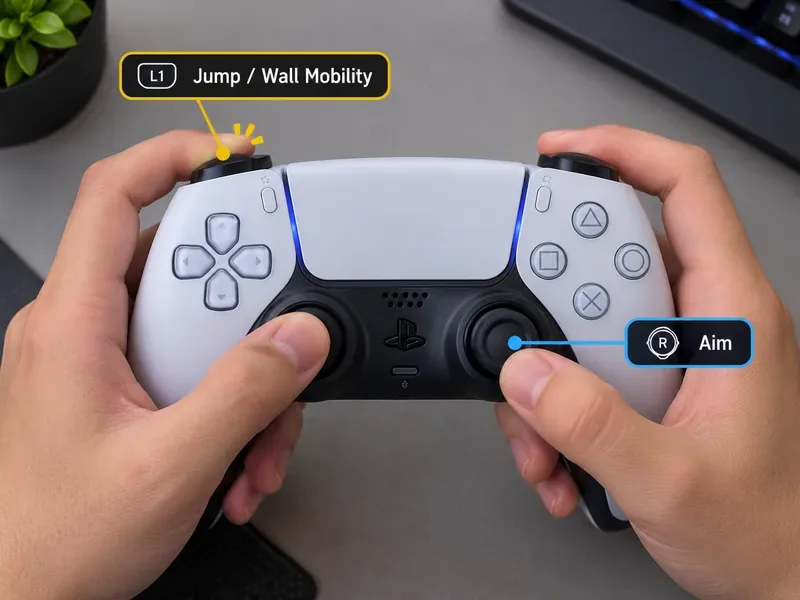
The best general starting point for controller players who frequently use wall-running or wall-crawling heroes is to move Jump / wall movement to L1 on PlayStation or LB on Xbox. If your controller has a comfortable rear paddle or back button, that can be even better because you can preserve your normal shoulder-button ability layout. This is a recommendation, not an official Marvel Rivals preset: the right choice still depends on the hero, your controller, hand comfort, and whether moving an ability creates a worse conflict elsewhere.
A mobility-focused controller concept: put Jump or wall movement on a shoulder input so your right thumb can stay on the camera stick while you climb, turn, and detach.
Why jump placement matters so much for wall mobility
Marvel Rivals uses the jump input as the gateway to several wall-movement mechanics. The official hero pages list Peni Parker’s Wall Crawl as “HOLD Jump,” Black Panther’s Subtle Step as “Hold Space to run on a wall,” Iron Fist’s Wall Runner on Space, Daredevil’s Blind Ascent on Space, and Spider-Man and Venom wall crawling on Space. Those pages are PC-oriented, so they do not prove that every controller uses one fixed button label; they do prove that these mechanics are built around the core jump action rather than a separate universal “wall climb” command. Check the official pages for Peni Parker, Black Panther, Iron Fist, Daredevil, Spider-Man, and Venom.
Action: if wall movement feels slow because you must stop aiming to press a face button, test Jump on L1/LB before changing sensitivity, deadzones, or aim curves. Button access is the more direct problem.
Recommended controller layout for fast climbing and camera control
Action
PlayStation-style
Xbox-style
Reason
Jump / wall crawl / wall run
L1
LB
Keeps the right thumb on the aiming stick while holding or tapping jump near walls.
Primary attack
R2
RT
Preserves a familiar trigger position for attacks and minimizes unnecessary relearning.
Secondary attack
L2
LT
Easy to combine with movement without leaving either stick.
Main traversal ability
R1 when practical
RB when practical
Good for swings, dashes, or fast movement abilities that need to be aimed while activated.
Melee or lower-priority utility
Face button or stick click
Face button or stick click
A reasonable place for actions that are not repeatedly held while steering the camera.
This table is a baseline, not a rule. The most important assignment is Jump/wall movement. Marvel Rivals heroes do not all use the same ability sequence, and a hero may need a different shoulder button for a high-frequency combat skill. If moving Jump to L1/LB forces an essential ability onto an awkward input, swap that one hero differently rather than forcing a universal layout.
Best option if you have rear paddles
A rear paddle is often the least disruptive answer because it lets you trigger Jump without moving your thumbs. If your controller software allows a rear button to mirror the game’s Jump input, use the paddle for Jump and keep your existing in-game ability mapping. This is especially useful if you already have strong muscle memory for shoulder-button abilities.
Action: start with one rear paddle only. Adding two or four new rear inputs at once can make it harder to identify whether the mobility change actually helped.
Which heroes benefit most?
Spider-Man and Venom
The official Spider-Man and Venom pages describe wall crawling on Space, with a faster sprint state while crawling. Spider-Man also has Web-Swing as a separate mobility skill, while Venom has his own traversal kit. For these heroes, the ideal layout lets you hold wall movement, steer the camera, and transition into a traversal ability without lifting your right thumb.
Action: place Jump/wall crawl on L1/LB, then put the traversal ability on an opposite shoulder input if that does not disrupt your combat combo. Practice attaching to a wall, rotating the camera 90 degrees, detaching, and immediately activating traversal.
Black Panther, Iron Fist, and Daredevil
These heroes use wall-running movement rather than Spider-Man-style crawling. Black Panther’s official Subtle Step description says to hold Space to run on a wall and jump after detaching. Iron Fist’s Wall Runner and Daredevil’s Blind Ascent are also listed on Space. The shared control principle is the same: you gain more control when the input used to stay on or leave the wall can be pressed without sacrificing camera control.
Action: practice short wall contacts instead of only long wall runs. The goal is to make entering and exiting the wall state deliberate, because an accessible button does not automatically fix poor approach angles.
Peni Parker
Peni Parker is a useful reminder that “wall climbing” is not identical across the roster. Her official page says to hold Jump to crawl on vertical surfaces, and her listed wall-crawling speed differs from other heroes. A shoulder or paddle Jump bind makes holding the input easier while you continue to steer.
Action: test sustained climbs as well as quick wall touches. If you feel finger fatigue from holding L1/LB, a rear paddle may be more comfortable.
Common misconception: a faster layout does not increase movement speed
Remapping does not raise a hero’s numerical wall speed. Official hero pages publish fixed values for several wall-mobility abilities—for example, different listed speeds for Black Panther, Iron Fist, Spider-Man, Venom, and Peni Parker. Your layout can reduce input delay caused by hand movement and make direction changes easier, but it does not change those underlying hero parameters.
Action: judge the new layout by consistency: fewer missed wall attachments, cleaner camera tracking, faster transitions into attacks or traversal, and fewer accidental ability presses. Do not judge it by whether the hero appears to run faster in a straight line.
Common misconception: higher stick sensitivity automatically improves climbing
Higher sensitivity can help you rotate the camera more quickly, but it can also make wall exits and close-range tracking less precise. Controller remapping and stick sensitivity solve different problems. The official PS5 page confirms that Marvel Rivals exposes both controller remapping and adjustable stick sensitivity, so you can tune them independently.
Action: change the button layout first and leave your current sensitivity alone for several practice runs. If you still cannot turn quickly enough while attached to walls, raise horizontal sensitivity in small increments rather than changing multiple settings at once.
What about “easy swing” or automatic movement options?
Do not assume that an automatic swing option makes button placement irrelevant. In the August 8, 2025 patch notes, Marvel Rivals added separate keybinds for simple and manual swinging for Spider-Man and Venom. That confirms the game distinguishes traversal styles and allows more granular binding for those heroes. See the official Season 3.5 patch notes.
Which style is best remains situational. Simple swinging may reduce mechanical load; manual swinging may offer a different level of control. Neither changes the ergonomic advantage of keeping high-frequency movement inputs within reach while both thumbs stay on the sticks.
Action: choose your swing style first, then place the version you actually use on the most accessible traversal button. Do not spend a premium shoulder button on a movement mode you rarely activate.
How to test whether your layout is actually better
Marvel Rivals provides a Practice Mode, so you can compare layouts without using competitive matches as a testing ground. A useful test is repeatable rather than subjective. Run the same short sequence ten times: approach a wall, attach, climb or run, rotate the camera toward a second direction, detach, use your main traversal ability, then aim at a target. Count obvious mistakes such as missed wall contact, camera overshoot, accidental ability activation, or losing aim because your thumb left the stick.
If the new layout reduces those errors after a short adjustment period, keep it. If it fixes climbing but causes frequent missed combat abilities, move only the conflicting hero to a separate configuration. Since Marvel Rivals added the ability to save, share, and swap controller configurations in Season 6, hero-specific or role-specific layouts are more practical than they used to be.
A safe competitive note on controller hardware
Using normal controller remapping is supported, but do not confuse that with keyboard-and-mouse adapters that emulate controller input. Marvel Rivals has an official policy stating that devices or software used to mimic controller inputs with keyboard and mouse can lead to penalties, including suspensions. The policy specifically discusses adapters such as XIM, Cronus Zen, Titan Two, KeyMander, and similar devices. Read the official keyboard and mouse adapters statement.
Action: use the game’s own remapping options or ordinary controller features intended for button reassignment. Avoid hardware or software designed to disguise keyboard-and-mouse input as controller input.
Bottom line
For most controller players focused on fast wall climbing and mobility, the strongest starting layout is Jump / wall movement on L1 or LB, with the right thumb remaining on the camera stick. If you have rear paddles, mapping Jump to a comfortable back button can be even cleaner because it preserves the default shoulder layout. Keep primary and secondary attacks on triggers, put a frequently aimed traversal skill on an accessible shoulder button when practical, and customize hero by hero when one global layout creates conflicts.
As of October 8, 2026, the most recent live patch notes checked here are the October 1 update, and they do not announce a new controller or movement-control system; the next published October 9 balance post focuses on hero balance changes rather than a replacement for the current remapping framework. You can review the October 1 patch notes and the October 9 balance post.
The part that remains unknowable without testing your own hands is which exact displaced ability should replace the old Jump button. That depends on your hero pool, controller shape, grip style, and muscle memory. Start with the one change that has the clearest mechanical rationale—moving Jump off the face buttons—then adjust only the conflicts that show up in practice.