Volleyball Substitution Limits: Why Indoor, NCAA and Beach Rules Differ
Compare FIVB indoor, NCAA women’s and beach volleyball substitution limits, including the 2026 trial and division-specific changes.
As of September 30, 2026, volleyball does not have one universal substitution limit. The familiar international indoor rule allows six team substitutions per set, but the NCAA has different limits in women’s indoor play, and the FIVB is testing an eight-substitution limit at selected 2026 international events. Beach volleyball is built around a fixed pair, so routine player substitutions do not work the way they do indoors.
The key is to identify the competition before counting. “Indoor,” “NCAA” and “beach” describe different rule systems, not interchangeable versions of a single rule. The figures below distinguish a regular substitution from a libero replacement and from a change to a beach team’s lineup before play begins.
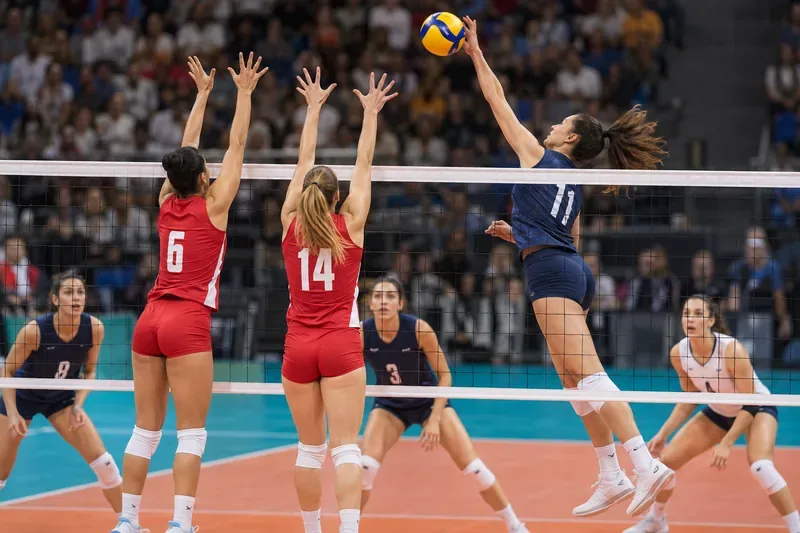
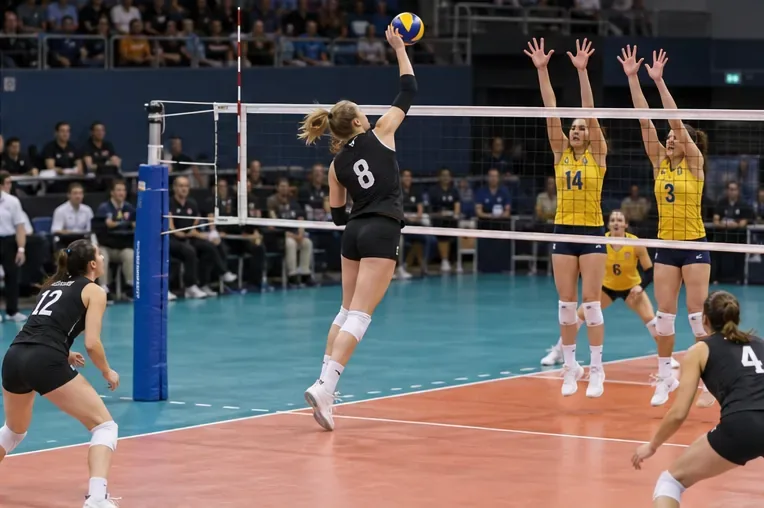
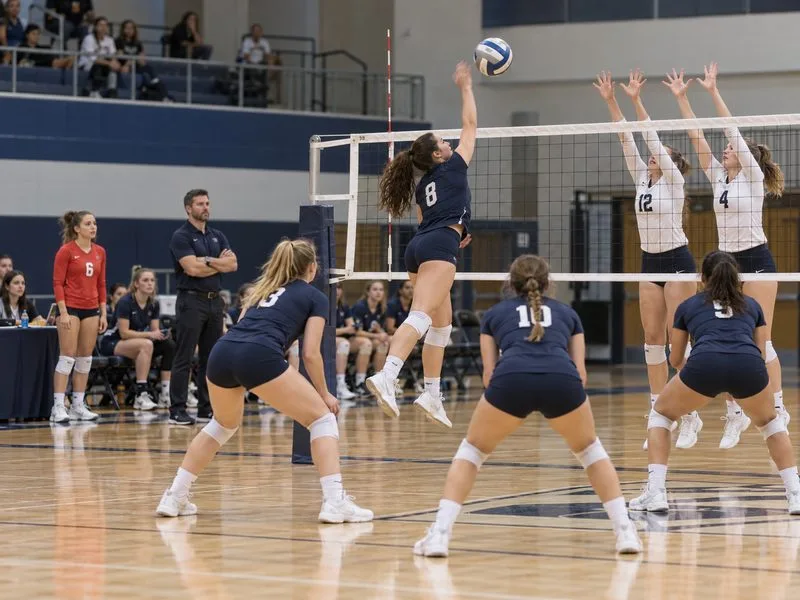
Six players from each team take part in an indoor rally while substitutes and coaches watch from the sideline.
Under the FIVB Official Volleyball Rules 2025–2028, each team may request up to six substitutions in a set. A substitution is a recorded exchange in which an eligible player enters to take the place of another player. A team may use one or more players in a single substitution request, but the count is based on the players exchanged, not simply on how many stoppages the coach requests.
The six-substitution limit is only part of the rule. FIVB’s normal substitution pattern ties a substitute to a particular starter: a starting player may leave once and return once in the same set, only to that player’s original lineup position. A substitute who enters for that starter may be replaced only by the same starter. This creates defined pairs of players rather than an unlimited chain of swaps.
For example, if a reserve enters for the starting middle blocker, that reserve cannot later leave for a different reserve. The original middle blocker is the player who can take that position back under the ordinary rule. The team also cannot exceed its total allotment of six regular substitutions in the set.
No, under FIVB rules. Libero replacements are a separate process and do not count as regular substitutions. They are unlimited, subject to the libero rules, including the requirement for a completed rally between replacements in most situations. This is why a match record may show frequent libero movement even though the team has used few of its six regular substitutions.
Do not assume every local or college rules code handles every libero procedure identically. When the count matters, check the rulebook and scorekeeping instructions used for that event. The official FIVB rulebook separates libero replacements from Rule 15’s regular substitution count.
NCAA limits are not a single number across all indoor divisions. For the 2026 women’s season, Division I continues with 15 substitutions per set. The NCAA approved an increase from 15 to 18 for Divisions II and III, effective in 2026. The NCAA’s February 2026 announcement explicitly limits that increase to Divisions II and III; it does not say that Division I moved to 18.
That change gives DII and DIII coaches three additional substitution opportunities per set. It can matter in close sets or when a coach uses planned offensive and defensive roles. It does not mean every player can enter freely: the applicable college rules still govern how substitutions are requested, recorded, and paired with lineup positions. The exact regulations should be checked in the current division’s rules book.
The NCAA publishes separate rules resources for women’s and men’s volleyball, and NCAA beach volleyball has its own rules page and modifications. A quick “NCAA volleyball substitution limit” search may therefore return a number that is correct for one competition but wrong for another. For women’s indoor matches in 2026, the practical comparison is Division I: 15; Divisions II and III: 18.
See the NCAA’s 2026 women’s volleyball rules-change announcement and its official women’s volleyball rules hub for the rulebook and current division materials.
The FIVB announced a trial that increases regular substitutions from six to eight per set. The trial applies during the 2026 Volleyball Nations League, FIVB Volleyball U17 World Championships and 2026 Continental Championships. The FIVB says updates to the official rules will be reviewed after the testing phase.
This is a competition-specific test, not a permanent rewrite of the 2025–2028 rulebook. So “FIVB allows eight substitutions” is too broad without mentioning the event. For a match at one of the named 2026 competitions, consult that event’s competition regulations and match information. For other matches using the standard FIVB rulebook, six remains the baseline described in Rule 15.1. The FIVB’s 2026 rule-test announcement identifies the events and says the trial will be evaluated.
Standard beach volleyball is played by two players per team, and both are expected to remain in play throughout the match. Under the FIVB’s basic beach rules, there is no substitution or replacement of players during a game. There is no six- or 15-substitution allowance because a beach pair has no regular bench rotation within that match.
NCAA beach volleyball adds a team-dual context: a school fields several pairs in separate doubles matches. Coaches submit a lineup and follow player-movement and order-of-ability requirements across those pairs. That roster and lineup management can look like a substitution from the stands, but it is not the same as sending a reserve onto the court during a beach match. NCAA’s beach volleyball rules hub provides the current USAV beach rules book, NCAA modifications and lineup resources.
For NCAA beach competition, the 2026 rules modifications state that once warm-ups begin in any match, substitutions are not permitted and players may not be replaced. The exact timing matters: roster and lineup decisions are handled before the match reaches that point. A player injury should be handled under the event’s injury and medical procedures; it does not create a general right to swap in a reserve whenever a coach wants.
| Competition | Regular substitutions | What to remember |
|---|---|---|
| FIVB indoor, standard 2025–2028 rules | Six per team per set | Substitutes are linked to starters; libero replacements are separate. |
| Selected FIVB international events in 2026 | Eight per team per set during the trial | Applies to VNL, U17 World Championships and 2026 Continental Championships. |
| NCAA women’s indoor, Division I, 2026 | 15 per team per set | The 2026 change did not raise the Division I limit. |
| NCAA women’s indoor, Divisions II and III, 2026 | 18 per team per set | Increase from 15 took effect with the 2026 season. |
| Beach volleyball | No routine in-match substitutions | Beach is played by a fixed pair; NCAA has additional team-lineup rules. |
The main reason limits differ is that the rules are designed for different competitive structures. Indoor volleyball uses a six-player rotation and manages tactical changes through capped, recorded substitutions. NCAA divisions set their own participation balance, with a higher women’s DII/III allowance beginning in 2026. Beach volleyball keeps a two-player pair on court, so depth is handled through team selection and lineups before play rather than routine substitutions during the match.
Compare FIVB indoor, NCAA women’s and beach volleyball substitution limits, including the 2026 trial and division-specific changes.
See how opponent strength, six possible set scores, and event weight shape FIVB ranking points—and how to check a match’s likely impact.
A volleyball screen is more than standing in front of a server. Under current FIVB and USA Volleyball rules, learn what actions create a screening fault and what does not.
Learn when touching the volleyball net costs a point, which contact can be legal under FIVB and USA Volleyball rules, and why timing and interference matter.
Learn when a volleyball setter dump is legal under FIVB rules, including double contacts, back-row attack limits, the 3-meter line and 2026 rule tests.
Learn when a back-row attack is a fault: check the player’s takeoff at the attack line, ball height at contact, and why landing position can mislead.
Can a libero serve? Compare current FIVB, NCAA women’s and men’s, and 2026–27 NFHS high-school rules, including the one-position limit and two-libero exception.
Learn the FIVB-style order for breaking volleyball pool ties: wins, match points, set ratio, point ratio, then head-to-head results.
Learn which players must stay in rotational order at service, how referees judge volleyball overlap by foot position, and how 2026 FIVB rule tests change the timing.
A practical guide to volleyball video challenges: which calls can be reviewed, how many challenges teams get per set, timing rules, outcomes, and 2026 FIVB tests.