FIVB Ranking Points Explained: Opponent Strength and Match Results
See how opponent strength, six possible set scores, and event weight shape FIVB ranking points—and how to check a match’s likely impact.
The volleyball challenge system is designed to correct specific officiating errors without turning every rally into an open-ended replay review. Under the FIVB Video Challenge System regulations, a team can ask for a video review of certain suspected faults after a rally, but the request must fit the permitted categories, be made on time, and follow the competition’s technology setup.
This reference uses the FIVB Video Challenge System Regulations published for 2025 as the baseline and highlights the officially announced 2026 test procedures that apply to selected FIVB competitions. That distinction matters because not every league, federation, or event uses the same equipment or the same trial rules.
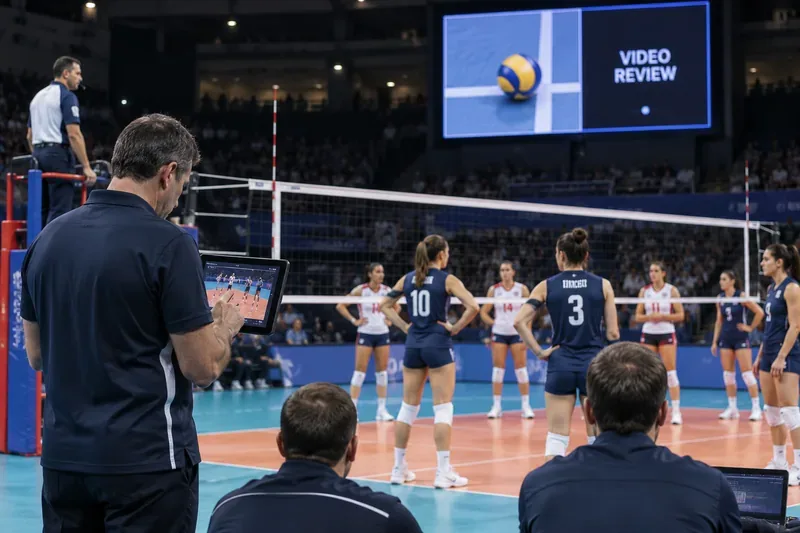
Under the FIVB Video Challenge System Regulations 2025, each team is given a maximum of two challenges per set. However, this is best understood as two challenge opportunities that are lost only after unsuccessful requests.
That means a team can make more than two review requests in one set if earlier challenges are successful or inconclusive. The practical limit is two unsuccessful challenges, not necessarily two total uses of video review.
The 2025 FIVB regulations list specific reviewable situations. Availability can depend on the installed technology, and automated systems can replace some manual challenge options.
| Review category | What officials can check | Important limit |
|---|---|---|
| Ball in or out | Whether the ball landed inside or outside the side or end lines | If an approved automated in/out system is operating, a separate in/out challenge may no longer be available |
| Block touch | Whether a blocker contacted the ball before it went out or continued in play | The review concerns the relevant touch in the rally sequence |
| Net fault | Whether a player contacted the net between the antennas while in the action of playing the ball | Not every incidental contact is automatically a fault under the playing rules |
| Antenna touch | Whether a player or the ball contacted an antenna | The challenge must identify the suspected action |
| Foot fault | Server foot fault, attack-line fault, or complete crossing of the center line by a foot or feet | The exact footage and camera coverage must show the relevant line |
| Floor touch | Whether the ball touched the floor, including close “pancake” defense situations | Clear video evidence is needed to overturn the original decision |
| Last touch | Which opponent made the final touch before the ball went out after near-simultaneous contact | If the video is inconclusive, the referee’s decision remains |
| Reaching beyond the net | Whether a player contacted the ball across the plane of the net in an illegal manner | Available only where the required technology is installed and operating |
The official source is the FIVB Video Challenge System Regulations 2025.
FIVB announced additional video-challenge procedure tests for the 2026 international season. According to FIVB’s February 27, 2026 announcement, the tests apply to the 2026 Volleyball Nations League, FIVB Volleyball U17 World Championships, and 2026 Continental Championships. They are tests rather than automatically permanent changes to the Official Volleyball Rules.
Under the 2026 test procedure, teams may mark a potentially challengeable action while the rally is still in progress. If the team later loses the rally, it may pursue one of the actions it marked. FIVB states that a mid-rally action cannot be challenged under this test unless it was bookmarked.
If both teams bookmark actions in the same rally, the sequence is reviewed and the first fault observed takes priority.
The 2026 tests also add touches in defense and serve receive to the challenge regulations for the competitions using the trial. FIVB specifies that clear and visible video contact is required to overturn the original decision. If the video does not provide evidence, the on-court decision stands.
These trial procedures are described in FIVB’s official 2026 rule-test announcement.
Under the 2025 FIVB regulations, a team has seven seconds after the rally ends to initiate the challenge through the electronic team tablet. After pressing the challenge button, the team must then identify the suspected fault from the available menu within the prescribed time.
The request must be specific. Officials may clarify with the coach what action is being challenged and where in the rally it occurred, such as a net touch during a particular attack or a block touch in a particular phase.
If the electronic team tablet fails, the head coach or assistant coach may make a manual signal and direct oral request to the referees.
The challenge referee reviews the available footage and communicates the finding to the first referee. The first referee announces the final decision and awards the point accordingly. The score is corrected if necessary before play resumes.
Several procedural details are easy to miss:
When the video evidence is inconclusive, the original referee decision remains in force. Importantly, the team does not lose a challenge in that situation.
The regulations also allow the video team to consult additional available television angles when needed. Precision takes priority over speed, even though the process is intended to be completed quickly.
Some competitions use automated ball in/out technology. Under the FIVB 2025 regulations, when that system is in use, the conventional challenge option for ball in/out is removed because the decision is generated automatically through the approved system.
This is why viewers should not assume every tournament will show the same menu of challenge choices. One event may allow a manual in/out challenge, while another may use automatic line decisions and reserve team challenges for other fault categories.
If there is a general technical failure, the second referee informs the teams and the match continues under normal officiating rules without video challenges. If the system later becomes operational again, teams are informed and challenges can resume from that point.
For VNL 2026 specifically, FIVB also introduced a pilot remote Video Challenge System hub. Selected challenge refereeing and technical functions can be operated centrally rather than entirely from the venue. The change concerns how the system is operated, not a blanket removal of the challenge process. FIVB described the remote model in its May 14, 2026 VNL announcement.
The FIVB’s current playing-rule framework is the Official Volleyball Rules 2025–2028, available through the FIVB Official Volleyball Rules document page. Video challenges are governed through separate challenge regulations and event procedures, which is why the challenge system can be updated or tested without every change immediately appearing as a permanent rule-book amendment.
As of September 30, 2026, the safest way to interpret a disputed review is to check three things in order: the Official Volleyball Rules, the applicable Video Challenge System regulations, and the specific competition regulations or officially announced test procedures for that event.
See how opponent strength, six possible set scores, and event weight shape FIVB ranking points—and how to check a match’s likely impact.
A volleyball screen is more than standing in front of a server. Under current FIVB and USA Volleyball rules, learn what actions create a screening fault and what does not.
Learn when touching the volleyball net costs a point, which contact can be legal under FIVB and USA Volleyball rules, and why timing and interference matter.
Learn when a volleyball setter dump is legal under FIVB rules, including double contacts, back-row attack limits, the 3-meter line and 2026 rule tests.
Learn when a back-row attack is a fault: check the player’s takeoff at the attack line, ball height at contact, and why landing position can mislead.
Can a libero serve? Compare current FIVB, NCAA women’s and men’s, and 2026–27 NFHS high-school rules, including the one-position limit and two-libero exception.
Learn the FIVB-style order for breaking volleyball pool ties: wins, match points, set ratio, point ratio, then head-to-head results.
Learn which players must stay in rotational order at service, how referees judge volleyball overlap by foot position, and how 2026 FIVB rule tests change the timing.
A practical guide to volleyball video challenges: which calls can be reviewed, how many challenges teams get per set, timing rules, outcomes, and 2026 FIVB tests.