FIVB Ranking Points Explained: Opponent Strength and Match Results
See how opponent strength, six possible set scores, and event weight shape FIVB ranking points—and how to check a match’s likely impact.
A back-row attack call can look obvious until someone watches the replay from a different angle. The hitter lands inside the three-meter line, so one side expects a fault; the other points to a takeoff behind it. In another rally, the player jumps near the net, but the ball is dropping below the tape at contact. These are different rule tests. The landing spot does not decide the first play, and the ball’s height does not excuse every takeoff.
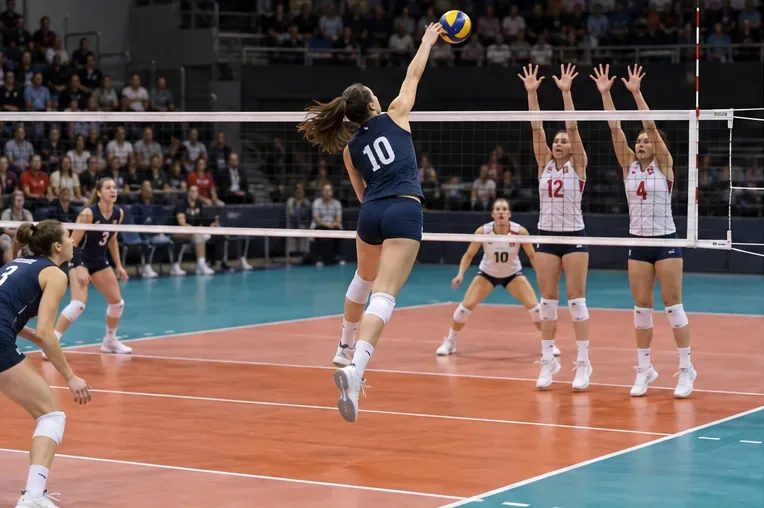
For the standard indoor game, the cleanest review separates three questions: Was the hitter a back-row player in the rotation? Where did the player’s foot or feet leave the floor? And, if the attack began in the front zone, was any part of the ball below the top of the net at contact? The current FIVB rule set is the Official Volleyball Rules 2025–2028. Local, school, or league competitions may use a different rulebook, so use the governing rules for the match.
“Back row” describes the player’s rotational position, not simply where the player happens to stand when the setter releases the ball. Once the serve is hit, players can move around the court. A back-row player may move forward to attack, and a front-row player may retreat to defend. When reviewing a disputed attack, first check the lineup or rotation record to establish whether the hitter is designated as a back-row player.
This first check prevents a common error: treating every athlete who approaches from the back of the court as a back-row attacker, or assuming that a player standing near the net has become a front-row player. Under FIVB Rule 7.4, the lineup establishes the three front-row positions and three back-row positions. Movement during the rally does not by itself change that role.
The attack line is three meters from the center line and marks the front zone. For a back-row player to attack a ball at any height from behind that zone, the player’s foot or feet at takeoff must not have touched or crossed the attack line. In practical terms, if the player’s last contact with the floor includes a foot on or over the line while launching into the jump, the back-row attack restriction has been violated.
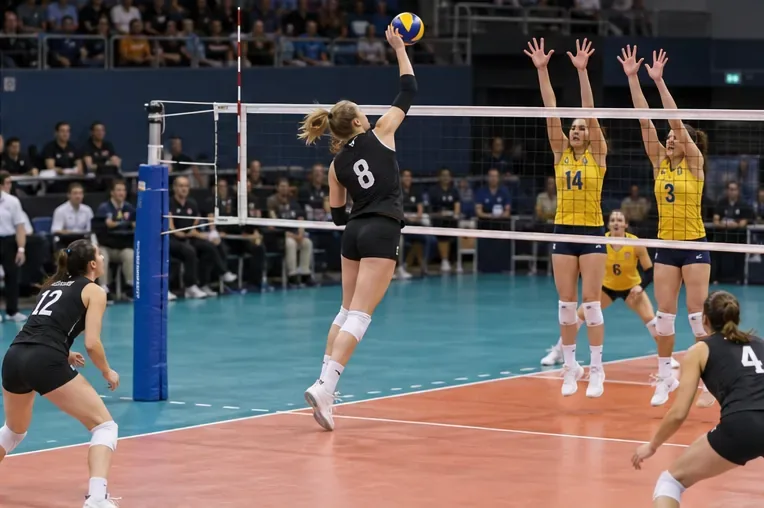
Rewind the footage to the final floor contact before the player becomes airborne. Freeze the frame only if the camera angle shows the line and the takeoff foot clearly. A low or diagonal camera can make a shoe look beyond the line when it is behind it, or hide a toe that is on the line. If the frame does not resolve the position, the footage may not support a confident call; avoid treating a blurry angle as proof.
Do not stop at the landing. The FIVB rule explicitly allows a back-row player who took off legally from behind the attack line to land in the front zone after the hit. A player can therefore jump from the back court, swing above or near the net, and come down inside the three-meter area without committing this particular fault. Landing is not a substitute for takeoff evidence.
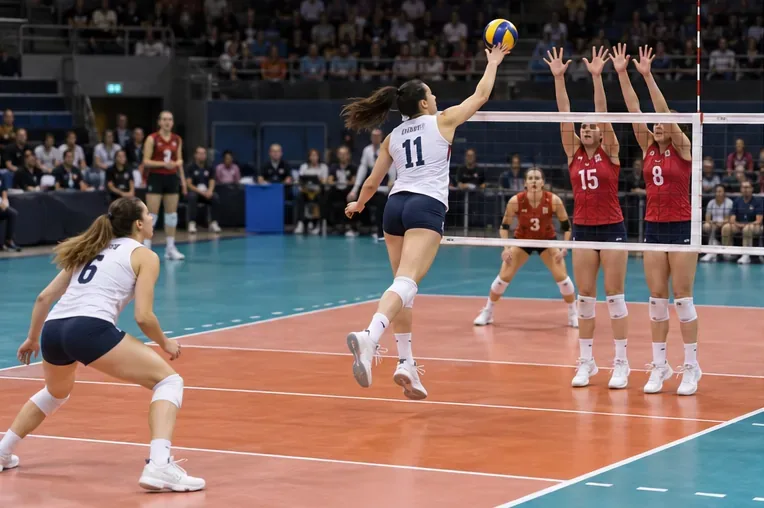
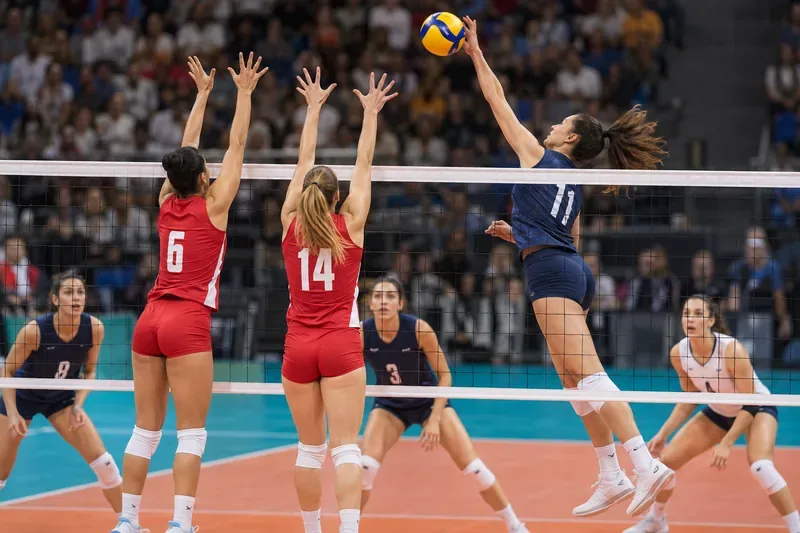
Ball height matters when the back-row player completes the attack from the front zone. That includes a player who takes off in the front zone rather than behind the attack line. Under Rule 13.2.3, that attack is allowed if, at the instant of contact, a part of the ball is lower than the top of the net. If the entire ball is above the top of the net at contact, the attack is a fault under Rule 13.3.3.
Look at the whole ball, not its center and not where it travels a fraction of a second later. A ball may be mostly above the net while its lower edge is still below the top tape; that is not “entirely higher.” Conversely, if the entire ball is clearly above the net when struck from the front zone by a back-row player, the exception does not apply. The rule’s reference point is the instant of contact, so a frame showing the ball already moving away can give the wrong impression.
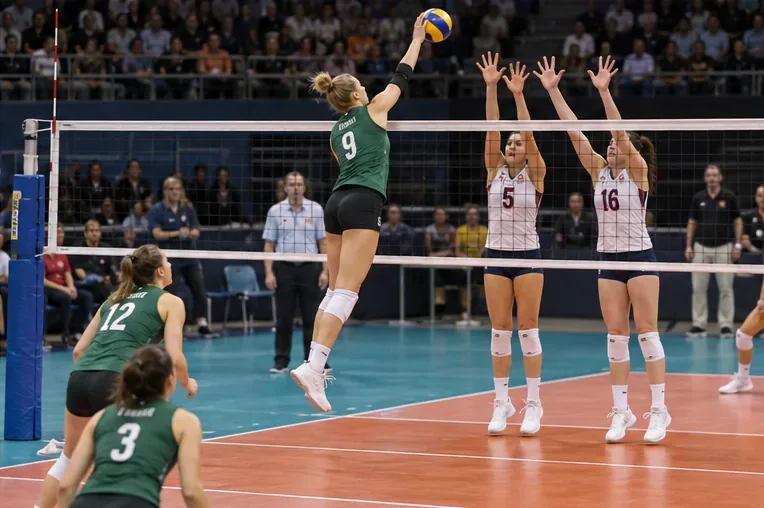
If the player took off behind the line without touching or crossing it, the player may attack from that jump at any height—even if the ball is entirely above the net—and may land in the front zone. The ball-height exception is not a general requirement for all back-row attacks; it applies to an attack from the front zone. Keeping those situations separate resolves many replay arguments.
A libero has a separate restriction: the libero may not complete an attack hit from anywhere if, at contact, the ball is entirely higher than the top of the net. That rule applies even when the libero attacks from behind the attack line. Also separate an attack on the opponent’s serve from an ordinary attack: under the FIVB rules, no player may complete an attack on the opponent’s service when the ball is in the front zone and entirely above the net. These rules can produce similar-looking calls but use their own conditions.
A front-row player is not subject to this back-row attack restriction, though other rules still apply. A hit that goes out, a net fault, or an illegal contact is judged separately. The back-row attack rule asks about the player’s rotational role, takeoff location, and—when the player attacks from the front zone—the ball’s height at contact.
Before accepting or disputing a back-row attack fault, write down four facts: the hitter’s rotational position; the takeoff foot position relative to the attack line; whether the attack began from behind or within the front zone; and, only for a front-zone attack, whether the ball was entirely above the net at contact. If the player launched from behind the line and later landed in front, the landing alone is not a fault. If the player launched from the front, compare the full outline of the ball to the net top at contact. If any decisive point is hidden, classify the clip as inconclusive and seek another angle or the referee’s explanation.
That checklist keeps the call tied to observable rule conditions rather than the visual drama of the landing or the height of the jump. For exact wording, use FIVB Official Volleyball Rules 2025–2028, especially Rules 1.3.4, 1.4.1, 7.4, 13.1–13.3, and 19.3.1.2; other competitions can publish their own interpretations or modifications.
See how opponent strength, six possible set scores, and event weight shape FIVB ranking points—and how to check a match’s likely impact.
A volleyball screen is more than standing in front of a server. Under current FIVB and USA Volleyball rules, learn what actions create a screening fault and what does not.
Learn when touching the volleyball net costs a point, which contact can be legal under FIVB and USA Volleyball rules, and why timing and interference matter.
Learn when a volleyball setter dump is legal under FIVB rules, including double contacts, back-row attack limits, the 3-meter line and 2026 rule tests.
Learn when a back-row attack is a fault: check the player’s takeoff at the attack line, ball height at contact, and why landing position can mislead.
Can a libero serve? Compare current FIVB, NCAA women’s and men’s, and 2026–27 NFHS high-school rules, including the one-position limit and two-libero exception.
Learn the FIVB-style order for breaking volleyball pool ties: wins, match points, set ratio, point ratio, then head-to-head results.
Learn which players must stay in rotational order at service, how referees judge volleyball overlap by foot position, and how 2026 FIVB rule tests change the timing.
A practical guide to volleyball video challenges: which calls can be reviewed, how many challenges teams get per set, timing rules, outcomes, and 2026 FIVB tests.