FIVB Ranking Points Explained: Opponent Strength and Match Results
See how opponent strength, six possible set scores, and event weight shape FIVB ranking points—and how to check a match’s likely impact.
A team can win a volleyball match and still lose FIVB ranking points. A heavy favorite may be expected to win in straight sets, while a lower-rated team may be expected to push the match to five. The ranking system compares the scoreline with that pre-match expectation, so a win is not automatically a large gain and a loss is not always a deduction.
This guide covers the FIVB senior indoor national-team World Ranking. It explains how opponent strength, set score and event importance affect the update, how to check a specific match, and where a simple explanation stops short of reproducing the official calculation. The FIVB launched its current dynamic system on February 1, 2020, using official match results dating back to January 1, 2019. Its system announcement says the model uses both teams’ scores and historical match data to estimate the probabilities of six possible set-score outcomes.
Each senior national team has a World Ranking score, often shown as ranking points. After an eligible match, the teams’ scores are adjusted according to how the actual result compares with what the model expected. A team’s total is therefore not simply a pile of fixed awards for tournament placement, nor is it the same as match points used to sort a pool table.
The ranking page updates as eligible matches are played. It reflects performance across recognized official competitions, rather than only a team’s finish at its most recent championship. An ordinary friendly, domestic club match or other non-eligible fixture should not be assumed to change the senior World Ranking. Check the FIVB rankings page for the current ranking and official information.
The opponent matters because the two teams’ current World Ranking scores help establish their relative strength. In practical terms, a much stronger team is more likely to win, and a likely winner is more likely to take the match in fewer sets. An upset therefore usually moves the result farther away from expectation than a routine win over a lower-rated opponent.
The model does not treat the published rank number as a simple bonus multiplier. A gap between two teams’ ranking scores informs the probability of each scoreline. Historical match results also inform those probabilities. A rank position by itself does not tell you exactly how many points either team will gain or lose.
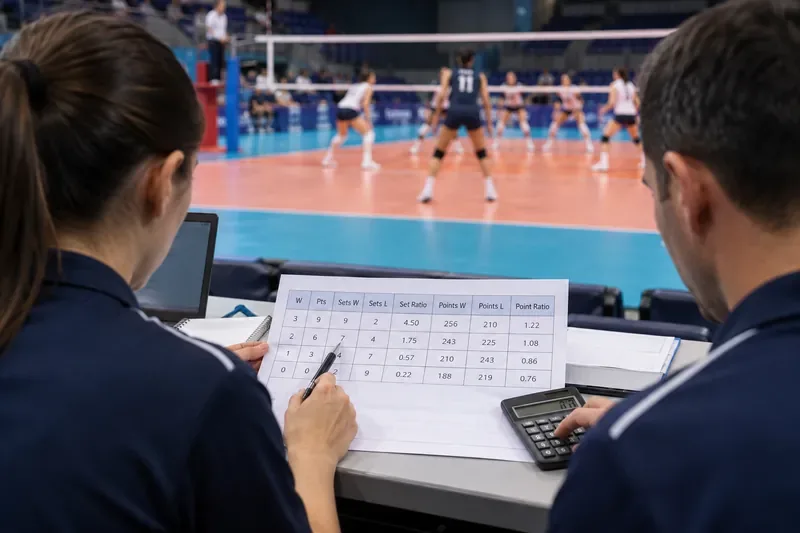
For a best-of-five match, the six possible final scorelines are 3–0, 3–1, 3–2, 2–3, 1–3 and 0–3. The model estimates the probability of each one before the match. It then compares the actual scoreline with that distribution. The closer the actual result is to the most expected outcome, the smaller the ranking adjustment tends to be; a result that strongly exceeds or falls short of expectation creates a larger change.
| Pre-match situation | What the scoreline can signal |
|---|---|
| A clear favorite wins 3–0 | A result close to expectation; the gain may be modest. |
| A clear favorite wins 3–2 | Winning still counts, but dropping two sets may be below the expected performance and can reduce or reverse the change. |
| An underdog loses 2–3 | The loss may still outperform a pre-match expectation of a straight-set defeat, so the underdog can gain ranking points. |
| An underdog wins 3–0 | A major upset can produce a larger positive adjustment than a routine victory, depending on the ratings and event weight. |
These are directional examples, not point forecasts. The exact adjustment depends on the ratings immediately before the match, the actual set score and the competition’s Match Weight Factor. No row should be read as a guaranteed numerical outcome.
Eligible competitions carry a Match Weight Factor (MWF), which changes the influence of a match on the ranking. The FIVB’s ranking explainer describes higher weight for more prestigious competitions. In February 2026, the FIVB announced an MWF of 20 for Zonal Association and Recognised Volleyball Associations events. Because event rules and factors can be revised, use current FIVB information rather than an old list of event values when comparing a particular fixture.
A higher-weight match can magnify the effect of both exceeding expectations and falling short. That makes “strong opponent” only part of the story: the event’s status matters too. The FIVB’s June 2025 update also revised its overlapping-events rule. Where the same team appears in overlapping eligible events, that team scores ranking points only from the event with the higher Match Weight Factor and stronger position on the World Ranking event table; other teams in both competitions continue to have their results recognized. Read the June 2025 rule update before interpreting an unusual calendar clash.
For VNL fixtures, the FIVB described a schedule feature that displays the ranking points available for each of the six possible outcomes and highlights the actual result after play. The VNL ranking-points tool announcement explains why a match’s projections are set after the teams’ preceding matches: those results change their scores. Availability and interface details may vary by competition and season, so use the current event page if the feature is shown.
A useful check is whether the observed scoreline was surprising relative to the teams’ pre-match strengths. If a top team wins as expected, a small gain—or little movement—can be consistent with the model. If a lower-rated team takes the match, a larger shift is plausible. If a favorite wins narrowly, the outcome may be less impressive in ranking terms than the win-loss column alone suggests.
Then check the event weight and confirm the match counted. A score movement that looks odd may reflect an event’s eligibility, a competition rule, or an updated pre-match rating rather than a different reward for each set won. The FIVB’s 2026 governance update also removed the previously applied 50-point inactivity penalty and says teams that have never competed can re-enter the ranking with zero points; it assigned MWF 20 to the specified zonal and recognized volleyball-association events. This is relevant context when reading newer score histories, not a formula for any one match.
The system is probabilistic, so a single match does not prove that one team is permanently stronger or weaker. Rankings summarize results in eligible matches under a defined model; they do not adjust for a particular lineup change, injury, travel burden or tactical matchup unless that factor is reflected through results and the model’s inputs. Nor should a ranking-point update be confused with an Olympic qualification decision: qualification uses the governing event’s published rules and ranking snapshot.
The FIVB’s public explanations describe the logic, but a hand calculation from team positions alone cannot reproduce a current match’s exact point change. For a dependable check, verify the latest score, event eligibility, set score and MWF in the official ranking or competition interface. The result you want is a clear account of why the change moved up or down—not an unsupported estimate based only on who won.
See how opponent strength, six possible set scores, and event weight shape FIVB ranking points—and how to check a match’s likely impact.
A volleyball screen is more than standing in front of a server. Under current FIVB and USA Volleyball rules, learn what actions create a screening fault and what does not.
Learn when touching the volleyball net costs a point, which contact can be legal under FIVB and USA Volleyball rules, and why timing and interference matter.
Learn when a volleyball setter dump is legal under FIVB rules, including double contacts, back-row attack limits, the 3-meter line and 2026 rule tests.
Learn when a back-row attack is a fault: check the player’s takeoff at the attack line, ball height at contact, and why landing position can mislead.
Can a libero serve? Compare current FIVB, NCAA women’s and men’s, and 2026–27 NFHS high-school rules, including the one-position limit and two-libero exception.
Learn the FIVB-style order for breaking volleyball pool ties: wins, match points, set ratio, point ratio, then head-to-head results.
Learn which players must stay in rotational order at service, how referees judge volleyball overlap by foot position, and how 2026 FIVB rule tests change the timing.
A practical guide to volleyball video challenges: which calls can be reviewed, how many challenges teams get per set, timing rules, outcomes, and 2026 FIVB tests.