FIVB Ranking Points Explained: Opponent Strength and Match Results
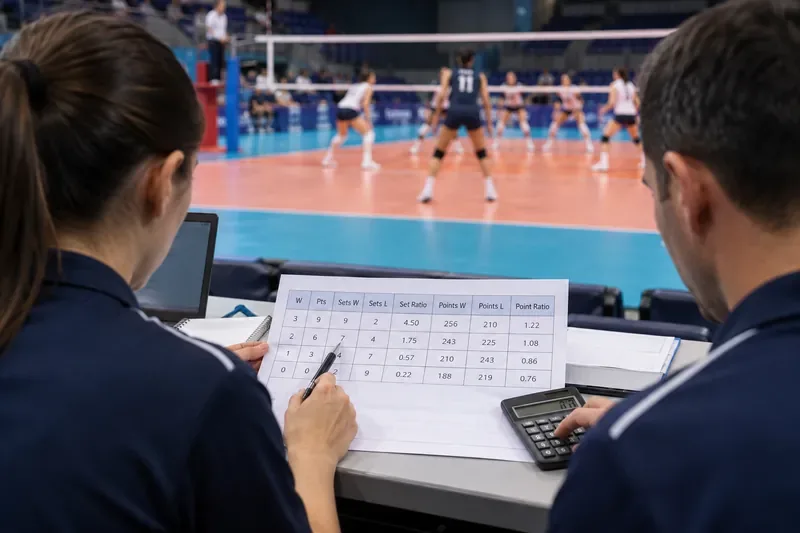
See how opponent strength, six possible set scores, and event weight shape FIVB ranking points—and how to check a match’s likely impact.
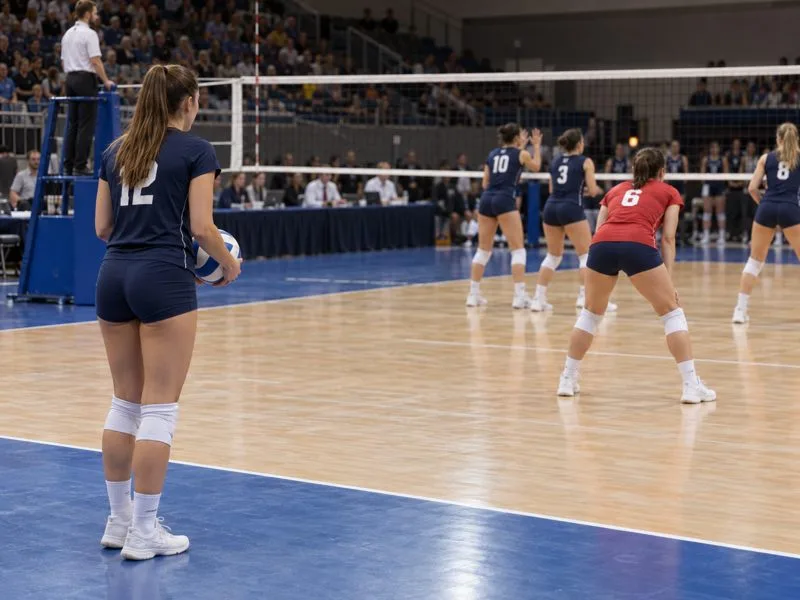
A volleyball “overlap” is a positional fault: at the rules-defined moment of service, a player on the receiving team is out of order relative to a teammate. Under the standard FIVB indoor rules for 2025–2028, the check happens when the server hits the ball. The receiving team must be in its rotational order then; the serving team may occupy any positions within its court, except that the server is outside the court in the service zone.
There is an important 2026 exception. The FIVB is testing a different timing rule at the 2026 Volleyball Nations League, FIVB U17 World Championships, and 2026 Continental Championships: receivers must be correctly rotated at the referee’s whistle, but may move as soon as the server begins the service action. The trial is not a universal change to the rulebook. If you are coaching, officiating, or watching a particular event, confirm which rule set that competition is using.
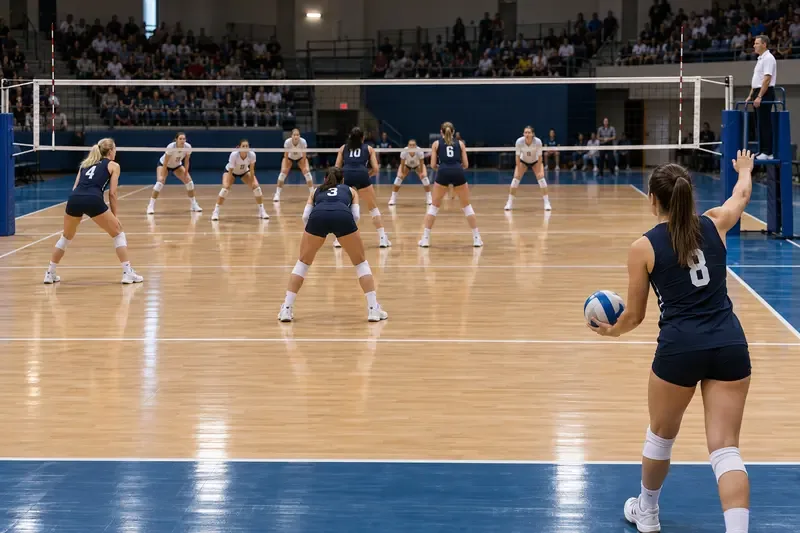
Each team has six numbered court positions. When a team wins the right to serve, its players rotate one place clockwise: the player moving from position 2 to position 1 becomes the next server. The lineup sheet records each player’s rotational place for that set. The positions are not permanent playing assignments; after the service hit, players may move into their specialized roles, such as a setter moving toward the target area.
| Row | Left | Center | Right |
|---|---|---|---|
| Front row, nearest the net | 4 | 3 | 2 |
| Back row | 5 | 6 | 1 |
Think of these numbers as the team’s court-position order, viewed from that team’s side while facing the net. A player can be only a step from a teammate and still be legal; the rule does not require equal spacing. It requires that the relative order be correct at the specified moment.
For the standard FIVB rule, the second referee is responsible for deciding and signaling positional faults by the receiving team. The first referee handles the server’s faults and the serving team’s position-related faults, including screening. The practical overlap check is therefore mainly about the receivers’ feet and their relationship to the corresponding front- and back-row teammates.
Each back-row player must be level with or behind the corresponding front-row player at service contact. The three pairs are position 1 behind or level with position 2, position 6 behind or level with position 3, and position 5 behind or level with position 4. “Behind” means farther from the center line and net. If position 6 is ahead of position 3 when the ball is hit, that is an overlap even if the players’ shoulders or bodies appear aligned.
Players in each row must also keep their lateral sequence. In the front row, position 4 stays to the left of 3, and 3 stays to the left of 2. In the back row, position 5 stays left of 6, and 6 stays left of 1. The left and right players must remain on the proper sides of their row’s central player.
The FIVB rule judges position by the feet contacting the floor. A player’s last contact with the floor fixes that player’s position. The rule’s foot test allows a player to be level with a teammate; it does not require a visible gap between them. Arms, shoulders, and torso can cross visually without creating an overlap if the feet meet the positional requirements.
| Question | Standard FIVB 2025–2028 rule | 2026 FIVB competition test |
|---|---|---|
| When must the receiving team be in order? | At the instant the server hits the ball | At the referee’s whistle |
| Can receivers move before ball contact? | No; they may move after the service hit | Yes, once the server begins the service action |
| Where does the trial apply? | Default rule outside an adopted variation | 2026 VNL, FIVB U17 World Championships, and 2026 Continental Championships |
The tradeoff is practical. Under the standard rule, a team must hold its legal receive alignment until contact, which makes the foot-position check straightforward but can delay the receiver’s first move. Under the 2026 test, the team must be in order at the whistle and can begin moving when the server’s motion starts, giving receivers more freedom to move early. A coach should teach the version that applies at the team’s next competition; practicing only the trial timing can create a fault in a tournament using the standard rule.
The FIVB announced these as tests for named competitions during the 2026 international season and said any update to the official rules would be reviewed after the testing phase. Check the event regulations or referee briefing rather than assuming a rule test applies to every league, school match, or club tournament.
If the receiving team is out of position at the applicable check point, the team commits a positional fault. Under the standard FIVB rule, the opponent receives a point and the next service, and the players’ positions must be corrected. The second referee’s viewpoint and the scorer’s lineup information help officials judge the fault.
Officials also apply a priority rule when two faults happen together. If the server commits a fault at the moment of contact—for example, the wrong player serves or the service is improperly executed—the serving fault is counted before the opponent’s positional fault. If the service was correctly executed but then becomes faulty, such as going out after contact, a receiving-team positional fault that occurred first is sanctioned. This distinction can affect who receives the point, so “the ball landed out” does not by itself settle a disputed overlap call.
The safest way to read an overlap call is to ask three questions: Which team is receiving? What is the service-position deadline in this competition? And where were the players’ feet at that instant? Those answers separate a real positional fault from a legal tactical formation.
See how opponent strength, six possible set scores, and event weight shape FIVB ranking points—and how to check a match’s likely impact.
A volleyball screen is more than standing in front of a server. Under current FIVB and USA Volleyball rules, learn what actions create a screening fault and what does not.
Learn when touching the volleyball net costs a point, which contact can be legal under FIVB and USA Volleyball rules, and why timing and interference matter.
Learn when a volleyball setter dump is legal under FIVB rules, including double contacts, back-row attack limits, the 3-meter line and 2026 rule tests.
Learn when a back-row attack is a fault: check the player’s takeoff at the attack line, ball height at contact, and why landing position can mislead.
Can a libero serve? Compare current FIVB, NCAA women’s and men’s, and 2026–27 NFHS high-school rules, including the one-position limit and two-libero exception.
Learn the FIVB-style order for breaking volleyball pool ties: wins, match points, set ratio, point ratio, then head-to-head results.
Learn which players must stay in rotational order at service, how referees judge volleyball overlap by foot position, and how 2026 FIVB rule tests change the timing.
A practical guide to volleyball video challenges: which calls can be reviewed, how many challenges teams get per set, timing rules, outcomes, and 2026 FIVB tests.