Home
» 🏑 Field Hockey
»
What Makes a Legal Drag Flick? Dangerous Play and First-Shot Height Rules Explained
What Makes a Legal Drag Flick? Dangerous Play and First-Shot Height Rules Explained
A penalty-corner drag flick can rise well above the backboard and still be legal. The key is the striking technique and the danger it creates—not a blanket height ceiling for every first shot. Under the FIH Rules of Hockey effective March 1, 2026, the 460 mm limit applies to a first shot that is a hit. A first-shot flick has no equivalent height limit, but it can still be penalized as dangerous play.
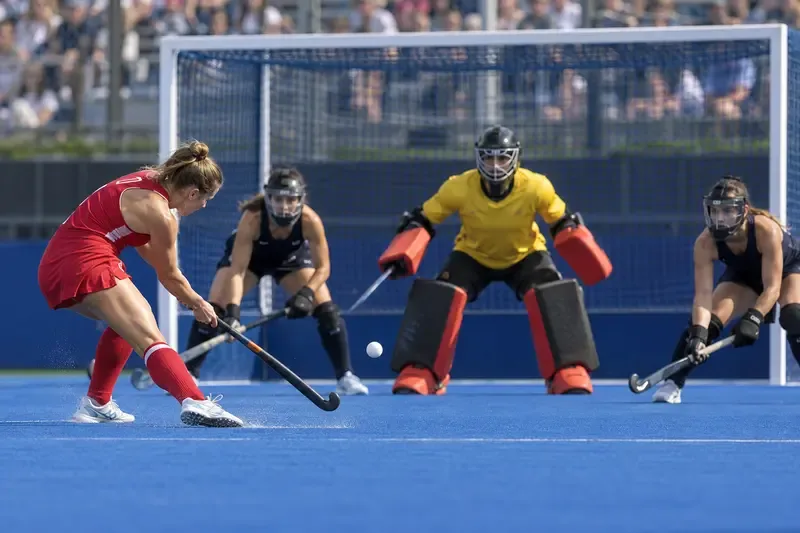
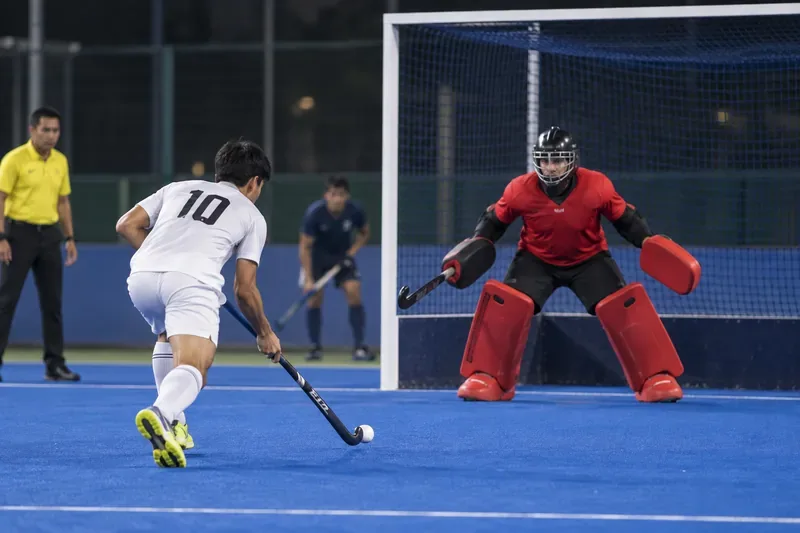
A drag flick rises toward goal during a penalty corner as the goalkeeper and masked defenders react.
This distinction matters when reviewing a goal, a whistle, or a coach’s instruction. “It went over the backboard” does not by itself tell you whether a drag flick was legal. You need to know whether the first shot was a hit or a flick, where the ball was headed, and whether a nearby defender faced a genuine safety risk.
What is a drag flick?
A drag flick is a penalty-corner shot in which the attacker draws or drags the ball along the stick before releasing it with a flicking action, lifting it toward goal. It is different from a hit, which is made with a swinging movement of the stick toward the ball. The distinction is important because Rule 13.3(l) sets a height condition for a first shot that is a hit, while Rule 13.3(m) addresses flicks, deflections, scoops, and later hits.
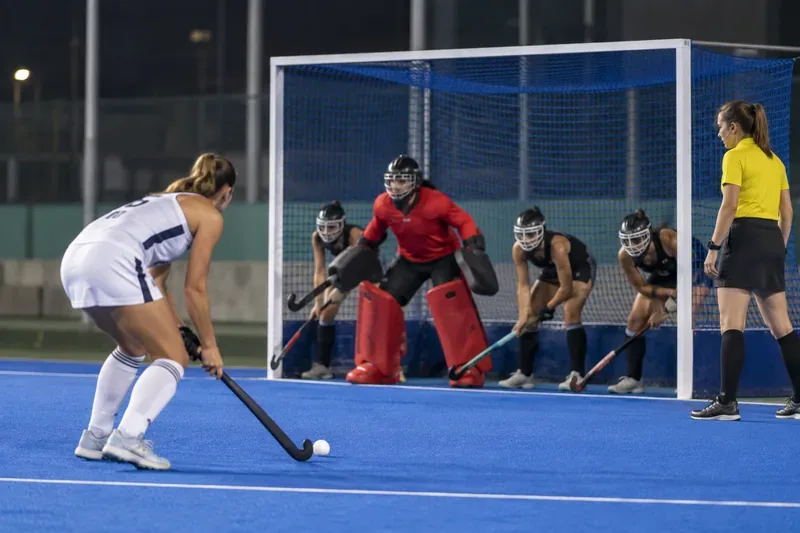
At a penalty corner, the initial injection must be pushed or hit from the back line without intentionally raising the ball. An attacker cannot score until the ball has traveled outside the circle. Once the first shot at goal is taken, the relevant height and safety rules depend on how that shot was played.
The quick rule: 460 mm applies to a first-shot hit
The backboard is 460 mm high. If the first shot at goal is a hit, the ball must cross the goal line—or be on a path that would have crossed it—at no more than 460 mm before any deflection for a goal to count. It can travel above that height earlier in its flight if it is not dangerous and would drop below 460 mm before reaching the line. A defender’s touch does not erase the requirement: the rule still applies if the ball touches a defender before the goal line.
A flick is treated differently. The FIH rule permits a flick as the first shot to be raised to any height, subject to the dangerous-play rule. The same safety condition applies to second and later hits, flicks, deflections, and scoops. “Any height” therefore means there is no stated 460 mm ceiling for those shots; it does not mean every trajectory is safe or legal.
Situation
Height rule
Safety rule
First shot is a hit
Must reach the goal line at 460 mm or lower, before any deflection, for a goal to count.
Must not be dangerous.
First shot is a flick
No 460 mm ceiling.
Must not be dangerous.
Second or later shot, including a hit
No 460 mm ceiling under Rule 13.3(m).
Must not be dangerous.
The operative wording is in Rule 13.3(l)–(m) of the FIH Rules of Hockey. This is why a video clip of a high first shot needs to be classified before judging it: a high first hit and a high first flick do not face the same height test.
When can a drag flick be dangerous?
Rule 9.8 prohibits playing the ball dangerously or in a way that leads to dangerous play. The rules also treat a ball as dangerous when it causes an opponent to take legitimate evasive action. For flicks and scoops, directing the ball toward an opponent within 5 metres is considered dangerous. The umpire must judge the actual play, including the ball’s line and speed, the distance, the defender’s position, and whether the defender’s reaction was a genuine attempt to avoid being hit.
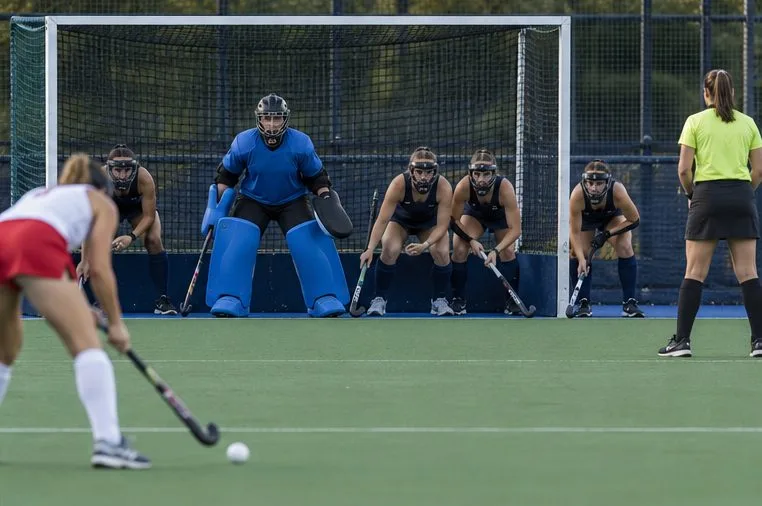
Penalty-corner shots have an additional, specific test for a defender within 5 metres of the first shot. If that defender is struck below the knee, another penalty corner is awarded. If the ball strikes the defender on or above the knee while the defender is in a normal stance, the shot is judged dangerous and the defending team receives a free hit. The rule also makes clear that a defender who clearly runs into the shot or into the shooter without trying to play the ball with the stick should be penalized for dangerous play. A defender cannot create an infringement simply by charging into a shot.
The phrase “in a normal stance” matters. If the defender is crouching, falling, or otherwise not in a normal stance when struck, the knee-height example cannot be applied mechanically. The umpire still evaluates danger under the full rule and the circumstances. Likewise, the 5-metre and body-contact outcomes are specific to the first shot in a penalty corner; they should not be copied onto a later phase of play without checking the applicable rule.
How to judge a disputed shot fairly
Identify the first shot. Follow the sequence from the injection and determine which attempt was the first shot at goal. A rebound or second attempt may have a different height rule.
Classify the technique. Was the ball hit with a swinging action, or flicked with a lifting release? Do not rely only on how high the ball flew.
For a first hit, check the goal-line path. Measure the ball’s height as it crosses, or would cross, the line before a deflection. Earlier height in the flight is not enough by itself to decide the 460 mm question.
Check danger separately. Note defenders within 5 metres, the direction of the shot, whether someone was struck, where on the body the ball made contact, and whether the defender was in a normal stance or ran into the shot.
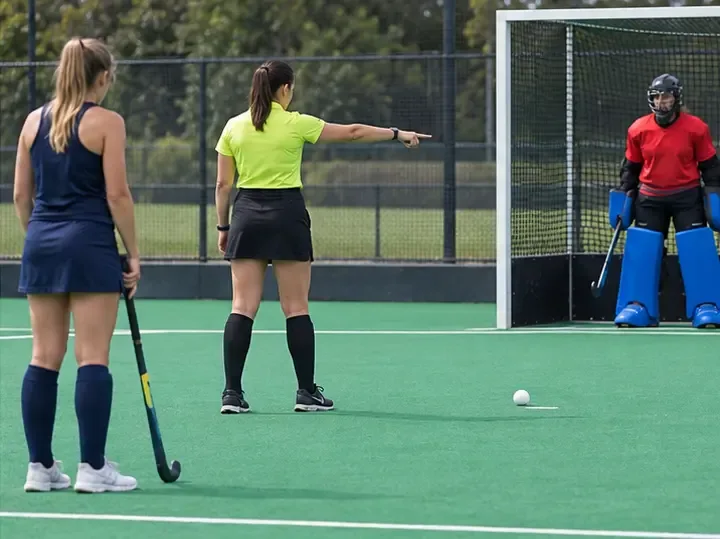
Apply the correct restart. A low contact below the knee with a defender within 5 metres of the first shot brings another penalty corner; contact on or above the knee in a normal stance makes the shot dangerous and gives the defense a free hit. If the defender caused the danger by charging into the shot without attempting to play it, the defender may instead be penalized.
When using replay, start with the first frame showing the shooter’s contact and follow the ball to the defender or goal line. A single still image can conceal whether the shot was a hit or a flick, whether a touch occurred before the line, or whether the defender moved into the ball. Treat those as separate questions instead of using height alone as a verdict.
What a legal shot should achieve—and what the rule cannot tell you
For the attacker, the practical target is a controlled flick that threatens goal without directing the ball dangerously at a nearby defender. For the defender, the practical target is a stick-first attempt to stop or deflect the ball while avoiding a late charge into its path. For an umpire or viewer, a sound assessment separates the hit-height test from the dangerous-play test and applies each to the right moment.
The rules provide a decision framework, but they do not turn every close call into a purely numerical judgment. “Dangerous,” “legitimate evasive action,” and “normal stance” still require an umpire to assess what happened in context. Camera angle, frame rate, obstruction, and whether the ball was deflected can limit what a broadcast replay proves.
The FIH says the 2026 Rules of Hockey took effect internationally on March 1, 2026, and that national associations may set their own implementation dates. For a domestic, school, or age-group match, check the governing association’s current rules and competition regulations before applying the international edition. The FIH’s official Rules of Hockey documents page is the best starting point for the current text.