Home
» 🏑 Field Hockey
»
Can Field Hockey Players Use Both Sides of the Stick? Common Foul Examples Explained
Can Field Hockey Players Use Both Sides of the Stick? Common Foul Examples Explained
Short answer: no. In outdoor field hockey, players may not play the ball with the back, or rounded non-playing side, of the stick. The legal playing side is the flat face identified by the International Hockey Federation (FIH), plus the edges of that face. That does not mean every use of an edge is automatically legal: a hard forehand edge hit is specifically prohibited.
The rule is simple to state but easy to misread in live play because skilled players constantly rotate the stick. A legal reverse-stick reception or shot can look as though the "other side" is being used when the player has actually turned the stick so the flat playing face still contacts the ball.
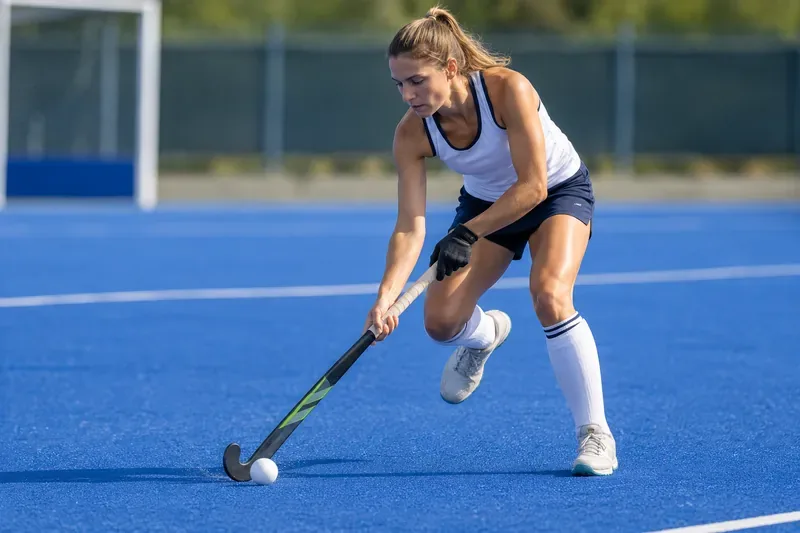
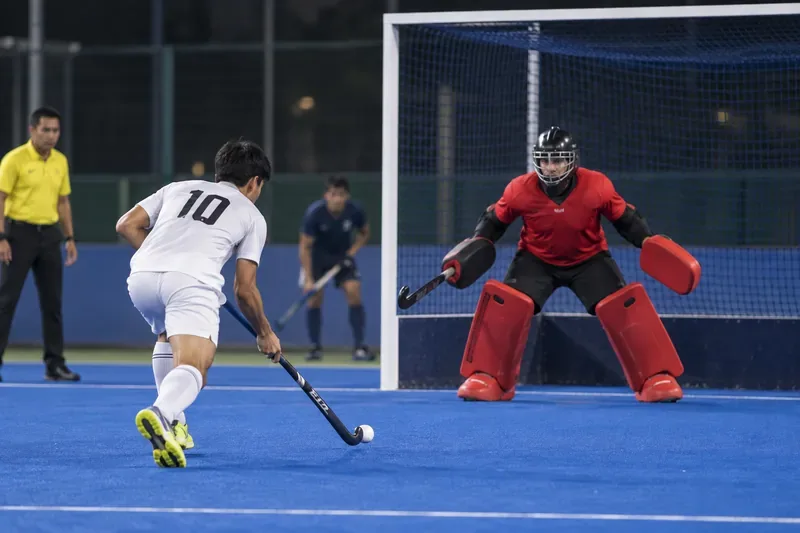
A field hockey player controls the ball with the stick rotated so the legal flat playing face is presented to the ball.
What the current FIH rule says
The governing source is the FIH Rules of Hockey page. FIH lists the Rules of Hockey 2026 as the current outdoor rulebook, effective from March 2026. FIH has also approved the 2027 rules, but those are scheduled to take effect on November 1, 2026, so the March 2026 rules remain the relevant reference for matches played before then.
Rule 9.5 in the FIH Rules of Hockey 2026 states that players must not play the ball with the back of the stick. The equipment specification adds a useful detail: the playing side is the entire designated face shown in the stick diagrams and the edges of that side. The opposite side is the rounded, non-playing side.
Quick reference: what is legal and what is not?
Situation
Usually legal?
Why
Push, trap or dribble with the flat face
Yes
The ball is being played with the designated playing side.
Reverse-stick shot after rotating the stick
Yes, if otherwise safe
The stick is turned so the legal playing face contacts the ball.
Ball contacted by the rounded back of the stick
No
Rule 9.5 prohibits playing the ball with the back of the stick.
Controlled use of an edge connected to the playing face
Potentially
The edges belong to the playing side, but other conduct rules still apply.
Hard forehand edge hit
No
Rule 9.6 specifically prohibits hitting the ball hard on the forehand with the edge.
Why reverse-stick play is not the same as using both sides
This is the most common source of confusion. A player can receive, pass or shoot on the reverse side of their body by rotating the stick in the hands. The body position may be "reverse," but the contact surface can still be the flat playing face. In other words, the legal distinction is about which surface of the stick touches the ball, not whether the player is on the forehand or reverse side of their stance.
A useful visual check is to watch the face of the stick immediately before contact. If the flat face has been rotated toward the ball, the action may be legal. If the curved back makes the controlling contact, it is a back-stick offence.
Common back-stick foul examples
1. A first touch rolls onto the rounded back
A player tries to cushion a pass, but the stick rotates too far and the ball is stopped by the rounded side. Even if the movement is gentle, the relevant question is whether the player actually played the ball with the back of the stick. This is different from the ball merely glancing off equipment without the player gaining an advantage; umpires also apply the general advantage principle when deciding whether to stop play.
2. A player dribbles around a defender without rotating the stick enough
During a tight change of direction, a player may attempt to carry the ball from forehand to reverse while leaving the stick face in the wrong orientation. If the rounded back propels or controls the ball, the umpire can penalize the action. Good stick work requires the player to rotate the shaft so the legal face remains available for the next touch.
3. A reverse tackle catches the ball with the back
A defender reaches across with the stick and cleanly contacts the ball before the attacker, but the contact is made with the non-playing side. Winning the ball first does not make that surface legal. A tackle can therefore look clean in terms of body contact yet still be an offence because of the face used.
4. A rushed reverse shot clips the rounded side
On a legal reverse-stick shot, the stick is turned so the flat face strikes the ball. If the player mistimes the rotation and the rounded back makes the meaningful contact, the shot is not legal. In fast play, this can be difficult for spectators to see, which is why the stick orientation at the instant of contact matters more than the overall swing direction.
5. A player tries to "scoop" with the wrong face
Flicks and scoops are allowed when performed legally and safely, but those techniques do not create an exception to Rule 9.5. The player still needs to use the playing side of the stick. A lift made by levering the ball with the rounded back is not made legal simply because the intended technique is a scoop.
Do the stick edges count as a second side?
No. The equipment specification treats the edges adjoining the playing face as part of the playing side, not as a separate legal face. However, Rule 9.6 places an important safety limitation on edge use: players must not hit the ball hard on the forehand with the edge of the stick.
That means "the edge is part of the playing side" should not be simplified into "hard edge hits are fine." A controlled touch, deflection or other legal use may be allowed, but a hard forehand edge strike is specifically excluded.
What penalty follows a back-stick offence?
The restart depends on where the offence happens, which team commits it and whether the offence disadvantages the opponent. Under Rule 12.1, a penalty is awarded only when an opponent is disadvantaged by a breach of the rules. This is the advantage principle, and it explains why an umpire may sometimes allow play to continue after a technical infringement that has no meaningful adverse effect.
When a penalty is required, a back-stick offence is handled under the ordinary penalty framework rather than by a special "back-stick penalty." Common outcomes include:
A free hit to the opposition for an offence between the 23-meter areas.
A free hit to the defense when an attacker commits the offence inside the 23-meter area the opponent is defending.
A penalty corner for a defender's offence in the circle when the offence does not prevent the probable scoring of a goal.
A penalty stroke when a defender's offence in the circle prevents the probable scoring of a goal, or for certain intentional offences in the circle against an opponent with possession or an opportunity to play the ball.
The exact decision can therefore depend on location, intent and impact on the play. A back-stick touch near midfield and a back-stick intervention by a defender in front of goal are not automatically restarted in the same way.
Back-stick versus other stick offences
It helps to separate several rules that can occur in the same action. A player can use the correct face and still commit a foul by playing dangerously, obstructing an opponent or making an illegal tackle. Conversely, a technically gentle touch can still be a back-stick offence if the wrong surface is deliberately used to play the ball.
FIH Rule 9.2 also requires players to hold the stick and not use it dangerously, while Rule 9.8 prohibits dangerous play. So checking only the stick face is not enough to judge an entire sequence.
Practical checklist for players, coaches and spectators
Identify the contact surface. Was the ball played by the flat face or its adjoining edge, rather than the rounded back?
Do not confuse reverse-side body position with reverse-stick illegality. A reverse action can be legal when the stick is rotated correctly.
Check edge use separately. The edge belongs to the playing side, but a hard forehand edge hit is prohibited.
Consider advantage. Not every breach necessarily produces an immediate whistle if the opponent is not disadvantaged.
Then assess the restart. Location and the role of attacker or defender affect whether play restarts with a free hit, penalty corner or penalty stroke.
How to tell whether your technique is legal
For practice, film a short dribbling sequence from the side or slightly in front. Slow the clip just before each forehand-to-reverse transition. You should be able to see the shaft rotate and the flat face reappear toward the ball before contact. If the ball repeatedly touches the rounded back during direction changes, the solution is usually not to "hide" the contact but to improve the timing of the stick rotation.
For coaches, a useful cue is to judge the contact point rather than the player's hand position alone. Two players can hold the stick differently but still present the same legal face to the ball. For spectators, the fastest practical rule is: reverse play is allowed; back-of-stick contact is not.
Bottom line
Field hockey players cannot use both broad sides of the stick to play the ball. Under the current FIH outdoor rules, the ball must be played with the designated playing side, while the rounded back is non-playing. Legal reverse-stick skills work because the player rotates the stick and still uses the proper face. The edges are part of the playing side, but a hard forehand edge hit remains prohibited.
When a back-stick offence occurs, the final umpiring decision also depends on advantage, field position and whether the offender is attacking or defending. For the authoritative wording and current effective version, check the FIH's official rules page and the 2026 rulebook linked above.