Home
» 🏉 Rugby
»
Scrum Reset or Penalty? Rugby Infringements Supporters Often Confuse
Scrum Reset or Penalty? Rugby Infringements Supporters Often Confuse
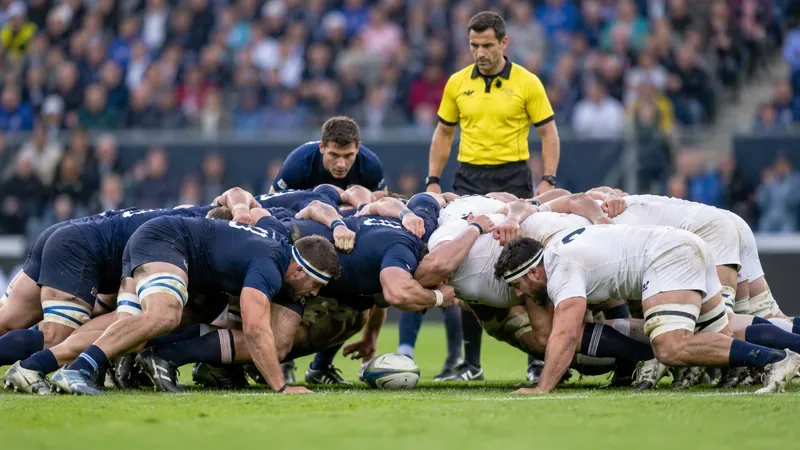
A scrum collapses, the referee whistles, and supporters immediately ask the same question: why was that a reset instead of a penalty? The simplest answer is that a reset is appropriate when the scrum has become unworkable without a clear infringement. A penalty or free-kick is different: it means the referee has identified a specific breach of the laws.
Under the current World Rugby Law 19, that distinction is explicit. A scrum can be reset when it collapses or breaks up, wheels beyond 90 degrees, produces no winner, or has certain accidental ball problems, provided there is no infringement. By contrast, illegal binding, pushing other than straight, intentional collapse, pulling an opponent, scrum offside and several other actions carry sanctions. The current official law text is available in World Rugby Law 19: Scrum.
A scrum that becomes unstable is not automatically a penalty. The referee first decides whether a specific player infringement caused the problem or whether the scrum simply needs to be reset.
When is a scrum reset instead of penalized?
A reset is the neutral outcome. World Rugby Law 19.34 says that when there is no infringement, the referee stops play and resets the scrum in several situations. These include a collapse or break-up before the scrum has otherwise ended, a wheel of more than 90 degrees, neither side winning possession, and some accidental problems involving the ball in the tunnel.
This is why a collapse alone does not prove that one prop has committed an offense. Scrums can lose stability for several reasons at once: footing can go, both packs can change height, pressure can shift, or the front rows can become tangled without the referee having a sufficiently clear basis to blame one side.
In those circumstances, safety comes first. World Rugby’s officiating material tells referees to prioritize safe engagement and to blow early if player safety is at risk. See the official World Rugby scrum officiating guidance.
Does every collapsed scrum mean someone should be penalized?
No. This is probably the most common misunderstanding among spectators.
Law 19.25 requires the referee to whistle immediately if a scrum collapses or if a player is lifted or forced upward. That whistle is primarily a safety action. The referee must then decide what caused the collapse. If no infringement is identified, the result can be a reset. If the collapse was intentional or caused by an identifiable illegal action, a sanction follows.
For example, imagine both front rows are initially square and legal, but the surface gives way and the scrum drops. If the referee cannot identify illegal conduct, resetting is consistent with the law. Now compare that with a prop deliberately folding the scrum downward to escape pressure. World Rugby classifies intentional collapsing as dangerous play and the sanction is a penalty.
What scrum actions are penalties?
Several common scrum offenses are penalties rather than resets. The most useful ones for supporters to recognize are these:
Action
Typical sanction under Law 19
Why it matters
Illegal prop bind
Penalty
Props must bind correctly on the opponent’s jersey and maintain that bind.
Pushing sideways or at an angle
Penalty
Players may push only straight and parallel to the ground.
Pulling an opponent
Penalty
World Rugby lists this as dangerous scrum play.
Intentionally lifting an opponent
Penalty
This can place front-row players in a dangerous position.
Intentionally collapsing
Penalty
This is expressly prohibited as dangerous play.
Intentionally falling or kneeling
Penalty
The law specifically prohibits it.
Scrum offside
Penalty
Scrum-halves and non-participating players have defined offside lines.
The key supporter’s test is not “did the scrum go down?” but “did the referee see an illegal action that caused or accompanied it?”
Why is illegal binding such a big issue?
Binding controls the shape and safety of the front row. Under Law 19.11, the loose-head prop must bind with the left arm inside the opposing tight-head’s right arm, while the tight-head binds outside the loose-head’s left upper arm. Each prop must grip the back or side of the opponent’s jersey, and that binding must be maintained.
A prop who slips onto the arm, loses the bind and fails to re-establish it, or uses a position that prevents a legal contest may be penalized. To a television viewer, the visible result may simply be a collapsing scrum. The referee, however, may have been watching the bind before the collapse happened.
Why can one scrum collapse be a reset and the next one a penalty?
Because the referee judges each scrum on its own evidence.
Suppose the first scrum becomes unstable immediately after engagement, with both sides losing their feet at nearly the same time. The referee may decide there is no clear offender and order a reset. On the next scrum, the referee may clearly see the loose-head prop lose the legal bind and pull downward. That second collapse can produce a penalty.
This can look inconsistent if a viewer watches only the final moment when the packs hit the ground. Referees are usually looking at the entire sequence: alignment before engagement, legal binds, body height, the direction of pressure, whether anyone steps sideways, whether the scrum is stationary before the feed, and what happens after the ball enters.
What does “not pushing straight” actually mean?
Law 19.19 says players may push provided they do so straight and parallel to the ground. The important part is direction. A prop cannot legally drive across an opponent at an angle simply because the pack is moving forward overall.
A common example is a front row that appears dominant but is actually turning the opposing prop inward. If the referee determines that the pressure is illegal rather than simply stronger, the result can be a penalty against the apparently dominant side.
This is also why supporters should be careful with the phrase “they were going backward, so they must have infringed.” Losing ground is not itself an offense. A team can be pushed backward legally.
When does a wheel mean reset rather than penalty?
In the standard 15-a-side law, if a scrum wheels through more than 90 degrees and there is no infringement, Law 19.34 provides for a reset. The same team that previously threw in the ball does so again.
But the word unintentional matters in practice. If the referee sees a team deliberately driving at an angle, illegally pulling, or otherwise causing the rotation through an offense, the outcome can be a penalty rather than a neutral reset.
Supporters watching age-grade rugby should also be careful: World Rugby’s Under-19 variations are different. The Under-19 law replaces the 90-degree provision with an unintentionally wheeled scrum beyond 45 degrees and separately states that intentionally wheeling the scrum is a penalty. See the official World Rugby Under-19 scrum variations.
What scrum mistakes are free-kicks rather than penalties?
Not every technical infringement results in a penalty. Some are free-kicks. This is another area where supporters often lump all whistle outcomes together.
Examples in the current law include failing to be ready to form the scrum within the required time, certain incorrect body positions during the engagement sequence, pushing before the scrum begins, an incorrect scrum feed, and some forms of illegally playing the ball in the tunnel.
One particularly useful distinction is pushing too early. Law 19.17 says teams may push only once the scrum begins, which occurs when the ball leaves the scrum-half’s hands. Pushing before then is a free-kick, not a penalty.
Can the non-offending team choose a scrum after a penalty?
Yes. When a penalty is awarded, the non-offending team may have options depending on where it occurred and the match situation. One of those options can be a scrum. This sometimes creates confusion because spectators hear a penalty whistle and then see another scrum form.
The important point is that the second scrum is not a “reset.” It is a new scrum selected as the restart after a penalty. World Rugby’s Law 19 table specifically includes a scrum option following a penalty. The distinction matters because the original decision was still a penalty.
Why does the referee sometimes talk to the front rows before deciding?
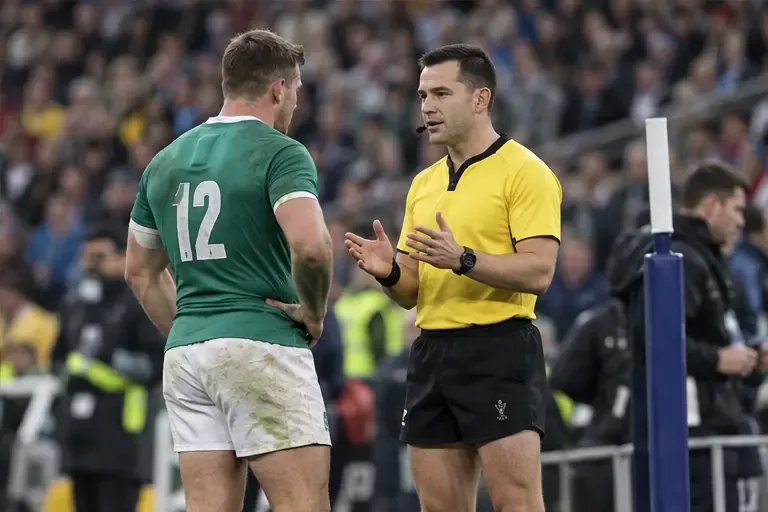
Management is part of scrum officiating. Referees often communicate before engagement, remind players about stability or binding, and use the “crouch, bind, set” sequence to create a controlled formation. The official World Rugby scrum guidance emphasizes a fair contest and a safe engagement.
That does not mean repeated problems will always remain resets. If a referee first sees instability without a clear offense, a reset may be appropriate. If subsequent scrums reveal a repeated illegal pattern, the referee can sanction the responsible team.
How can a supporter tell what the referee probably saw?
Start with the referee’s signal and the restart, then work backward.
Scrum simply set again, same team feeding: likely a reset because no infringement was identified.
Penalty arm raised: the referee has identified a penalty offense such as illegal binding, angled pushing, intentional collapse or offside.
Free-kick signal: look for a technical offense such as an early push, engagement problem or incorrect feed.
Another scrum after a penalty: check whether the non-offending team chose a scrum as its penalty option; that is not the same as a reset.
Television commentary can help, but the official signal is more reliable than assuming the cause from the way the scrum looked on the final frame.
What has changed for 2026?
For the specific reset-versus-penalty distinction covered here, the current World Rugby Law 19 continues to use the same central principle: a reset is available when listed scrum failures occur without an infringement, while identified illegal actions are sanctioned. World Rugby has issued other law application guidance during 2026, including guidance for mauls, but that is separate from the scrum rules discussed here.
Because competitions can use permitted law variations, especially at Under-19, sevens, tens or community levels, supporters should check the competition format before assuming every scrum follows the standard 15-a-side details. The main World Rugby laws portal is available at World Rugby Laws of the Game.
Quick self-check: reset, penalty or free-kick?
When the whistle goes at the next scrum you watch, ask three questions in order:
Was there a clear illegal action? If yes, expect a penalty or free-kick depending on the law breached.
Did the scrum simply become unsafe or unworkable without a clear offender? If yes, a reset is plausible.
What signal did the referee give? The signal tells you whether the decision was a neutral reset, a penalty, or a free-kick.
The most important lesson is that the visual outcome does not determine the sanction. A scrum on the ground can be a reset or a penalty. A scrum going backward can be perfectly legal. A dominant-looking pack can still concede a penalty if it achieved that dominance through an illegal angle or bind. Once you separate the result of the scrum from the cause identified by the referee, many apparently mysterious decisions become much easier to follow.