Home
» 🏉 Rugby
»
Rugby’s 20-Minute Red Card Rule: When a Replacement Is Allowed
Rugby’s 20-Minute Red Card Rule: When a Replacement Is Allowed
A rugby union red card always removes the player who received it for the rest of the match. Whether the team can later replace that player is a separate question. Under World Rugby’s 2026 law, an elite competition may choose to let a team field a replacement after 20 minutes of playing time for some red-card offenses. A deliberate, highly dangerous act remains a permanent numerical loss for the team.
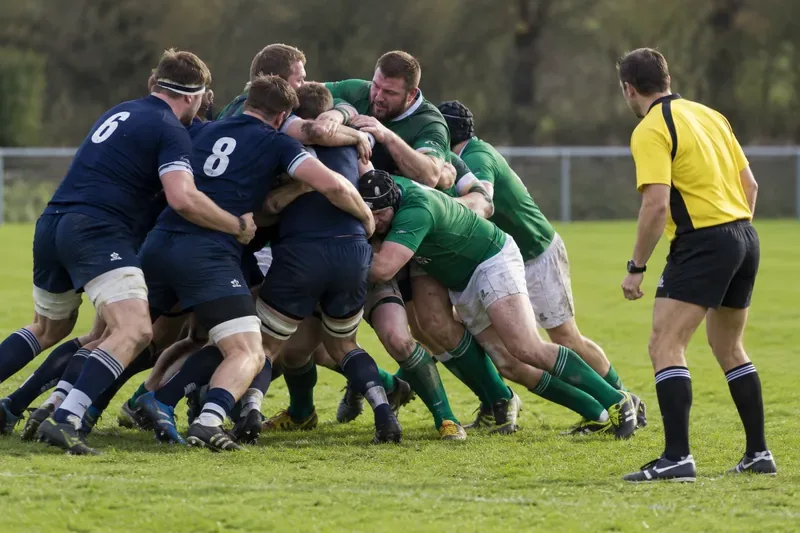
A referee shows a red card during a rugby union match, while nearby players wait for the decision.
The practical question for a viewer is not simply, “Was it a red?” It is: “Does this competition use the 20-minute replacement option, what kind of red was shown, and has the full 20 minutes of playing time elapsed?” Checking those points gives a more reliable answer than assuming every red card works the same way.
What the rule means in 2026
World Rugby approved the 20-minute replacement as a global law trial in 2025 for elite rugby. On June 17, 2026, the Council approved moving several trials into full law, including an option for elite competitions to use 20-minute red cards. The 2026 Laws of the Game now state that, in elite rugby, a player sent off for an action that is not intentional and highly dangerous may be replaced after 20 minutes of playing time. Competitions decide whether to use the option; it is not automatically used in every match or every level.
World Rugby defines elite rugby as professional rugby, with the individual union or competition determining the level at which the specified laws and protocols apply. So a professional setting alone may not tell a spectator enough: the competition’s own match regulations matter. World Rugby’s Law 9 on foul play and its implementation guideline are the key references.
When may a replacement enter?
A replacement is allowed only when all of these conditions are met:
The match is in an elite competition that has adopted the 20-minute red-card option.
The referee’s decision is a qualifying 20-minute red, rather than a permanent red for an intentional, highly dangerous act.
Twenty minutes of playing time have elapsed from the initial incident.
The team has an eligible replacement and follows the normal replacement procedure. The player who was sent off never returns.
“Playing time” is the match clock, not 20 minutes on a wall clock. Stoppages do not count while the game clock is stopped. And the replacement does not enter the instant the 20 minutes expires: World Rugby’s officiating guidance says the eligible replacement enters at the next time a replacement could be made. That means the team waits for a lawful substitution opportunity and the officials’ approval.
The replacement may be an unused substitute. Under the relevant team-replacement law, an otherwise eligible player who was previously tactically replaced may also be able to return to replace a teammate sent off with a qualifying red. The exact bench situation depends on the match’s replacement rules. A team cannot simply return the dismissed player to restore its numbers.
When is a replacement not allowed?
Intentional and highly dangerous foul play
If the referee determines that the act was both intentional and highly dangerous, the player receives a permanent red card and the team cannot replace that player. The side remains one player short for the rest of the match, subject to other laws that may separately affect team numbers. The key distinction is the official classification of the act, not how severe the scoreboard impact looks to either team.
The competition does not use the option
The 20-minute provision is for elite rugby and is optional at competition level. If a competition has not adopted it, the ordinary sending-off rule applies: the dismissed player cannot return, and the player may not be replaced. This is why it is useful to check the competition regulations or official match guidance before interpreting a red-card signal.
No eligible replacement is available
Twenty minutes creates permission to replace a qualifying red-carded player; it does not create a new player or an unlimited bench. If the team has no eligible replacement under the competition’s rules, it cannot restore its full complement through this provision. Front-row requirements can also complicate the decision, because a replacement must leave the team able to meet scrum laws. The referee and match officials manage any resulting scrum or numbers issue.
How to read the referee’s decision
Implementation may vary with the officials and review technology available. World Rugby’s guideline provides for decisions made directly on the field, or with support from a Television Match Official (TMO) or Foul Play Review Officer (FPRO). In a review process, an incident that first meets the yellow-card threshold may be shown as a yellow while an off-field review takes place. The reviewer may leave it yellow or recommend an upgrade to a 20-minute red; that review route cannot convert it into a permanent red. If the act is clearly intentional and highly dangerous, the referee can issue a permanent red directly.
Where the 20-minute red signal is used, the referee shows a red card and crosses both arms above the head. A red card without that signal indicates a permanent sending-off under the implementation guideline. Signals help viewers, but they are not a substitute for the competition’s written rules or the referee’s final decision.
Two yellow cards leading to a red generally result in a 20-minute replacement being permitted in a competition using the option. If the second offense itself meets the intentional-and-highly-dangerous threshold, the result is instead a permanent red. The sending-off player still takes no further part in either case.
A match example: what changes after the card?
Suppose a team receives a qualifying 20-minute red after a non-intentional foul-play incident. Its 14 players play short while the clock runs for 20 minutes. If the clock stops for an injury or another stoppage, that time does not move the 20-minute countdown. Once the period has elapsed, the team can bring on an eligible replacement at the next lawful substitution opportunity. It returns to 15 only if it has an eligible player and can comply with the scrum and replacement rules.
If the same match instead produces a permanent red for an intentional, highly dangerous act, no replacement may come on for that dismissal. The team continues short for the rest of the game. If the competition has not adopted the 20-minute option at all, the same short-handed outcome applies even when the conduct does not meet the highly dangerous threshold.
How to judge whether the rule applies
Use this quick check when watching a match or reading a report:
Confirm the competition. Is it an elite competition, and has it opted into the 20-minute provision?
Identify the sanction. Did the referee signal a 20-minute red, or issue a permanent red?
Check the clock. Has 20 minutes of playing time passed since the incident?
Wait for the substitution. The replacement enters at the next permitted substitution opportunity, not automatically at the 20-minute mark.
Check team eligibility. Is a replacement available under the match rules, including any front-row and scrum requirements?
A correct interpretation should match the referee’s signal, the elapsed match-clock time, and the competition regulations. If those do not align, use the official competition statement or match official explanation as the final guide.
What the rule does not change
The 20-minute replacement does not cancel the red-carded player’s personal sanction. The player leaves immediately, cannot return, and may face a post-match disciplinary process. The rule changes whether the team can replace that individual after the temporary numerical disadvantage; it does not turn a red card into a yellow or guarantee that the team will get back to 15 players.
For a specific fixture, competition rules are the limit of any general explainer. World Rugby’s law establishes the option, while unions and competition organizers determine where it is used. If an organizer changes its regulations, the latest match regulations take precedence over older summaries. World Rugby’s law-trial notice records the transition, and the current 2026 Laws of the Game provide the updated rule text.