Home
» 🏉 Rugby
»
HIA Substitutions in Rugby: The 12-Minute Rule, Temporary Replacements, and Return Decisions
HIA Substitutions in Rugby: The 12-Minute Rule, Temporary Replacements, and Return Decisions
As of September 29, 2026, World Rugby’s current Law 3 and HIA guidance still describe a 12-minute actual-time temporary replacement for an approved Head Injury Assessment (HIA). The published guidance reviewed for this article does not announce a new change to that match-day substitution rule. HIA substitution is a narrow safety process, not a general injury timeout: it applies only in matches authorized to use the protocol, and some signs of concussion require immediate permanent removal with no return that day.
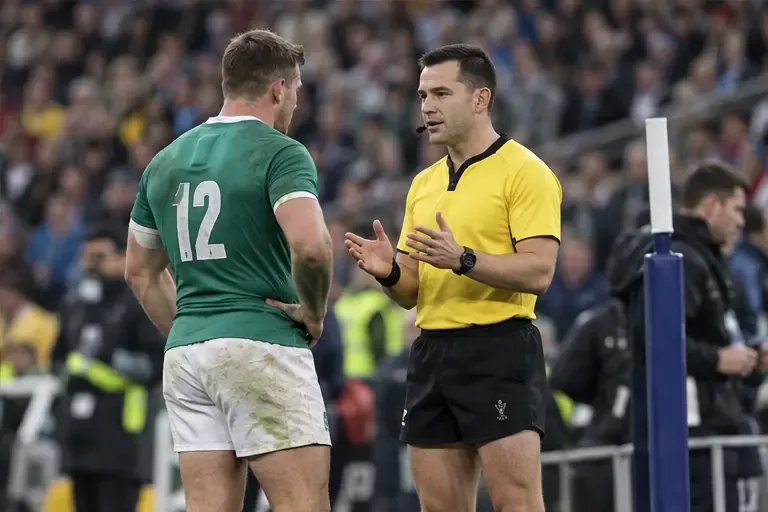
A rugby player speaks with medical staff beside the touchline during a match pause.
For coaches, players, and fans, a replacement entering the field is not a promise that the original player will return. A return depends on medical clearance, completion of the off-field process, and the match-official procedure.
First, check whether the match uses HIA
The temporary replacement rule is not universal across rugby. World Rugby Regulation 10 says the HIA temporary replacement procedure is for elite adult matches, series, or tournaments approved in advance by World Rugby. An approved competition must meet concussion welfare standards and have an HIA review process and access to match video. Other competitions may have a different medical process or require suspected concussion to be handled under “Recognize and Remove.”
Do not assume professional television rules apply at a club, school, or community match. A union, school, or tournament can set its own competition regulations and safety requirements. Check the match regulations or ask the organizer or team medical lead. If the event is not authorized to use HIA, a temporary HIA replacement should not be assumed to be available.
World Rugby’s current Law 3 team rules and Regulation 10 on concussion establish the governing scope. The competition’s own regulations determine whether it has approval and how its match-day arrangements work.
What happens when a player is sent for an HIA?
When medical staff identify a head-impact event that meets the HIA criteria and no immediate sign requires permanent removal, the player leaves the field for an HIA1 off-field assessment. A temporary replacement may enter even if the team has used all regular replacements. The referee does not restart play until the player has been replaced.
HIA1 is more than a quick memory quiz. World Rugby describes a combination of clinical evaluation, symptom and cognitive checks, balance assessment, video review, and relevant head-impact monitoring information. The treating doctor conducts the assessment; an Independent Match Day Doctor may also be involved under the competition’s arrangements. A normal score by itself does not force a return if the doctor still suspects concussion.
The 12-minute clock is actual time
Law 3 sets the period at 12 minutes of actual time from when the player leaves the playing area—not 12 minutes of playing time. The player cannot return before all 12 minutes expire, even if the assessment ends early. If cleared, the player must report to the fourth match official within that window. If the player is not available in time, the replacement becomes permanent.
Near halftime, the assessment is not postponed until the break. World Rugby’s FAQ says the player must report to a match official before the second half begins or be treated as permanently replaced. If the player also has a bleeding injury, the current FAQ allows a combined 17 minutes for the assessment and bleeding control. That is a specific exception, not a general extension for other injuries.
Thus, “the player passed” is only part of the answer. Check that the authorized HIA process applies, the doctor has cleared the player, the 12 minutes have elapsed, and the player reported within the deadline.
When return is prohibited
“Criteria 1” signs call for immediate and permanent removal. World Rugby lists signs such as loss of consciousness, convulsion, tonic posturing, balance disturbance or ataxia, being clearly dazed, disorientation, definite confusion, definite behavior change, and other observed signs or symptoms of concussion. A player with a Criteria 1 indication is diagnosed as concussed for that match and cannot return through the temporary-replacement route.
The doctor conducting HIA1 can also permanently remove a player if clinical suspicion remains, even when the off-field assessment appears normal. An abnormal HIA1 means no return as well. A structured screen supports clinical judgment; it does not overrule it.
This decision is not a coach’s tactical choice or the player’s personal call. Team medical staff may request an assessment; non-medical staff can alert them to a concerning incident. World Rugby’s HIA procedures FAQ says that once a team’s on-field medical staff request an HIA and the referee acknowledges it, the request cannot be canceled. Competition rules set out who conducts the assessment and how disagreements are handled.
Temporary replacement versus permanent replacement
Match-day outcome
Player
Replacement
HIA1 cleared; player reports within 12 minutes
May return only after the full period and medical clearance
Leaves when the assessed player returns
Criteria 1, abnormal assessment, or clinical suspicion
Permanently removed from that match
Becomes a permanent replacement
Player is unavailable by the deadline
Considered replaced for injury
Replacement becomes permanent
Match is not approved for HIA
Follow the competition’s concussion rules
No assumed HIA return right
An HIA temporary replacement is distinct from an ordinary tactical substitution. It covers the assessment period and can be used even after regular replacements are exhausted. If the assessed player does not return, the replacement stays on as a permanent injury replacement. This allowance makes a proper assessment possible; it is not an extra tactical substitution that lets a team later restore a different player.
Returning to the match is not the end of follow-up
A normal HIA1 and return to play do not prove concussion has been ruled out. World Rugby’s HIA materials describe an HIA2 assessment on the same day after the match and an HIA3 assessment 36 to 48 hours after the incident. Symptoms can emerge later, so the match-day choice and final clinical picture are separate. HIA2 and HIA3 help a doctor make or exclude a diagnosis; they do not give a player a second chance to re-enter a match after permanent removal.
Report new or worsening symptoms promptly and follow the team’s medical instructions after the game, even if the player returned. A confirmed concussion requires the appropriate individualized rehabilitation and return-to-play process. Passing the sideline screen is not clearance for the next training session or match.
Common misunderstandings
“The 12 minutes are playing time.” No. The law and FAQ say actual time. Start the clock when the player leaves the playing area and follow the fourth official’s return procedure.
“A normal HIA means the player comes straight back.” No. The player must wait until the 12 minutes expire, receive medical clearance, and report in time.
“Every head knock gets a temporary replacement.” No. The match must be approved for HIA; clear concussion signs require permanent removal.
“If the player returns, concussion is ruled out.” No. Follow-up assessments remain part of the protocol, and later symptoms matter.
“The rule is identical in every league and age group.” Do not assume that. Check competition regulations and applicable union guidance, especially outside approved elite matches.
What to verify on match day
Coaches and team staff should confirm the competition’s HIA approval and identify the authorized medical decision-makers before kickoff. Players should report symptoms honestly and never self-clear. Spectators should read a temporary replacement as a sign that assessment is underway, not a promise of return. World Rugby’s HIA Protocol and HIA procedures FAQ provide the detailed process. The match-day decision is straightforward: the player is either cleared under the approved protocol and returns after the required checks and clock, or is permanently removed from that match.