Home
» 🏉 Rugby
»
Rugby Sevens Pool Tiebreakers: Points Difference, Tries, and Head-to-Head
Rugby Sevens Pool Tiebreakers: Points Difference, Tries, and Head-to-Head
A three-team tie can turn the last few minutes of a rugby sevens pool match into a standings puzzle. The key is to follow the competition’s written sequence: match points come first, then one or more tie-break criteria such as head-to-head result, points difference, or tries. The order is not universal across every sevens event.
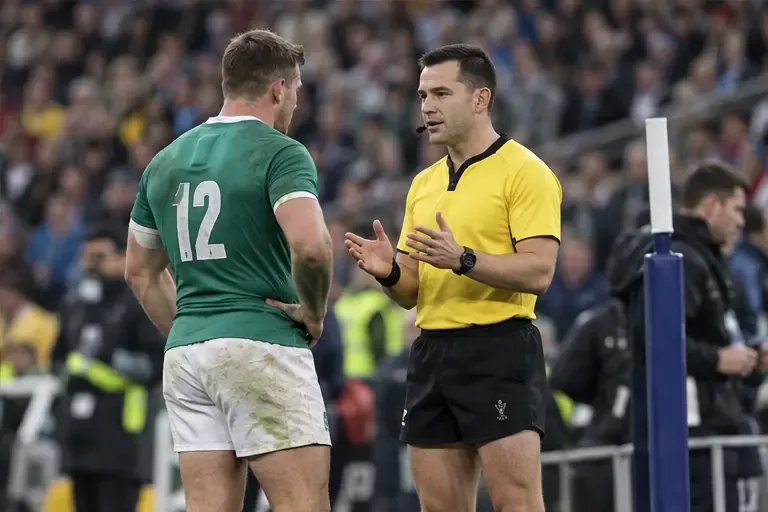
A referee stands on the field as a blurred stadium display sits in the background; start by checking the event’s pool table and match-point system.
Before comparing teams, check the event’s format
A pool is a group in which each team plays the other teams, usually once. A team’s pool ranking can decide whether it advances, which opponent it faces next, or whether it is eliminated. A tie-breaker is the ordered rule used when teams finish level on the main standings measure, commonly match points.
Do not assume every competition uses the same match-point awards or tie-break order. For example, the 2026 FISU Rugby Sevens Technical Handbook awards three match points for a win, two for a draw, one for a loss by seven points or fewer, and none for a larger loss. Its pool ranking criteria then begin with head-to-head when exactly two teams are tied. Other tournaments can set a different sequence in their own regulations.
Before the first pool match, find the event’s competition handbook or tournament regulations. Look for “match points,” “pool ranking,” “classification,” or “tie-break.” Note whether a close-loss bonus is available, how many teams can be compared at once, and what happens if all listed criteria remain level.
Step 1: Confirm the match-point table
Match points are standings points awarded for each result. They are separate from the points scored on the field. A team might score 24 points in a match but earn three match points for the win; a tournament may award bonus standings points under additional conditions.
In the FISU 2026 example above, a team that loses by seven or fewer receives one match point. That can change the pool table before any tie-break is needed. Other competitions may use another system, so read the event’s table rather than importing a rule from a different series or past season.
Also confirm whether a drawn pool match is allowed. World Rugby’s sevens FAQ explains that pool-match draws share the available match points, while a drawn knockout match is decided by sudden-death extra time. That is a different question from how teams tied in the pool standings are ranked.
Step 2: Count how many teams are tied
Once teams are level on match points, identify whether the tie involves two teams or three or more. This matters because a direct meeting can separate two teams, but a three-team tie has no single match that represents the whole group.
Under the FISU 2026 handbook, if exactly two teams are tied, the team that won their head-to-head match ranks higher. “Head-to-head” means the result of the match played between the tied teams. If that match was drawn, the criterion does not separate them, so the next criterion applies. The handbook says this direct-result step applies only when exactly two teams are tied.
When three or more teams share the same match-point total, do not assume that the team with the best mini-table among those tied automatically advances. The FISU example moves to aggregate points difference across all pool matches. A different tournament may define its own multi-team method, so use its written wording.
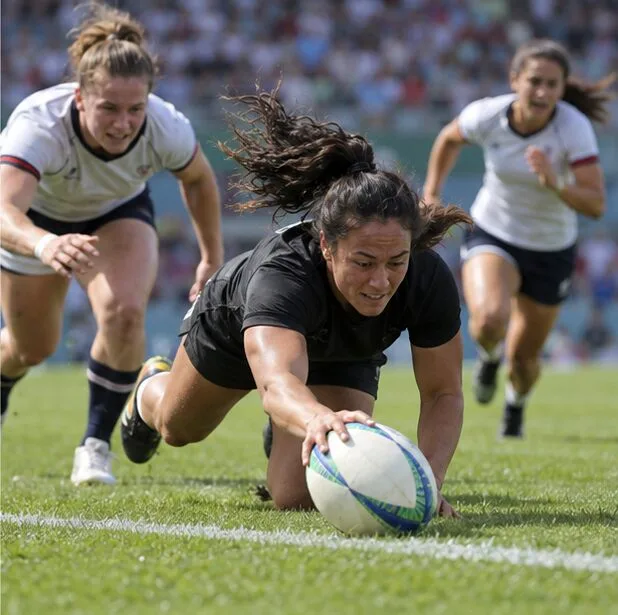
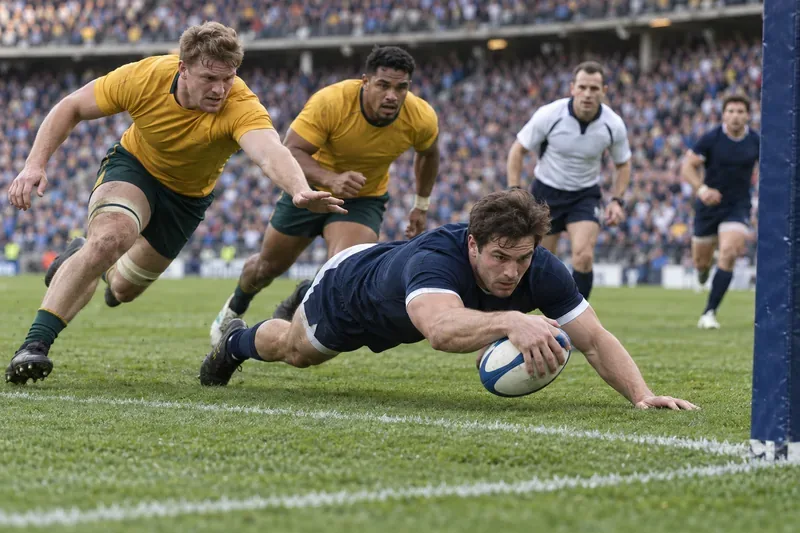
A player reaches toward the try line; a try contributes to the match score and may also count separately in the tournament’s try-based tie-breaks.
Step 3: Calculate points difference across the pool
Points difference, sometimes called points differential, is a team’s total points scored minus its total points conceded in all pool matches. “Points” here means the scoreboard total, not standings points. Under the FISU 2026 sequence, this is the next check after a head-to-head result fails to split a two-team tie—or the first tie-break check when three or more teams are level.
For a simple illustration, imagine a four-team pool in a tournament using the FISU 2026 criteria. Teams A and B each win two matches and draw with each other, so both earn eight match points. Their direct match ended 12–12, so head-to-head does not separate them. Team A’s pool scores are 12–12, 19–7, and 24–14: 55 points scored and 33 conceded, for a difference of +22. Team B’s scores are 12–12, 28–12, and 14–12: 54 scored and 36 conceded, for +18. Team A ranks above Team B on aggregate points difference.
This calculation uses every pool match, not just the match between the tied teams. A late score can therefore affect a team’s margin even when the match result is already secure. The effect on ranking depends on the competition’s criteria and on whether another measure is reached first.
Coaches review a score record on a clipboard; add all points scored and conceded in the pool before calculating the margin.
Step 4: Compare tries if points difference is still level
Try difference is tries scored minus tries conceded across all pool matches. It is a separate statistic from points difference because a try is only one part of the scoreboard total: conversions, penalties, and drop goals can also add points. A team can score more tries yet still lose the points-difference comparison if the opponent’s total scoreboard margin is better.
In the FISU sequence, try difference follows points difference. If the points margins are equal, count every try scored and conceded across the pool and subtract. For example, +5 tries ranks above +3 under that criterion. If try difference also ties, the FISU handbook next compares total points scored, then total tries scored, followed by Games seeding. If the tie remains unresolved, the handbook specifies a coin toss between the team managers.
Other competition rules may stop earlier, use a different order, or name a different final fallback. Treat the FISU list as an example of a complete sequence, not as a universal World Rugby rule.
What head-to-head does—and does not—tell you
Head-to-head can be decisive when exactly two teams are tied and the event places it first. But it is not automatically the first test in every tournament, and it may not apply to a tie of three or more. In a multi-team tie, a win over one tied opponent does not necessarily settle the comparison with the whole group.
Recent event reporting shows why checking the applicable rules matters. At the 2025 HSBC SVNS World Championship in Los Angeles, World Rugby reported that Spain, New Zealand, and Australia each finished on seven points in men’s Pool B, with Australia missing the semifinals on points difference. The report describes the outcome; the tournament regulations remain the source to consult for the full ranking procedure.
Two players shake hands after a match; for a two-team tie, check whether the competition uses this direct result before aggregate statistics.
A quick checklist for following a live pool table
Open the current event’s official regulations, not a generic rugby explainer or an old event guide.
Confirm how match points are awarded, including any close-loss or try-scoring bonus.
Check the number of tied teams before applying head-to-head.
Follow the tie-break criteria in their printed order.
For points difference, total points scored minus total points conceded across the required matches.
If needed, count tries separately; do not estimate try totals from scoreboard points.
Check any stated final fallback, such as seeding or a coin toss, rather than guessing.
Common mistakes to avoid
Confusing match points with points difference. Match points determine the main pool total; points difference compares scoreboard points scored and conceded. Keep those columns separate.
Using head-to-head for every tie. In the cited FISU rules, direct result applies only when two teams are tied. A multi-team tie proceeds to aggregate criteria.
Using only the tied teams’ match scores. Aggregate differences normally cover all pool matches when the rule says “all pool matches.” Check the wording carefully.
Assuming a try is worth the same as a scoreboard point. Try difference counts tries; points difference counts all points on the scoreboard. A conversion changes the scoreboard but not the number of tries.
Carrying a familiar rule into a new event. Tournament formats change. World Rugby’s 2025 SVNS report confirms that points difference decided a three-way pool tie, while the FISU 2026 handbook publishes a fuller sequence that includes head-to-head for a two-team tie. Use the handbook for the event you are watching.
Sources and scope
This guide uses the FISU 2026 Rugby Sevens Technical Handbook as a concrete, current example of pool match-point awards and tie-break order, and World Rugby’s May 4, 2025 report for an example of a three-team SVNS pool tie resolved on points difference. World Rugby’s Rugby Sevens FAQ distinguishes pool draws from knockout ties. Regulations are competition-specific and may be revised; for a live event, the event’s current competition handbook and official standings control.