Home
» 🏉 Rugby
»
How the Rugby Bunker Review Works After a Yellow Card
How the Rugby Bunker Review Works After a Yellow Card
Illustrative example—not a real match: Imagine North RFC’s flanker makes a tackle that appears to contact an opponent’s head. The referee sees enough to issue at least a yellow card, but the available on-field view does not make a red-card decision clear. In a competition using the Foul Play Review Bunker, the referee can send the incident for an off-field review while the game continues. The player serves the yellow-card period as the review takes place.
The Bunker is the off-field foul-play review process. It is designed to let an additional match official inspect footage during live match time, reducing a long on-field stoppage. It does not mean every yellow card is automatically reconsidered, and the exact red-card replacement rule depends on the competition. Here is how North RFC’s hypothetical incident would move through the process.
First, know who is making which decision
The referee remains the lead on-field decision-maker. The Television Match Official (TMO) is the match official who supports decisions using video. Where appointed, a Foul Play Review Officer (FPRO) is an additional official who reviews referred foul-play incidents off the field. Fans may hear the whole process called “the Bunker,” but that nickname refers to the review system, not a separate team that takes over the match.
A “sin bin” is the area where a temporarily suspended player must remain away from the field. Under the standard rugby union law, a yellow card means the player is cautioned and suspended for 10 minutes of playing time. The clock is match time, not necessarily 10 minutes of wall-clock time: a lengthy injury stoppage does not make the player’s suspension disappear faster.
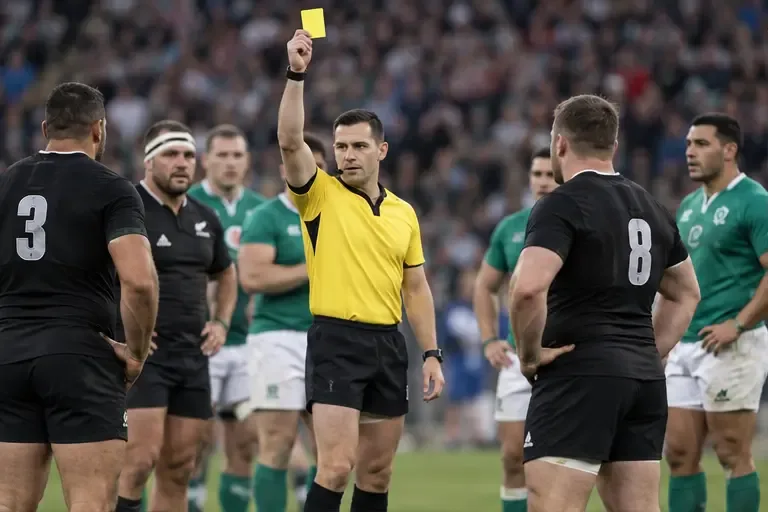
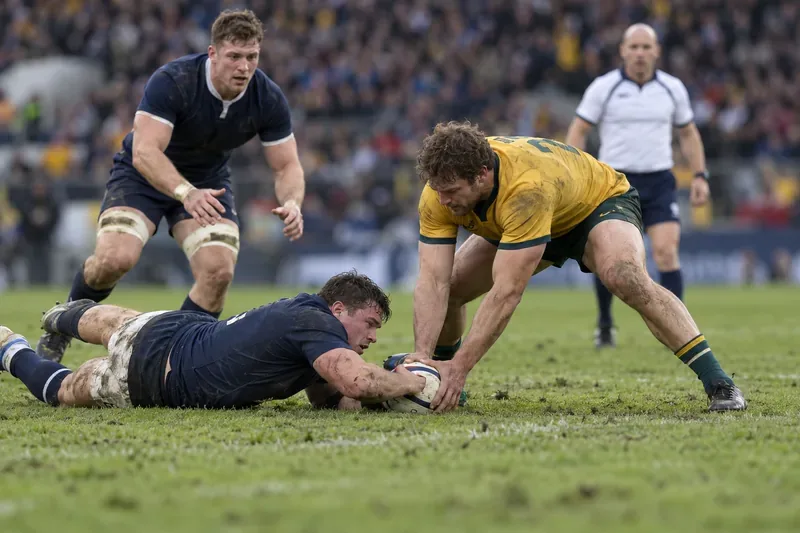
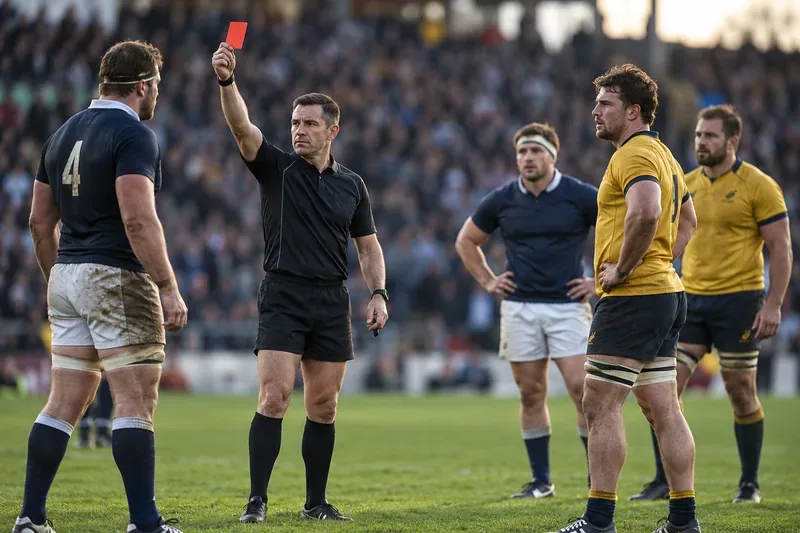
A referee shows a yellow card during a stoppage, beginning a temporary suspension and, where the competition uses the process, an off-field review.
Step 1: The referee deals with the incident on the field
In the example, the referee and other officials first decide whether the tackle is foul play and what minimum sanction is justified. They can consult the TMO and look at the available big-screen or sideline replays. If the officials determine that a permanent red card is already clear—such as for intentional, highly dangerous foul play under the relevant protocol—the referee can issue it directly. The Bunker is not a required extra stage for every red card.
If the evidence meets at least the yellow-card threshold but does not yet settle whether a red card is warranted, the incident may be referred for formal off-field review where that process is operating. In the World Rugby process, the referee signals the referral by crossing the arms above the head after showing the yellow card. North RFC’s flanker leaves the field for the temporary suspension; the match can restart rather than waiting through every video angle.
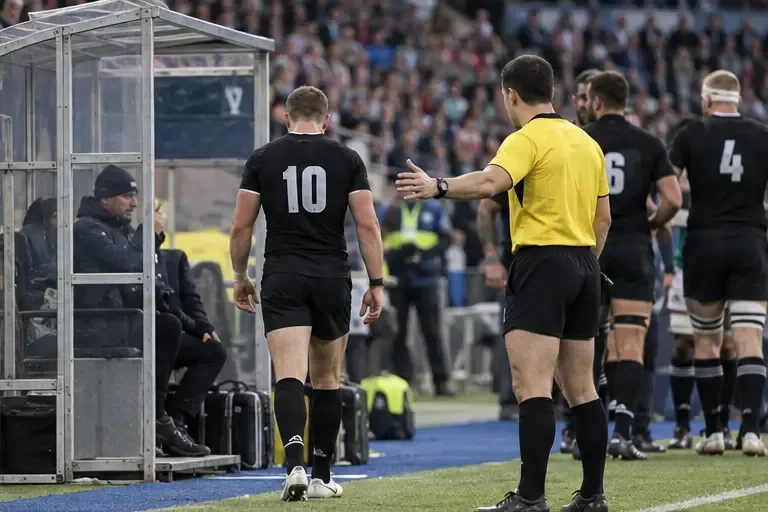
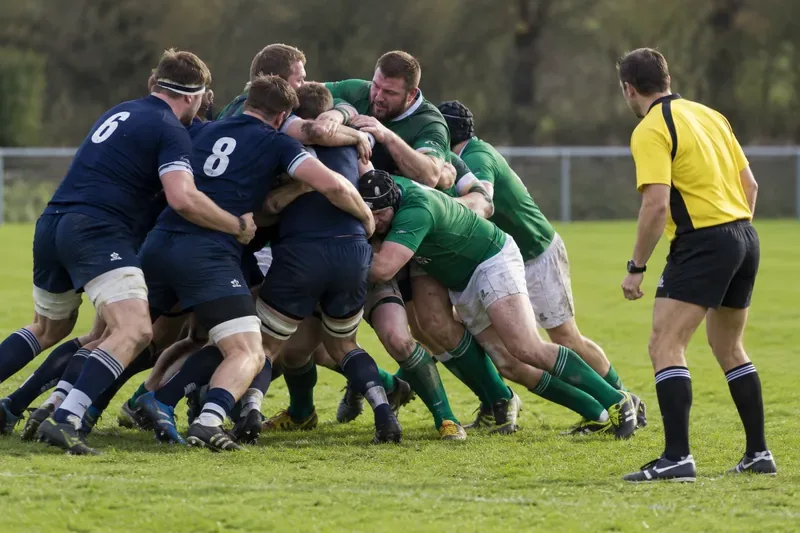
The carded player leaves the field while the match continues with the team temporarily reduced by one player.
Step 2: The player serves the yellow while the footage is reviewed
The carded player goes to the sin bin and the team plays with one fewer player. The FPRO examines the incident using available footage and technology, which can include different camera angles and replay speeds. World Rugby’s published process gives the FPRO up to eight minutes to complete the review. That review occurs during live match time, inside the 10-minute yellow-card period; it is not an extra eight minutes added to the suspension.
For North RFC, the question is whether the tackle stays at yellow-card level or meets the higher red-card threshold. The review is about the incident and the appropriate sanction under the laws and competition protocol. It is not a coach’s appeal, and a player’s team cannot demand that the review produce a particular result. The referee and review official communicate through the match-official system; television replays shown to viewers are not necessarily every angle the officials can access.
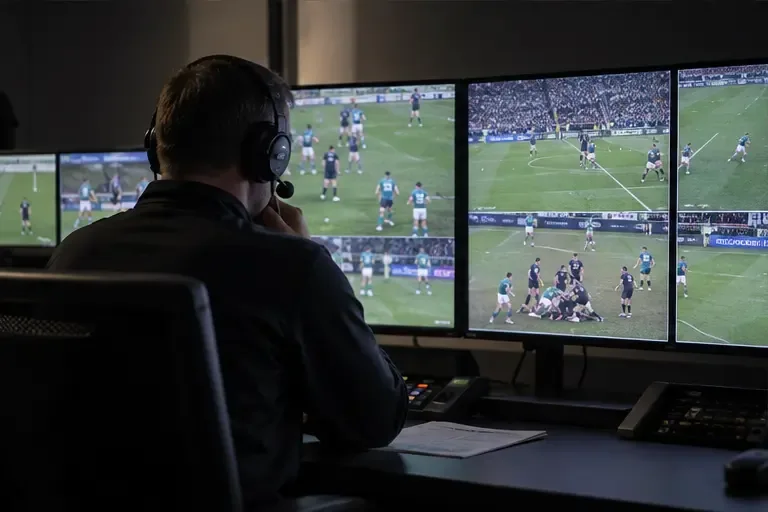
An off-field review official studies match footage from multiple camera angles during live match time.
Step 3: The review produces an in-match outcome
In World Rugby’s process, the review official advises the referee whether the yellow card should stand or be upgraded under the applicable protocol. The referee communicates the outcome to the players and match officials. The main paths are:
Review outcome
What happens to the player
What happens to the team
Yellow card confirmed
The player remains off until the 10-minute playing-time suspension has been served, then may return as allowed by the laws.
The team plays short-handed during the temporary suspension.
Red-card sanction under an adopted 20-minute replacement trial
The player cannot return to the match.
In eligible elite competitions, the team may use an available replacement after 20 minutes of playing time from the incident.
Permanent red card
The player is dismissed for the remainder of the match.
The player is not replaced, so the team remains short for the rest of the match.
In North RFC’s hypothetical match, suppose the review confirms the yellow. The flanker stays in the sin bin for the full 10 minutes, after which the team can restore its playing numbers according to the referee’s timing and substitution procedures. If the review instead upgrades the sanction, the same player cannot come back. Whether a substitute can restore the team to 15 players later is a separate question governed by the competition’s red-card rules.
After the review, the referee communicates the decision; the result determines whether the yellow stands or the sanction is upgraded under the competition rules.
What changed for some elite competitions?
Do not treat “red card” as a single universal team-number outcome in every 2026 rugby match. World Rugby’s August 2025 implementation guidance describes a Global Law Trial for elite rugby only. Unions decide what counts as elite in their jurisdictions, and competitions must specify how they will apply the trial. Under the trial, some red-carded players cannot return, but an available replacement can enter after 20 minutes of playing time for eligible red-card incidents. For intentional, highly dangerous acts, the permanent red remains and the dismissed player cannot be replaced.
In a match with both a TMO and FPRO, the guidance says the FPRO can recommend that the yellow remain or be upgraded to a 20-minute red-card replacement. The FPRO does not recommend a permanent red through that off-field review; the referee can issue a permanent red directly after the on-field review where the criteria are met. If a match has no FPRO, the TMO may perform the off-field review if the competition’s setup permits. Some elite games may lack the staffing or technology for an off-field review, and then the on-field officials decide the sanction at the time.
World Rugby’s 2026 Men’s Six Nations official note said foul play meeting the yellow threshold should go to the Bunker for review, while permanent red cards remain for intentional foul play. That describes the competition approach announced for that tournament; it should not be assumed to govern every domestic league, age grade, sevens event, or community match. As of September 2026, World Rugby describes the 20-minute replacement as a law trial running through 2026 for later Council review.
Use the hypothetical example to follow a real match
When you see a player shown yellow and the referee cross the arms overhead, follow this sequence:
Note the initial card. The player has been temporarily suspended for 10 minutes while the incident is reviewed, if the competition uses the Bunker process.
Watch the match clock. Play may resume while the video official reviews. The review can take up to eight minutes under World Rugby’s published process.
Listen for the communicated decision. The yellow may stand, or the sanction may be upgraded according to the competition protocol.
Track the player and team separately. A confirmed yellow can end with that player returning after the 10-minute suspension. A red means that player cannot return; a replacement after 20 minutes is possible only when the competition uses the relevant elite-game trial and the red is eligible.
Check the competition regulations if numbers matter. The tournament’s match regulations and official referee explanation are the best sources for whether a red card is permanent or allows a replacement after 20 minutes.
For North RFC, the viewer should not assume that the player returns just because the first card was yellow, or that the team stays down to 14 for the whole match if the review ends in a red. The review’s outcome and the adopted red-card procedure both matter.
Common misunderstandings to avoid
“The Bunker reviews every yellow.” Not necessarily. The referral threshold and competition protocol control which incidents are sent off the field.
“The review adds eight minutes to the sin bin.” No. Eight minutes is the review official’s maximum review window in the published process; the ordinary yellow suspension is 10 minutes of playing time.
“The review official gives a red card.” The review official assesses and advises under the protocol. The referee communicates the in-match sanction. Under the 2025 elite trial guidance, an off-field review can upgrade to the 20-minute replacement red, not recommend a permanent red.
“Every red card lets the team replace the player after 20 minutes.” No. That replacement provision is tied to the elite-game trial and competition implementation. Permanent red cards for intentional, highly dangerous actions do not allow replacement.
“A yellow card means the player is always back exactly 10 minutes later.” The suspension is 10 minutes of playing time, but the return still has to follow match officials’ timing and substitution procedures. A later red-card upgrade means the player cannot return.
The practical takeaway
The Bunker lets officials review a serious foul-play incident away from the field while the match continues. In the hypothetical North RFC tackle, the referee first establishes at least a yellow-card threshold, the player leaves for 10 minutes, and the FPRO reviews available footage for up to eight minutes. The yellow can stand, or the sanction may be upgraded under the competition’s rules. If upgraded, the player is done for the match; whether the team can replace that player after 20 minutes depends on the adopted elite-game trial and the type of red-card sanction. Check the tournament rules before assuming either team-number outcome.