Home
» 🏉 Rugby
»
Goal-Line Dropout vs. 22-Metre Dropout: Which Rugby Restart Applies—and Why
Goal-Line Dropout vs. 22-Metre Dropout: Which Rugby Restart Applies—and Why
Two rugby restarts can look similar on television but come from very different situations: the goal-line dropout and the 22-metre dropout. For a new viewer, the easiest way to tell them apart is not to memorize every edge case. Instead, track how the ball entered in-goal, how it became dead, and whether the kick was a shot at goal.
There is also one terminology update worth knowing before going further. World Rugby now uses try line drop-out instead of “goal-line drop-out.” The governing body introduced that terminology in its 2025 law book, changing “goal line” to “try line” throughout the laws. Many fans and broadcasts still say goal-line dropout, so this article uses both terms where helpful. The current wording can be checked in World Rugby Law 12 and the terminology notice in World Rugby’s 2025 law-book update.
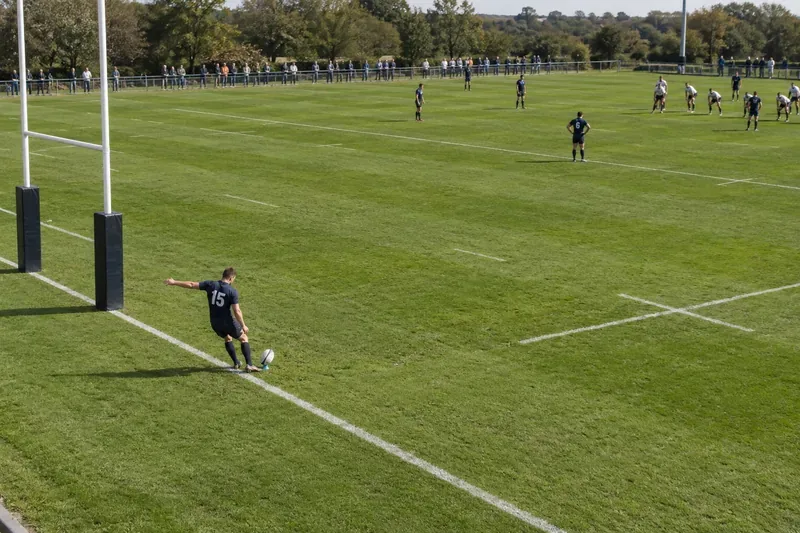
A rugby player takes a drop kick near the try line, illustrating the field position that separates a try line drop-out from a restart taken on or behind the 22-metre line.
Start with three terms: in-goal, try line, and drop-out
In-goal is the area between the try line and the dead-ball line. An attacking player scores a try by legally grounding the ball in the opponents’ in-goal. If the ball instead becomes dead there without a try, the referee has to choose the correct restart.
A drop-out is a restart taken with a drop kick. Under World Rugby Law 12, both the 22-metre drop-out and the try line drop-out are drop kicks. What changes is where the kick is taken and which event caused it.
The 22 is the area between a team’s try line and its 22-metre line. A 22-metre drop-out is taken on or behind that 22-metre line. A try line drop-out is taken on or behind the defending team’s try line.
The quick decision rule
When the attacking team sends or carries the ball into the opponents’ in-goal and then fails to score, the restart is commonly a try line drop-out. When a kick at goal fails and the ball is made dead in-goal, the restart is a 22-metre drop-out. An open-play kick that goes all the way through in-goal and becomes dead beyond it creates another important possibility: the defending team may choose a 22-metre drop-out or a scrum where the ball was kicked.
What happened?
Typical restart
Why
Attacker carries the ball into in-goal and is held up
Try line drop-out
The attack put the ball into in-goal but did not score.
Attacking open-play kick enters in-goal and a defender grounds it
Try line drop-out
The attacking side put the ball into in-goal and the defender made it dead there.
Attacker knocks the ball forward in the opponents’ in-goal
Try line drop-out
Law 12 specifically lists an attacking knock forward in in-goal.
Unsuccessful penalty goal or dropped-goal attempt becomes dead in in-goal
22-metre drop-out
Law 12 gives this situation its own restart.
Open-play kick goes through opponents’ in-goal into touch-in-goal or over the dead-ball line
Defending team may choose a 22-metre drop-out or a scrum at the kick location
Law 21.11 gives the defending team that choice.
Step 1: Ask who put the ball into in-goal
This is the first useful habit for a newcomer. If the attacking team carried, played, or kicked the ball into the opponents’ in-goal and then failed to score, a try line drop-out is often the answer. World Rugby Law 12 includes attacking carries and open-play kicks that become legally dead in in-goal, as well as an attacking knock forward in the opponents’ in-goal.
For example, imagine a winger kicks through behind the defense. A defender gets back first and grounds the ball inside in-goal. Because the attacking team put the ball there and the defender legally made it dead, the restart is a try line drop-out.
Now change one detail: the defending team itself takes the ball back into its own in-goal and it then becomes dead. That is not automatically a try line drop-out. Depending on the exact action, a five-metre scrum to the attacking team can apply. This is why simply seeing a defender ground the ball does not tell you the restart by itself.
Step 2: Ask whether the ball died inside in-goal or went dead through it
This distinction catches many first-time viewers. A normal attacking kick that is grounded by a defender inside in-goal leads to a try line drop-out. But if a team kicks the ball from the field of play and it travels through the opponents’ in-goal into touch-in-goal or over the dead-ball line, World Rugby Law 21.11 gives the defending team a choice: take a 22-metre drop-out or have a scrum at the place where the kick was made.
That choice exists because the kick has effectively been sent too long. It prevents the attacking team from gaining an automatic territorial reward for a kick that has gone dead beyond the in-goal area.
Step 3: Identify kicks at goal before applying the open-play rule
A failed attempt at goal is treated differently from an ordinary tactical kick. If an unsuccessful penalty goal or attempted dropped goal is grounded or made dead in in-goal by the defending team, or goes dead through in-goal, the restart is a 22-metre drop-out.
This is an explicit exception in the laws. So when you see the ball travel dead after a shot at goal, do not automatically use the “attacking kick into in-goal equals try line drop-out” shortcut. First classify the kick. A tactical grubber, chip, or clearance is one category; a penalty-goal attempt or dropped-goal attempt is another.
Step 4: Learn what “held up” means
A ball is held up when the attacking ball carrier reaches in-goal but cannot legally ground the ball because the defense prevents it. The ball becomes dead. Under the current laws, if the attacker brought the ball into in-goal, this leads to a try line drop-out rather than the attacking five-metre scrum that older fans may remember from earlier law eras.
This change was originally introduced to encourage attacking variety and reduce repeated close-range scrums. For present-day decisions, however, the practical point is simpler: attacker carries into in-goal, no legal grounding, ball held up — expect a try line drop-out.
Step 5: Check where the restart must be taken
Once you know which drop-out applies, the field position becomes straightforward:
22-metre drop-out: taken on or behind the defending team’s 22-metre line. The ball must cross the 22-metre line.
Try line drop-out: taken on or behind the defending team’s try line. The ball must cross the five-metre line.
In both cases, the kick must be a drop kick and must be taken without delay. Opponents may not advance in front of the applicable sanction line before the ball is kicked. A drop-out must not go directly into touch; World Rugby lists options for the non-kicking team if that happens.
Common mistakes to avoid
Mistake 1: Thinking every defender grounding in-goal means a 22-metre drop-out
That was a familiar pattern under older law structures, but it is no longer a safe shortcut. If an attacking open-play kick enters in-goal and the defender grounds it there, the normal restart is a try line drop-out.
Mistake 2: Ignoring who took the ball into in-goal
The team responsible for putting the ball into in-goal matters. An attacker taking it in and being held up can produce a try line drop-out. A defender taking it back into their own in-goal can produce a different restart, including a five-metre scrum.
Mistake 3: Treating a kick at goal like a tactical kick
An unsuccessful penalty-goal attempt or dropped-goal attempt has a specific 22-metre drop-out outcome when it becomes dead in or through in-goal. Identify the purpose of the kick before deciding the restart.
Mistake 4: Missing the dead-ball-line exception for open-play kicks
If an ordinary kick from the field of play runs dead through the opponents’ in-goal, the defending team can choose between a 22-metre drop-out and a scrum at the place of the kick. That choice is different from the usual try line drop-out after a defender grounds an attacking kick inside in-goal.
A simple sequence you can use while watching a match
Did a try get scored? If yes, none of these restarts applies.
Who put the ball into in-goal? Attacking team or defending team?
Did the ball become dead inside in-goal, or did it go through in-goal and dead beyond it?
Was the kick an attempt at goal? If it was a failed penalty goal or dropped-goal attempt, think 22-metre drop-out.
If it was ordinary attacking play and the attack failed to score in in-goal, think try line drop-out unless a specific exception applies.
If an open-play kick went dead through in-goal, remember the defending side’s 22-metre-drop-out-or-scrum choice.
One final terminology note
If a commentator says “goal-line dropout,” they are usually referring to what the current World Rugby laws call a try line drop-out. The law itself has not vanished; the label changed. That matters when searching official material, because newer law pages use “try line,” while older explanations and fan discussions may still use “goal line.”
The most reliable beginner rule is to follow the ball’s journey. If the attacking side puts the ball into in-goal and fails to score, a try line drop-out is usually the restart. If a penalty-goal or dropped-goal attempt fails and becomes dead in or through in-goal, use a 22-metre drop-out. If an ordinary kick travels all the way through the opponents’ in-goal and goes dead beyond it, the defense may choose a 22-metre drop-out or a scrum back where the kick was made. Once you identify those three patterns, most restart decisions become much easier to read in real time.