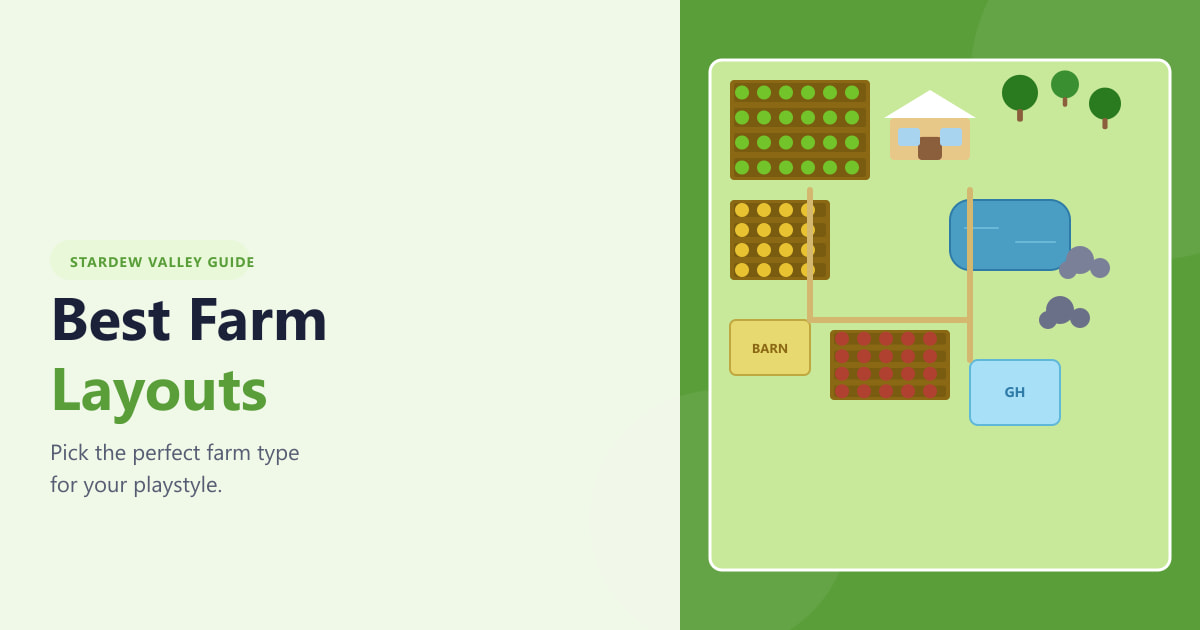
The best farm layout in Stardew Valley depends on what you want to do most: grow crops, raise animals, forage, fish, mine, or share the work in co-op. There are eight farm maps in the currently documented 1.6 roster. Standard Farm is the easiest choice for a large crop-and-animal operation, while Meadowlands gives new animal keepers a head start. The other maps trade some convenient farmland for a distinct feature.
Choose carefully at character creation: the farm map is locked to that save. The comparison below uses the published tillable-tile counts as a rough measure of crop space. A tile count does not show how easy that space is to reach or arrange, so consider the terrain and your routine as well.
Stardew Valley farm layouts at a glance
| Farm | Best fit | Tillable tiles | Main trade-off |
|---|---|---|---|
| Standard | Crops, animals, flexible play | 3,427 | Few built-in bonuses beyond open space |
| Riverland | Fishing and an island-style farm | 1,578 | Water breaks up the usable land |
| Forest | Foraging and hardwood | 1,413 | Less continuous space for fields |
| Hill-top | Supplemental mining | 1,648 | Cliffs and a stream fragment the farm |
| Wilderness | Nighttime combat atmosphere | 2,131 | Monsters can appear on the farm at night |
| Four Corners | Co-op zoning or a varied solo farm | 2,952 | Four parcels mean less uninterrupted space |
| Beach | Fishing, foraging, and buildings | 2,700 | Sprinklers cannot water sandy soil |
| Meadowlands | Early animal raising | 2,066 | Water and terrain divide the crop plots |
These are map-wide counts of tillable tiles, not a promise that every tile forms one easy-to-sprinkle field. Standard has the most tillable ground; Meadowlands, Beach, and Four Corners still have plenty of room, but terrain changes how you can use it.
Which farm layout is best for your playstyle?
Standard Farm: best for beginners and crop space
Pick Standard Farm if you want the least complicated start or expect crops and farm buildings to be the center of your save. Its broad, open areas make it straightforward to arrange crop rows, sprinklers, barns, coops, sheds, and paths. It has the largest number of tillable tiles, so it is also the strongest pick for players who want to scale outdoor farming without working around many cliffs or waterways.
The map does not provide a special resource like the Forest or Hill-top farms. Its advantage is room to choose your own direction. A practical early layout is to keep a compact crop patch near the farmhouse, leave clear routes to exits, and reserve a larger block for later sprinklers and buildings.
Forest Farm: best for foraging and hardwood
The Forest Farm swaps crop area for a wooded border and useful western clearings. Renewable large stumps provide hardwood, while seasonal forage items and distinctive weeds appear in the forested area. That makes it attractive if you enjoy gathering or want a steady source of materials while developing the farm.
Its 1,413 tillable tiles are the lowest count of the eight maps, and ponds and grass make the available space less uniform. Treat the clearings as part of the farm’s value instead of trying to turn every corner into a field. Place a smaller, efficient crop garden near the house and use the remaining clear ground for buildings or paths.
Hill-top Farm: best for mining between errands
Hill-top Farm has a southwest quarry area where stones, ore nodes, and geode nodes can appear. It gives mining-focused players a convenient source of occasional resources without replacing trips to the Mines. The stream and elevation changes create scenic zones, but they also split the farm into smaller working areas.
Choose Hill-top for the quarry and its layout, not as a substitute for regular mining. Plan around the quarry entrance and the flatter sections you can reach easily. If large uninterrupted crop fields are your priority, Standard or Four Corners will be simpler to organize.
Riverland Farm: best for fishing on the farm
The Riverland Farm is built around water channels and separated patches of land. Fishing is more practical here than on most farm maps, and the map has bubble spots enabled. In version 1.6, it also starts with a Fish Smoker, a useful early boost if you plan to turn catches into a regular part of your income.
Water takes up space and makes movement between land sections part of the daily routine. The map has 1,578 tillable tiles, so it is a poor match for a huge crop operation but a good fit if you genuinely want to fish often. Fishing access is convenient rather than exclusive: you can fish elsewhere in the valley on any farm.
Wilderness Farm: best if you want nighttime encounters
On the Wilderness Farm, monsters can spawn at night, giving the property a more adventurous feel. The map has a large pond and some cliffs, while its 2,131 tillable tiles leave more room for crops than Riverland, Forest, or Hill-top. It is a reasonable middle ground if you want a distinctive map without giving up as much field space.
Night monsters are the defining trade-off, not a shortcut to combat training: monsters spawned on the farm award reduced Combat experience. If you prefer peaceful evenings, select another layout or review the farm-monster options when starting a save.
Four Corners Farm: best for co-op and clear zones
Four Corners Farm divides the property into four parcels, each with a different feature: a forest clearing with a large stump, a generous crop section, a pond, and a small quarry. The layout makes it easy for co-op players to assign areas or keep crops, animals, and production buildings organized. Solo players can use the same natural boundaries to create separate farm districts.
Its 2,952 tillable tiles provide substantial crop space, though cliffs and ponds break it up. It is not a requirement for multiplayer; any farm map can be used for co-op. Choose Four Corners when the built-in zoning helps your group, or when you want a varied map without committing to one specialty.
Beach Farm: best for a nontraditional farm plan
The Beach Farm offers open coastal space, fishing, foraging, and occasional supply crates that wash ashore. The key limitation is sandy soil: sprinklers cannot water crops planted on it. Only small nonsandy areas can support a sprinkler-based crop plan, so this map works better when you expect to rely on animals, buildings, fishing, or foraging alongside a smaller crop garden.
Although its total of 2,700 tillable tiles looks generous, the sprinkler restriction matters more than the headline number for a late-game crop layout. Beach is a rewarding challenge for experienced players who like the setting and are willing to diversify their income.
Meadowlands Farm: best for starting with animals
Added in version 1.6, Meadowlands Farm begins with a coop and two chickens. Its chewy blue grass is especially appealing to animals, so this is the clearest choice if you want to raise livestock early instead of building your first season around a large parsnip crop. A river and two small lakes add variety, but they divide the available plots.
With 2,066 tillable tiles, Meadowlands still supports crops; it simply encourages a different balance. Use its starting chickens and blue grass as an early resource, then add fields and other buildings as you learn where the map’s open areas fit your routine.
How to choose and plan your farm
- Choose your main activity first. Standard favors flexible crop farming, Forest favors foraging, Hill-top mining, Riverland fishing, Wilderness nighttime combat, Beach fishing and foraging, and Meadowlands animal raising. Four Corners blends several features.
- Think about usable space, not just tile totals. Water, cliffs, grass, and special zones can make a smaller field easier to manage—or make a larger total feel divided.
- Keep early chores close together. Put your first crop patch and frequently used machines near the farmhouse. Leave paths wide enough for daily movement and animal access.
- Reserve room for later buildings. Coops, barns, sheds, fish ponds, and paths all compete with crop plots. Decide which map features you want to preserve before clearing trees or placing permanent buildings.
- Remember the Greenhouse. Every farm map includes the abandoned building that can be restored as the Greenhouse. It provides an indoor crop option, but does not remove the outdoor layout’s advantages or drawbacks.
For exact terrain views and map-specific details, see the Stardew Valley Wiki farm map reference. The official 1.6 changelog confirms the Meadowlands addition and its starting coop and chickens.
Frequently asked questions
What is the best Stardew Valley farm for beginners?
Standard is the most forgiving choice for a first save because its large, open crop area is easy to plan around. Meadowlands is a strong alternative if you are especially excited to raise animals and want a coop and two chickens from the start.
Can you change farm layouts after starting a save?
No. The farm type is selected when the save is created and cannot be changed for that character. If you want another map, you will need a new save.
Which farm is best for co-op?
Four Corners is the easiest to divide into zones because the map already has four distinct parcels. It is a convenience, not a multiplayer requirement; co-op can use any farm map.