Home
» 🧭 Other Sports
»
UFC Weigh-In Rules: Title Limits, the One-Pound Allowance, and Missed-Weight Consequences
UFC Weigh-In Rules: Title Limits, the One-Pound Allowance, and Missed-Weight Consequences
UFC weigh-ins decide whether athletes have made the weight agreed for a bout, but the rule is not simply “add one pound.” A championship bout generally requires each eligible fighter to weigh at or below the division’s exact title limit. In a non-title bout, UFC weigh-ins commonly allow one extra pound. That allowance is a customary rule that must be provided for by the written bout contract or the local regulation, according to the Association of Boxing Commissions (ABC). The athletic commission supervising the event and the bout agreement are the final references for a particular card.
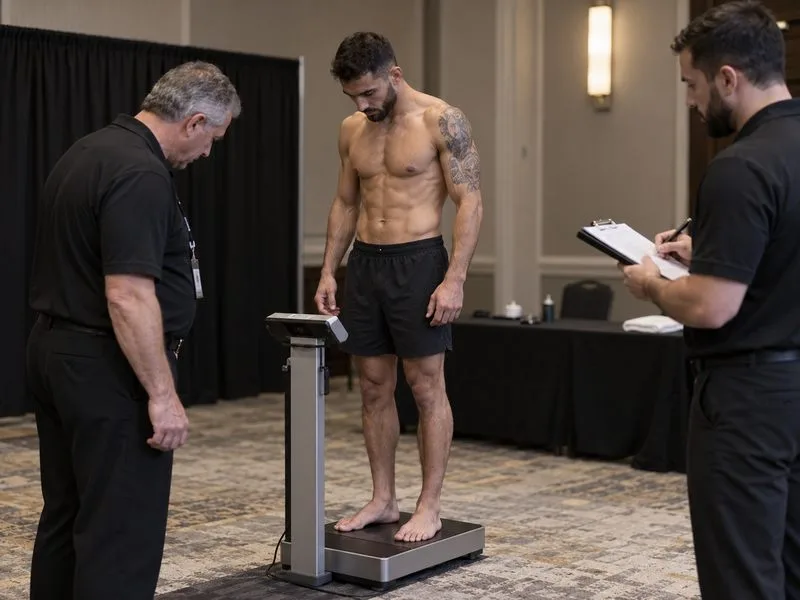
A fighter stands on a scale as officials record the official weigh-in.
Quick reference: which number applies?
Bout type
Usual UFC limit
What to verify
Championship bout
At or below the division limit
The title limit listed by the UFC and the commission; no routine one-pound cushion
Non-title bout
Often up to one pound over the division limit
That the event commission and written bout terms recognize the allowance
Catchweight bout
The contracted catchweight
The actual contract and commission approval; do not assume another pound is added
Missed contracted weight
Above the applicable cap
Commission decision, opponent’s agreement, revised bout terms, and any purse penalty
For example, UFC’s published weight-class guide describes a non-title lightweight bout as allowing up to 156 pounds, while a lightweight title fight requires 155 pounds or less. The one-pound allowance changes the non-title cap; it does not change the official 155-pound championship limit. Read the UFC’s weight-class and weigh-in guide alongside the supervising commission’s instructions.
UFC division limits at a glance
These are the familiar maximum championship limits for UFC divisions in pounds. The one-pound non-title cap shown in the final column reflects the usual allowance, where recognized. “At or below” matters: a title athlete at 155.1 pounds has not made a 155-pound title limit.
Division
Championship limit
Usual non-title cap
Strawweight
115 lb
116 lb
Flyweight
125 lb
126 lb
Bantamweight
135 lb
136 lb
Featherweight
145 lb
146 lb
Lightweight
155 lb
156 lb
Welterweight
170 lb
171 lb
Middleweight
185 lb
186 lb
Light heavyweight
205 lb
206 lb
Heavyweight
265 lb
266 lb
The UFC has women’s divisions at strawweight, flyweight, bantamweight, and featherweight, using the same division limits shown above. Check the bout listing, because a fighter may agree to compete at a catchweight or a different division limit. The table is a practical reference, not a substitute for the event’s official weigh-in notice.
Why title fights have no one-pound cushion
A title fight is for a championship at a defined division limit. The allowance commonly used for non-title contests is not a general permission to weigh one pound over whenever a fighter is on a UFC card. The UFC’s own guide explicitly contrasts the 156-pound non-title lightweight cap with the 155-pound title cap.
The ABC’s committee report describes the one-pound allowance for non-title MMA bouts as an unwritten custom that should continue only when it is included in the written bout contract or provided for by regulation. That means the phrase “UFC gives everyone an extra pound” is too broad. For a specific bout, confirm the limit in three places: the bout type, the official event weigh-in instructions, and any relevant contract or commission rule. The ABC’s committee report on Unified Rules for MMA explains the contract-or-regulation condition.
What counts as a missed weight?
A fighter misses weight when the official reading is above the applicable limit for that bout. The applicable limit may be the title cap, the non-title cap with an authorized allowance, or a specific contracted catchweight. A catchweight is a one-off weight agreed for a bout outside the usual division maximum; it is not automatically the nearest UFC division limit plus one pound.
Use the official commission-supervised weigh-in result. UFC events often include a public ceremonial weigh-in for fans and broadcast coverage, but the number that matters for eligibility is the official result—not a faceoff photo, an announced walk-around weight, or a fighter’s gym scale. UFC’s fight-week pages distinguish scheduled official weigh-ins from ceremonial fan events. UFC publishes official weigh-in result pages, such as its UFC 284 official results.
What can happen after a fighter misses weight?
The bout can proceed under revised terms. The opponent may agree to fight at a catchweight or accept the bout as contracted, subject to the commission’s approval. The commission can also reject a change or cancel the contest.
The fighter may forfeit part of the purse. UFC weigh-in reports frequently state that a fighter who missed weight forfeited 20 percent of the purse to the opponent. That is a common UFC outcome, not a universal fixed penalty. The amount and recipient can depend on the contract and commission. An official UFC report from Moscow, for example, recorded different forfeiture percentages for two separate misses, showing why a single percentage should not be treated as automatic.
A championship opportunity can change. A fighter who is over the title limit is not eligible to win that title under the stated limit. The promotion and commission may restructure the contest or remove its title status. If the reigning champion misses weight, the title may be vacated or stripped under the event’s decision. At UFC 274, Charles Oliveira weighed 155.5 pounds for a 155-pound lightweight title defense; the UFC said he would vacate the title when the main event began. Treat that as a documented example, not a universal formula that answers every title-miss scenario.
The fight can be canceled. A missed weight does not guarantee that the opponent will accept the bout. Safety considerations, the size of the miss, the opponent’s decision, and commission approval can all affect whether it goes ahead.
For a current event, read the official weigh-in report and any UFC or commission update after the weigh-in. UFC reports may state that a fight proceeds, identify a purse forfeiture, or specify that a title is no longer at stake. Those event-specific details take precedence over assumptions based on another card.
A practical verification checklist for fans
Identify the bout type. Is it a championship fight, regular non-title bout, or agreed catchweight contest?
Find the correct cap. Start with the UFC division limit, then account for the non-title allowance only if the official event rules permit it.
Use the official scale result. Check the UFC’s official weigh-in results and, when available, the supervising commission’s release.
Read the update after a miss. Confirm whether the bout proceeds, whether the opponent accepted revised terms, the stated purse consequence, and whether a title can still be won.
Keep the event-specific details together. A 156-pound reading means different things in a lightweight title bout, a non-title bout with the one-pound allowance, and a separately contracted catchweight bout.
Common mistakes to avoid
Applying the one-pound non-title allowance to a championship limit.
Assuming a one-pound allowance is guaranteed everywhere without checking the local commission and bout terms.
Assuming every missed-weight fighter automatically forfeits 20 percent. UFC reports commonly show that figure, but the amount is not one universal rule.
Assuming the opponent must accept the bout or that the event will proceed.
Treating a catchweight as if the standard divisional allowance automatically applies on top of it.
Reading an official weigh-in outcome as though it decides every title consequence on a different event. Verify the promotion’s and commission’s specific ruling.
As of September 30, 2026, the most dependable quick rule is: exact division limit for a title bout; commonly one pound over for a non-title UFC bout when the commission or bout terms allow it; and event-specific decisions after any miss. The local commission regulates the event, so its written instructions and the official weigh-in report settle the case.