Home
» 🧭 Other Sports
»
Formula 1 Sprint Weekend Explained: Parc Fermé, Qualifying, and Grid Penalties
Formula 1 Sprint Weekend Explained: Parc Fermé, Qualifying, and Grid Penalties
On a Formula 1 Sprint weekend, Saturday has two separate starting grids to keep straight. Friday’s Sprint Qualifying sets the grid for the Sprint; Saturday’s regular Qualifying sets the grid for Sunday’s Grand Prix. The Sprint result does not normally set the Grand Prix grid, although a penalty from the Sprint can carry over to the next race.
The 2026 calendar has six Sprint weekends. The session order remains the current standalone format: one practice session and Sprint Qualifying on Friday, the Sprint and Grand Prix Qualifying on Saturday, then the Grand Prix on Sunday. F1’s current Sprint guide lists the 2026 venues and explains the format. This article uses the FIA’s 2026 Sporting Regulations, Section B, listed as Issue 08 on August 5, 2026; the FIA can amend regulations, so a specific event’s final schedule and starting grids remain authoritative.
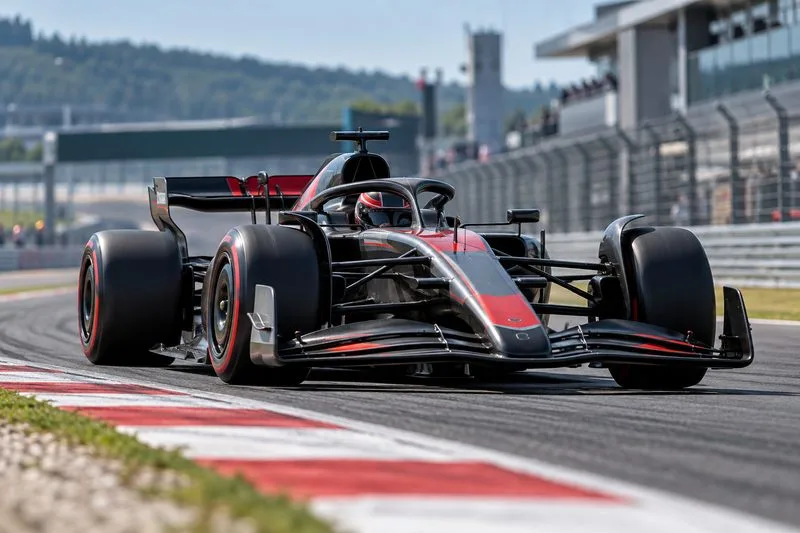
An open-wheel race car crosses a corner curb during a sprint-style race weekend; each qualifying session sets a different starting grid.
What happens on each day of a Sprint weekend?
The weekend compresses the usual preparation time and adds a short race. That makes the first practice session unusually important: teams have only one hour of free practice before the first competitive qualifying session.
Day
Session order
What it decides
Friday
Free Practice 1, then Sprint Qualifying (SQ1, SQ2, SQ3)
Sprint Qualifying sets the Sprint grid.
Saturday
Sprint, then regular Qualifying (Q1, Q2, Q3)
The Sprint awards points; regular Qualifying sets the Grand Prix grid.
Sunday
Grand Prix
The main race uses the final Grand Prix starting grid after penalties.
Sprint Qualifying is a shorter knockout session: under the 2026 format, SQ1 lasts 12 minutes, SQ2 lasts 10, and SQ3 lasts eight. The regular Grand Prix Qualifying uses the familiar Q1, Q2, and Q3 format. The exact timetable and session start times vary by event and time zone, so use the event schedule rather than assuming every Sprint weekend follows identical clock times.
The Sprint is a 100-kilometer race with no mandatory pit stop under the standard format. It awards points to the top eight finishers. It is a separate contest from the Grand Prix: finishing first in the Sprint does not give a driver pole position for Sunday.
Which session sets each starting grid?
Think of Sprint Qualifying and Grand Prix Qualifying as two independent qualifying sessions. The results are not combined:
Sprint Qualifying: establishes the starting order for Saturday’s Sprint.
Grand Prix Qualifying: establishes the starting order for Sunday’s Grand Prix.
Sprint classification: determines Sprint points and can be affected by penalties, but it does not replace Saturday’s Grand Prix Qualifying result as the Sunday grid.
For example, a driver could start the Sprint from pole, lose places during the Sprint, then set the fastest time in Grand Prix Qualifying and earn pole for Sunday. Conversely, a driver who wins the Sprint could qualify poorly later on Saturday and start the Grand Prix farther back. The exception to watch for is a penalty that is explicitly carried forward: a Sprint penalty that cannot be served during the Sprint may be applied at the driver’s next race, usually Sunday’s Grand Prix.
What does parc fermé mean on a Sprint weekend?
Parc fermé is the period when the car is under technical control and teams may perform only permitted work. It limits major setup changes after the car has been committed to qualifying, helping prevent teams from using one configuration for qualifying and a substantially different one for the race. It does not mean the car is locked away for the entire weekend.
The 2026 FIA Sporting Regulations define two key pre-race periods on a Sprint weekend:
For the Sprint, parc fermé begins when a car first leaves the pit lane during Sprint Qualifying and continues until the start of the Sprint.
For the Grand Prix, a separate parc fermé period begins when a car first leaves the pit lane during regular Qualifying and continues until the start of the Grand Prix.
Only work listed in the regulations is allowed while the car is in these conditions. Some repairs or adjustments may be permitted, and the Technical Delegate can approve other work under the rules. Teams cannot freely change the car’s parts or suspension setup. Cars are also subject to post-session checks, and a car may be selected for inspection after either qualifying session.
This separation matters after the Sprint. The Sprint’s pre-race parc fermé does not turn Sprint Qualifying into the start of a single lock that lasts through Sunday. Once the Sprint procedure and checks are complete, teams prepare for Grand Prix Qualifying; the second pre-race parc fermé period starts when the car first leaves the pit lane in that qualifying session.
How can parc fermé affect a starting position?
The consequence depends on when the breach happens. Under the FIA rule, if a team changes a car outside the permitted work while it is under parc fermé before the Sprint starts, the driver must start the Sprint from the pit lane. If the breach occurs after Grand Prix Qualifying has begun, the driver must start the Grand Prix from the pit lane.
That is different from an ordinary grid drop. A grid drop moves a driver back a specified number of places from the position otherwise earned. A pit-lane start places the car at the pit exit to join the race after the grid has started, following the prescribed procedure. The distinction is visible in official event documents: for example, Formula 1 reported a 2026 Sprint weekend case in which an unauthorized suspension setup change under parc fermé led to a pit-lane start for the Sprint.
Teams can request approval for work that is not on the permitted list. An urgent repair to a damaged part may also follow a special procedure, but it is not an automatic waiver: the part, reason, timing, and scrutineer oversight matter. The practical clue for viewers is the official FIA decision or final grid notice, which states whether the result is a grid drop, a pit-lane start, or another sanction.
How do grid penalties work across Sprint and Grand Prix sessions?
A starting-grid penalty is applied after the relevant qualifying classification, so the final starting order can differ from the raw lap-time result. The trigger may be an on-track infringement, a technical rule breach, or a component change that exceeds the season’s allocation. The number of places and the event where the penalty is served depend on the specific decision and regulation.
Keep these distinctions in mind:
Penalty imposed for the Sprint: a driver may receive a grid drop on the Sprint grid. If a Sprint penalty cannot be served in that race, F1 says it is served at the next race the driver enters, usually the Grand Prix on Sunday.
Penalty from Grand Prix Qualifying: a grid drop changes the Sunday starting order. The F1 stewards state the offence and penalty in their decision, and the final grid reflects it.
Parc fermé breach: unauthorized car changes can require a pit-lane start rather than a fixed grid-place drop. Before the Sprint, the sanction applies to the Sprint; after regular Qualifying begins, it applies to the Grand Prix.
Time penalty: this affects a race result rather than automatically changing a later grid. A time penalty can still alter finishing positions and points.
Do not assume every penalty from qualifying applies to both races. Check the decision’s wording and the final grid for that session. Penalties can also be announced after a session, which is why a broadcast’s provisional order may not match the published final starting order.
A reliable way to follow the weekend
When you are checking a driver’s prospects, identify the session first, then find the matching grid:
Confirm whether the result came from Sprint Qualifying or Grand Prix Qualifying.
Use Sprint Qualifying classification for the Sprint starting order and regular Qualifying classification for the Grand Prix starting order.
Look for FIA stewards’ decisions, component penalties, or parc fermé breaches that may change that order.
Use the official final grid, not just the qualifying classification, to confirm where each car starts.
Track penalties from the Sprint separately, since an unserved penalty may carry into the Grand Prix.
F1’s weekend guide summarizes the session flow, while the FIA regulations library lists the current Formula 1 Sporting Regulations. Use those together with the published event schedule and final grids. Regulations describe the general procedure; stewards’ decisions determine how a specific incident or penalty is applied.
What Sprint weekends do—and do not—change
A Sprint weekend adds a race and a second qualifying session, but it does not make the Sprint the qualifying event for Sunday. The two grids, and the two parc fermé periods, are the central points to remember. Grid penalties can modify either starting order, and an unserved Sprint penalty may carry over, but the exact result depends on the FIA decision and the rule involved.
For the 2026 season, F1 lists six Sprint rounds, including new Sprint venues in Montreal, Zandvoort, and Singapore. The schedule is a current-season detail; session timing can vary by circuit, and the FIA can revise its sporting rules. For a specific weekend, the clearest evidence of where a driver will start is the final published grid for the Sprint or Grand Prix.