Home
» 🧭 Other Sports
»
Boxing Same-Day vs. Day-Before Weigh-Ins: Rehydration Clauses, Title Limits and the Tradeoffs
Boxing Same-Day vs. Day-Before Weigh-Ins: Rehydration Clauses, Title Limits and the Tradeoffs
Short answer: a day-before weigh-in gives a boxer more time to replace fluid, carbohydrate and body mass before the opening bell, but that extra recovery window can also encourage larger last-minute weight cuts. A same-day weigh-in leaves much less time to recover, which can reduce the practical reward for extreme cutting, but it does not automatically prevent dehydration. A rehydration clause adds another limit after the official weigh-in, while a sanctioning body may impose its own second-day or fight-day cap for a title bout.
That distinction matters because boxing does not use one universal weigh-in system. The applicable rules may come from the local athletic commission, the sanctioning body whose title is at stake, the event regulations, and the bout contract. As of September 30, 2026, those layers can produce very different requirements even when two fights are contested at the same nominal weight.
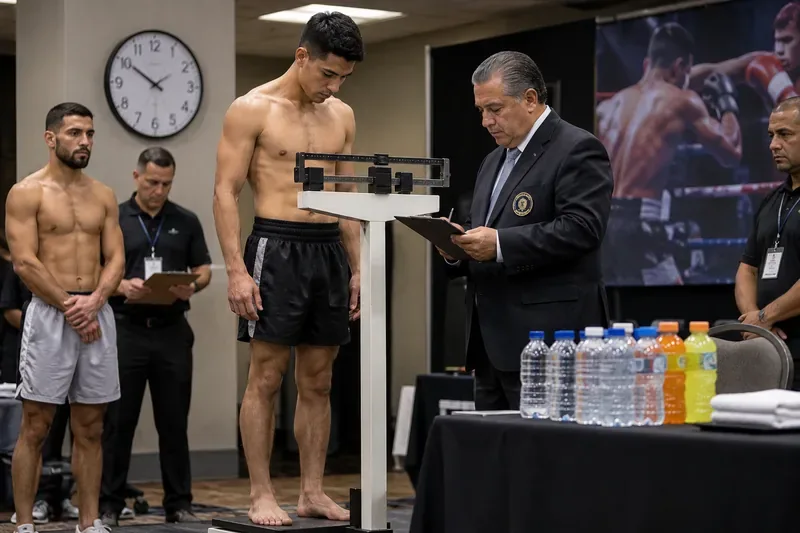
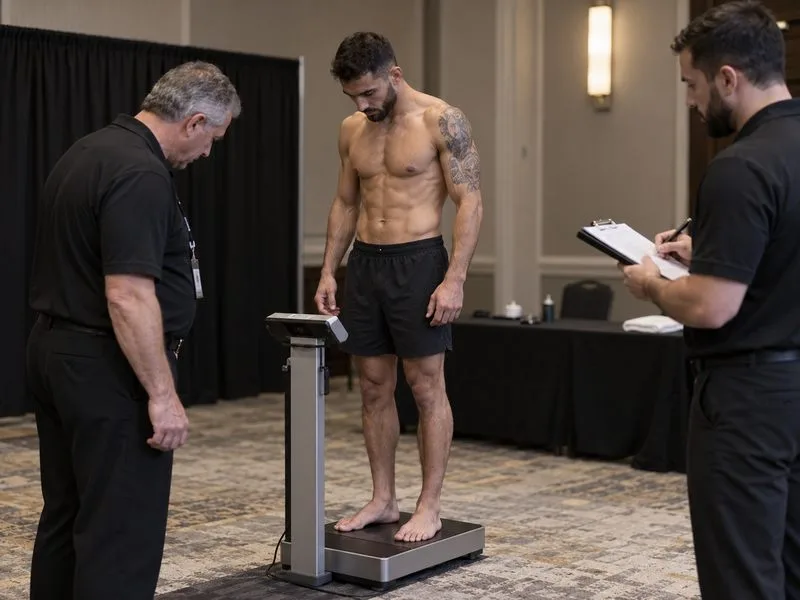
A formal boxing weigh-in separates the official scale requirement from what happens afterward: recovery, any second weigh-in, and title-specific limits may all be governed by different rules.
Same-day and day-before weigh-ins solve different problems
A day-before weigh-in normally means the official scale takes place roughly a day before the bout. The main advantage is recovery time. A boxer who has reduced food and fluid intake can begin eating, drinking and restoring glycogen after making weight. The tradeoff is that more recovery time can make a deeper cut appear more manageable, because a fighter expects many hours to regain weight.
A same-day weigh-in places the official weight check on the day of competition. In Olympic-style boxing, this model is well established. World Boxing’s competition rules state that boxers generally weigh in in the morning on competition days and must make weight on the day they box; the interval from the end of the daily weigh-in to the first bout must be at least three hours. See the World Boxing competition rules.
The practical tradeoff is straightforward: with only a few hours before competition, a boxer has less opportunity to regain several pounds after a severe cut. That can reduce the incentive to arrive at the scale heavily depleted. However, the same short recovery window also means that a boxer who does dehydrate aggressively has less time to normalize fluid balance before fighting.
Issue
Day-before weigh-in
Same-day weigh-in
Recovery time
Usually much longer
Usually much shorter
Potential reward for a large cut
Higher, because more regain is possible
Lower, because recovery time is limited
Risk if a boxer still dehydrates heavily
Recovery may remain incomplete despite more time
Less time is available to correct dehydration
Common setting
Professional boxing
Olympic-style tournament boxing
Need for extra rehydration rules
Often more relevant because regain can be large
May be less central, depending on the competition rules
What a rehydration clause actually means
A rehydration clause is a rule or contractual term that limits how much a boxer may weigh at a later checkpoint after the official weigh-in. It is not the same thing as the original division limit. For example, a fighter might make 135 pounds at the official weigh-in and then face a separate next-morning or fight-day ceiling.
Some rehydration clauses are privately negotiated in bout contracts. Others come directly from a sanctioning body. The wording matters: the clause may specify a fixed number of pounds, a percentage above the official weight, a particular time, a particular scale, and consequences for exceeding the cap. Because contract terms are not standardized across professional boxing, readers should not assume that a limit reported for one bout applies to another.
For a boxer or manager, the useful question is not simply “Is there a rehydration clause?” It is: Who imposed it, when is the second weighing, what is the exact cap, and what happens if the boxer is over?
IBF title fights show why the second weigh-in can change title eligibility
The International Boxing Federation provides one of the clearest examples of a sanctioning-body rehydration limit. Its current championship rules, published in a June 2025 version, provide for an initial weigh-in generally 20 to 30 hours before the first bout on the card, or at a time determined by the local commission. They also require a second weigh-in between 8:00 a.m. and 10:00 a.m. on the morning of the event unless otherwise approved. The second-day rule is waived for heavyweight championships and unification bouts. See the IBF championship contest rules.
The IBF no longer describes the second-day requirement as a universal flat 10-pound cap across every division. Its published second-day guideline lists specific ceilings by weight class. Examples include 145 pounds after a 135-pound lightweight weigh-in, 158 after a 147-pound welterweight weigh-in, 172 after a 160-pound middleweight weigh-in, 188 after a 175-pound light-heavyweight weigh-in and 214 after a 200-pound cruiserweight weigh-in. The IBF second-day weigh-in guidelines contain the full table.
The title consequence is important. Under the IBF rules, a champion who fails the second-day limit after the permitted additional period, or fails to appear, can forfeit the title on the scale. If the challenger is compliant, the contest may continue with the vacant title available only under the conditions set out in the rules. If the challenger is the one who fails the second-day requirement, the champion can retain the title regardless of the bout result. Vacant-title and elimination bouts have their own consequences.
This is more than a private money penalty. It can determine whether a championship can be won, retained or left vacant.
The WBC uses a different model: staged weight management plus a fight-day check
The World Boxing Council takes a different approach. Its current published rules require pre-bout safety weigh-ins for non-heavyweight championship participants at 30, 14 and 7 days. The stated limits are no more than 10% above the division limit at 30 days, 5% at 14 days and 3% at 7 days. The same rules incorporate the WBC Weight Management Program and a day-of-bout weighing protocol. See the WBC Rules and Regulations.
The WBC also describes an arena weigh-in intended to monitor post-weigh-in gain, with fighters not to exceed 10% above what they recorded at the official weigh-in. That percentage model differs from the IBF’s division-specific second-day limits. For teams, that means “rehydration rule” is not enough information; the formula can be materially different depending on the sanctioning body.
Local commission rules still matter
Sanctioning-body rules do not replace the authority of the commission that licenses and regulates the event. Nevada illustrates the distinction. Its current unarmed-combat rules require each contestant to be weighed in the presence of the opponent, a commission representative and a promoter representative at a time and place designated by the executive director. Nevada also states in its official event guidance that a boxer may generally weigh one pound over the contract weight unless the bout is a championship for which the sanctioning body requires otherwise, or the contract marks the weight as a maximum. See the Nevada Rules of Unarmed Combat and the commission’s official event guidance.
That is a useful example of why a familiar “one-pound allowance” should never be assumed for a title fight. Championship rules may be stricter than a commission’s default treatment of ordinary contract weights.
California’s regulations likewise show that weigh-in administration is jurisdiction-specific. The California State Athletic Commission laws and regulations manual sets its own procedures and weight classifications. The practical lesson is to verify the commission rule for the actual venue, not rely on what happened in a different state or country.
Why more recovery time does not guarantee full rehydration
The physiological tradeoff is easy to oversimplify. A boxer can regain body mass quickly without necessarily restoring every aspect of hydration and recovery.
An original study of 17 elite amateur boxers found that the group using rapid weight loss reduced body mass by an average of about 5.6% and showed decreases in total body water, blood volume and plasma volume. The authors concluded that the rapid loss produced hypohydration. See the study indexed by the U.S. National Library of Medicine: Rapid weight loss and the body fluid balance and hemoglobin mass of elite amateur boxers.
Another study analyzed 71 IBF title fights and 142 boxers using first- and second-weigh-in data. Average weight gain between the two weigh-ins was 2.52 kg, or 3.8% of initial body weight, with substantial individual variation. The study did not find a significant relationship between weight gain and fight outcome, but it documented that substantial rapid regain occurs in professional boxing. See Rapid weight gain in professional boxing and correlation with fight decisions.
Those findings support a cautious interpretation: a longer interval allows more recovery, but the number on the scale is not a complete measure of hydration status, neurological recovery or medical readiness.
Which format fits which competitive goal?
For a multi-day Olympic-style tournament
Same-day weighing fits a system in which boxers may compete repeatedly across several days and must remain within their assigned category. It reduces the opportunity to make one severe cut, regain a large amount, and carry that advantage through the event. The tradeoff is that athletes who cut aggressively anyway have limited recovery time.
For a professional title fight with a long recovery window
A day-before official weigh-in gives medical staff and boxers more time between the scale and the bout, but a sanctioning body may add checkpoints to discourage very large rebounds. The IBF’s second-day limits and the WBC’s staged monitoring are two different attempts to manage that problem.
For a negotiated catchweight or non-title bout
A private rehydration clause can be used when the parties want an additional ceiling beyond the official scale. The key tradeoff is certainty versus flexibility: a strict cap can reduce a large size rebound, but it also creates another deadline that could encourage a boxer to remain lighter or more depleted for longer. The exact medical and competitive effect depends on the timing, the size of the cap and the boxer’s weight-management method.
How to read a bout’s weight rules without getting misled
Before treating a reported weight clause as decisive, check four separate layers:
Commission rule: Which government or athletic commission regulates the event, and when does it require the official weigh-in?
Sanctioning-body rule: Is an IBF, WBC, WBA, WBO or other title actually at stake, and does that organization impose a second-day, fight-day or advance weight check?
Bout contract: Is there a privately negotiated rehydration clause, catchweight, “maximum” designation or financial penalty?
Title consequence: Does missing a checkpoint merely trigger a contractual penalty, or does it change who can win or keep the championship?
Do not merge those layers. A fighter can satisfy the commission’s official scale requirement yet still violate a sanctioning-body second-day limit. Conversely, a contractual clause may impose a stricter post-weigh-in ceiling than the commission requires.
What the rules can and cannot tell you
Weigh-in timing is a regulatory tool, not a direct measurement of safety. Day-before systems allow more recovery but can encourage larger cuts. Same-day systems reduce the time available for large rebounds but can leave too little time to recover if a boxer arrives dehydrated. Rehydration caps may limit size gain, but a scale alone cannot establish whether a boxer is fully hydrated or medically ready.
For readers evaluating a specific fight, the most reliable approach is therefore rule-specific rather than slogan-specific. Identify the jurisdiction, the sanctioning organization, the exact contract weight, the official weigh-in time, every later weight checkpoint and the consequence attached to each one. That tells you far more than simply hearing that a bout has a “rehydration clause.”
Bottom line
Same-day and day-before weigh-ins create different incentives. A day-before weigh-in favors recovery time but permits greater weight regain. A same-day weigh-in narrows that rebound window but makes aggressive dehydration harder to correct before competition. Rehydration clauses add another control, yet their meaning depends on whether they come from a private contract or a title organization.
For professional championship boxing, the decisive document is often the sanctioning body’s current rulebook combined with the local commission’s regulations. For Olympic-style competition, same-day tournament rules are more common. In either setting, the safest interpretation is to treat weight limits as multiple checkpoints with separate purposes—not as one universal rule that applies to every boxing match.