Freestyle wrestling can look simple on the scoreboard—one wrestler’s points against the other’s—but the value of an exchange depends on control, position, danger, continuity and where the action finishes. Under the United World Wrestling (UWW) International Wrestling Rules in force from January 1, 2026, the familiar building blocks remain: one-point step-outs, two-point takedowns and exposures, higher-value throws, and a 10-point margin for technical superiority in freestyle. The practical challenge is understanding when those outcomes overlap and what a wrestler gives up by choosing one scoring route over another.
This guide uses the UWW Olympic Wrestling Rules page and the January 2026 International Wrestling Rules as the primary references. Rules can be revised between seasons, so athletes, coaches and officials should confirm the edition used by their event.
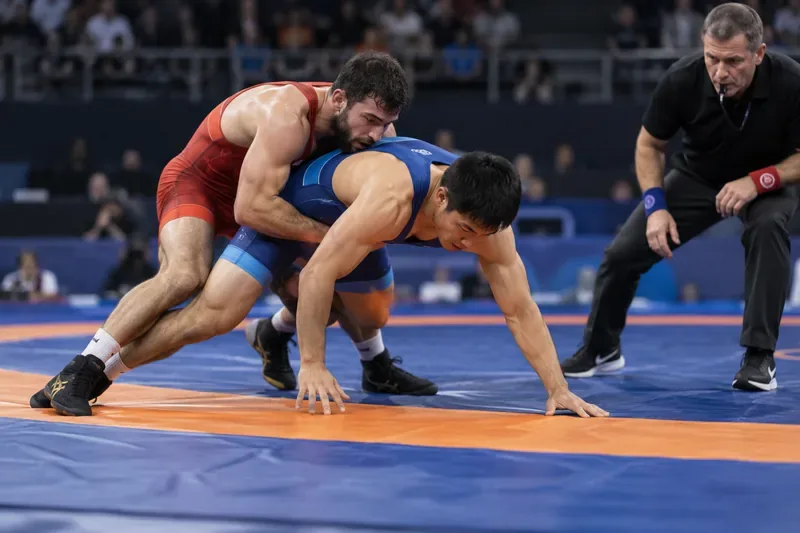
Two freestyle wrestlers contest control near the boundary, where a completed takedown, continued action or a simple step-out can produce different scoring outcomes.
The quickest way to read a freestyle score
For U20, U23 and senior wrestling, a bout is two three-minute periods separated by a 30-second break. The points from both periods are added together. A fall ends the bout immediately, while technical superiority ends a freestyle bout when one wrestler establishes a 10-point advantage, subject to the action being completed and the wrestlers returning to a neutral position before the result is declared.
| Common scoring event | Typical value | What the referee is looking for |
|---|
| Step-out | 1 point | An opponent goes into the protection area with one entire foot in standing wrestling, without a completed scoring hold |
| Takedown / go-behind control | 2 points | The attacker overcomes the opponent and establishes control, including the required points of contact |
| Exposure / danger position | 2 points | The opponent’s back is brought below 90 degrees to the mat, or the opponent rolls through the danger position |
| Dynamic throw to danger | 4 points | A standing action brings the opponent directly into danger in a continuous, dynamic motion |
| Grand-amplitude throw to immediate danger | 5 points | A high-amplitude action brings the opponent directly and immediately into danger |
Those values are not interchangeable labels. A “takedown” is not automatically any moment when someone touches the mat, and “exposure” is not simply a dramatic roll. UWW scoring is tied to defined control and position criteria.
Takedowns: reliable points, but control matters
A common two-point takedown occurs when a wrestler gets behind, overcomes the opponent and establishes control. The 2026 rules specify that three of seven possible contact points—hands, knees, head or elbows—must be touching the mat simultaneously for this form of control. A correct and complete throw that puts the opponent prone or on the flank can also be worth two points when the defender loses control during the throw.
The tactical appeal of a standard takedown is predictability. A low single, double leg or go-behind may offer a comparatively direct route to two points while keeping the attacker in top position for a possible turn. The tradeoff is that a conservative finish may leave points on the table if a higher-value action was available.
When a two-point finish makes sense
- Protecting a lead: securing control can be more valuable than attempting a riskier throw that exposes the attacker to a counter.
- Setting up par terre offense: the initial two points can become the start of a scoring sequence if the top wrestler can turn the opponent.
- Late-clock management: a clean takedown may be enough when the score situation does not require a four- or five-point action.
By contrast, when a wrestler needs several points quickly, choosing a low-risk takedown may consume too much time compared with an action that puts the opponent directly into danger. That is a score-and-clock decision, not a universal rule about which technique is “better.”
Exposure: why turns can change a bout fast
Exposure is scored when the defender enters the “danger position.” UWW defines that position around the back or shoulder line forming an angle of less than 90 degrees to the mat while the wrestler resists being pinned. A wrestler can also be exposed by rolling onto the shoulders or turning the back through that danger angle.
A standard exposure is worth two points. The important practical distinction is that exposure can follow a takedown, so one attack may create a multi-part scoring sequence: two for gaining control, then additional points for turning the opponent. In par terre, repeated turns can quickly widen the score if each action satisfies the rules for a new scoring action.
This creates a classic tradeoff. The top wrestler can try to keep pressure and pursue turns, which offers rapid scoring but may create space for a reversal. The bottom wrestler’s priority is usually to return to a defensible position, stand up or counter. UWW’s rules allow the wrestler underneath in freestyle to counterattack and stand, so top control is valuable only while it can be converted safely.
Step-outs: one point can be strategically huge
A normal standing step-out gives one point to the opponent of the wrestler who puts one entire foot into the protection area without executing a scoring hold. That seems simple, but the boundary rules deliberately distinguish meaningful attacks from mere pushing.
The January 2026 rules state that when a wrestler deliberately pushes an opponent into the protection area with no meaningful action, the wrestler is no longer automatically rewarded with the step-out point; the referee may instead give only a verbal warning. That matters because boundary pressure is supposed to reward wrestling activity, not turn the bout into a pure shoving contest.
There is another important tradeoff at the edge: the attacking wrestler may step into the protection area first while completing a hold. If the action continues successfully, the attacker can still receive the appropriate 1, 2, 4 or 5 points. If the attacker fails to complete the hold, one point may go to the opponent. If the attacker lifts and controls the opponent but cannot finish the hold in one continuous action, the referee can stop the bout without awarding a point.
How to think about the edge
- If you need one point: sustained, legitimate pressure that produces a true step-out can be efficient.
- If you have a strong scoring hold: keep completing the action rather than abandoning it merely because your own foot reaches the protection area first.
- If you are defending: circling back toward the center can deny easy boundary points, but overreacting can expose your legs or back.
A grounded defender can also concede a step-out point: under the current clarification, if the defensive wrestler steps out of the protection area while on the knees, the attacking wrestler is awarded one point.
Why four- and five-point actions change the risk calculation
Although many freestyle exchanges score one or two points, the UWW rules also award four points for several higher-impact actions, including a continuous dynamic standing hold that brings the opponent into danger. Five points are reserved for grand-amplitude throws that place the defender directly and immediately into danger.
These actions can transform a bout because they compress scoring into a single exchange. A wrestler trailing by six points may need three ordinary takedowns if nothing else follows, but a four-point action plus a turn changes the arithmetic dramatically. The tradeoff is mechanical and positional risk: high-amplitude attacks can require deeper commitment, and a failed attempt may leave the attacker underneath or near the boundary.
For spectators, the useful rule is to watch the defender’s landing and back angle, not just the size of the throw. A spectacular-looking lift is not automatically worth five. The scoring value depends on how the action is executed and where the defender is placed.
Technical superiority: the 10-point threshold is a margin, not a target score
In freestyle, technical superiority is reached when one wrestler leads by 10 points. That means scores such as 10-0, 12-2 or 15-5 all meet the margin. It does not mean that 10 points by itself always ends the bout; a score of 10-4 is only a six-point difference.
UWW also specifies that the bout is not interrupted for technical superiority in the middle of an active scoring situation. The action is allowed to resolve, and the winner is declared after the athletes return to a neutral position and the mat chairman confirms the margin.
This detail affects tactical choices. A wrestler leading by eight does not necessarily need a spectacular finish: a two-point takedown can reach the 10-point margin. A wrestler leading by nine may be able to finish with a legitimate step-out. On the other side, a wrestler close to the threshold has to balance urgency against the danger of giving away the final point through an uncontrolled attack near the edge.
Choosing the right scoring route for the match situation
| Situation | Lower-risk option | Higher-upside option | Main tradeoff |
|---|
| Leading late | Secure control, defend center | Continue turning from top | Extra points versus reversal or scramble risk |
| Trailing by 1 | Pressure for a legitimate step-out | Attack for a takedown | Boundary efficiency versus greater scoring value |
| Trailing by several points | Chain takedowns | Seek exposure or a four-/five-point action | Predictability versus faster scoring |
| Leading by 8 or 9 | Use the simplest legal score available | Pursue a larger action | Closing the bout versus unnecessary exposure to counters |
For athletes and coaches, the score, remaining time, position on the mat and opponent’s defensive style should determine the preferred route. For viewers, the most useful habit is to separate four questions: Who established control? Did the defender enter danger? Did either wrestler step into the protection area first? Did the scoring action continue cleanly through the boundary situation?
A final checklist for reading freestyle wrestling scores
- A standard takedown or exposure is commonly worth two points.
- A standing step-out is normally one point, but deliberate non-wrestling pushes are treated differently.
- Dynamic throws into danger can score four, while grand-amplitude throws into immediate danger can score five.
- Exposure can follow a takedown, so one attack may produce multiple scoring actions.
- Freestyle technical superiority requires a 10-point lead, not simply reaching 10 points.
- At U20, U23 and senior level, regular time is two three-minute periods, and scores from both periods are combined.
For the official definitions and edge-case clarifications, consult the UWW International Wrestling Rules, January 2026 edition. UWW also provides a concise overview of Olympic wrestling scoring on its official “The Sport” page.