Home
» 🧭 Other Sports
»
Gymnastics Scoring Explained: Difficulty, Execution, Neutral Deductions, and Inquiries
Gymnastics Scoring Explained: Difficulty, Execution, Neutral Deductions, and Inquiries
Artistic gymnastics scores can look simple on a scoreboard and still be difficult to decode. A gymnast may show a 5.8 difficulty score, an 8.233 execution score, and then finish below the sum of those numbers because a separate penalty has been applied. The key is to read the result in layers: Difficulty (D), Execution (E), and any neutral deductions or other penalties.
As of September 30, 2026, the FIG rules index lists the Women’s Artistic Gymnastics Code of Points for 2025–2028 with an August 27, 2026 posting date, while the Men’s Artistic Gymnastics Code of Points for the same cycle is listed with an April 25, 2025 date. The core scoring structure remains the familiar open-ended system: D and E are calculated separately, then applicable penalties are taken from the score. The current source documents are available through the FIG rules library.
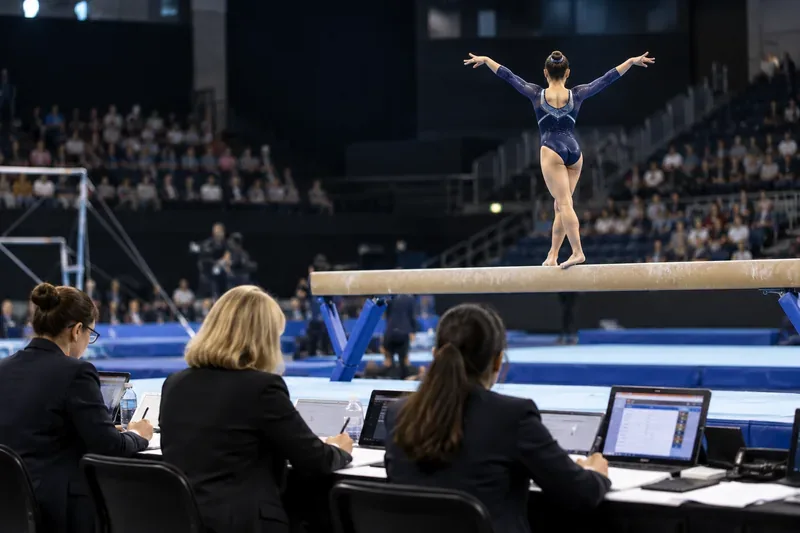
A balance beam routine is evaluated by separate judging functions: difficulty determines what receives credit, while execution judges assess how well the routine was performed.
The basic formula: D-score plus E-score, then penalties
For artistic gymnastics, a useful shorthand is:
Final score = D-score + E-score − applicable neutral deductions or penalties.
The exact components of the D-score vary between men’s and women’s events, and vault uses its own difficulty tables. But the split between content and performance is fundamental. The FIG Women’s Artistic Gymnastics Code of Points states that the D-Jury establishes the content score and the E-Jury establishes execution and artistry. The FIG Men’s Artistic Gymnastics Code of Points likewise uses separate D and E scores.
Score component
What it measures
Typical question to ask
D-score
Recognized difficulty and composition content
What skills and connections actually received credit?
E-score
Execution, technique, body position and, in WAG where applicable, artistry
How cleanly was the recognized routine performed?
Neutral deductions / penalties
Specified rule violations handled separately from ordinary E deductions
Was there a line, time, short-exercise or other prescribed penalty?
Difficulty: why the D-score is open ended
The D-score does not start from 10. It is built upward from recognized content. That is why one gymnast can have a 5.2 D-score and another a 6.0 without either number being “out of 10.”
Women’s artistic gymnastics
On uneven bars, balance beam and floor exercise, the WAG Code says the D-score includes the highest counting difficulties, composition requirements, connection value and bonus where applicable. Difficulty values rise in tenths: A is 0.10, B is 0.20, C is 0.30, and so on through progressively harder elements. Vault is different: the vault itself has a listed difficulty value.
The important viewing point is that attempted difficulty is not automatically credited difficulty. The D-Jury decides whether an element met the technical requirements for recognition, whether connections qualify, and whether composition requirements were satisfied.
Men’s artistic gymnastics
MAG also builds the D-score from counting elements plus applicable element-group requirements and connection value. The current MAG Code specifies the counting framework for each apparatus. Because the rules differ by apparatus, a raw D-score should be interpreted as the credited content of that specific routine, not as a universal percentage.
Execution: starting from 10 and deducting mistakes
The E-score works in the opposite direction. It starts from 10.000, then judges deduct for visible execution, technique and presentation faults under the relevant code. Small form errors cost less than major faults; larger deviations, major landing errors and falls can be much more expensive.
This creates an important tradeoff. Adding difficulty can raise the D-score, but if the harder routine causes extra execution deductions, the final score may not improve. A routine with lower difficulty can therefore beat a harder routine if the execution gap is large enough.
For WAG, the current code also treats artistry as part of the E-side evaluation on the apparatus where artistry criteria apply. In MAG, the E-score covers exercise presentation, including execution, technique, body position and composition-related presentation requirements defined by the code.
What neutral deductions are — and what they are not
A neutral deduction is not simply another synonym for an execution deduction. It is a separately prescribed penalty, normally applied after the D and E components have been determined. On a results display, it may appear as “ND” or another penalty field.
Common examples include boundary and time violations, but the exact list depends on apparatus and discipline. On WAG floor exercise, for example, the current Code specifies a 0.10 penalty for one foot or hand outside the boundary and 0.30 when both feet, both hands or another body part are outside. It also specifies a 0.10 overtime penalty when the routine reaches 91 seconds or more. Those line and time violations are reported to the D-Jury and taken from the final score.
MAG has its own floor boundary and timing rules. The current MAG Code similarly assigns line penalties and directs the D1 judge to ensure the relevant deduction is taken from the final score. Short exercises can also trigger significant neutral deductions under the applicable rules, which is why an interrupted routine can produce a surprisingly low total even if the E-score itself does not look catastrophic.
A simple scoring example
Suppose a gymnast receives a D-score of 5.800. The E panel produces a final E-score of 8.233. Before neutral deductions, the total is 14.033. If a 0.10 line penalty applies, the final score becomes 13.933.
This example is only arithmetic, not a reconstruction of any real competition. It shows why looking only at D and E can be misleading: the scoreboard may contain a third line that changes the final number.
What can be challenged through an inquiry?
At FIG-organized or FIG-sanctioned competitions, the inquiry process is much narrower than many fans assume. Under the FIG Technical Regulations 2026, only the Difficulty score may be the subject of a formal inquiry in the disciplines covered by that rule, with the stated exception of Parkour where no inquiry is admitted. For artistic gymnastics, that means a federation can challenge whether the D-score was calculated correctly; it cannot use a standard D-score inquiry simply because it disagrees with the E-score.
The inquiry is submitted by the designated National Federation authorized representative for that gymnast. It must be made verbally immediately after the score is published and, at the latest, before the next gymnast’s score is shown. For the final gymnast in a rotation, the deadline is one minute after the score appears. Meet procedures can add operational details, so teams must still follow the event directives.
The reviewing panel can increase the D-score, leave it unchanged, or reduce it. An inquiry therefore is not a risk-free request for “more points.”
Inquiry fees under the 2026 FIG Technical Regulations
First inquiry during the competition: CHF 300.
Second inquiry: CHF 500.
Each subsequent inquiry: CHF 1,000.
If the D-score is increased, the fee is waived.
If the D-score stays the same or is reduced, the fee is charged.
The regulations also state that an inquiry cannot be withdrawn once submitted.
Can a neutral deduction be reviewed?
This is where the terminology matters. The 2026 FIG Technical Regulations separate formal D-score inquiries from requests to revise certain time or line deductions or bonuses when the relevant Code of Points allows such a request. Those requests follow the same general procedure and deadlines but do not carry an inquiry fee.
However, the regulations specifically say that requests to revise other neutral deductions or penalties are not permitted. So “there is a neutral deduction” does not automatically mean a coach has a general right to challenge it.
How to read a gymnastics score quickly
Find the D-score. This tells you the difficulty and content that were actually credited.
Find the E-score. Compare it with 10.000 to understand the total execution and presentation deductions.
Look for ND or penalty fields. Do not assume D + E must equal the displayed final score.
Check apparatus-specific rules. Vault, bars, beam, floor and the six MAG apparatus do not build D-scores identically.
If an inquiry appears, remember its scope. A formal FIG inquiry addresses difficulty, not an ordinary disagreement with execution judging.
The safest way to interpret a disputed score
Start with the official result breakdown, then check the applicable edition of the Code of Points and Technical Regulations. Avoid assuming a low final score means the judges “took points twice.” An execution deduction and a neutral penalty can legitimately coexist because they address different rule categories.
For the current cycle, the most reliable starting point is the FIG rules page, which lists the active 2025–2028 Codes, appendices, help desks and judges’ rules. The 2025–2028 Code of Points Appendix also contains cross-discipline procedures such as the restricted use of video review systems for inquiries and blocked scores.
For national, collegiate, junior or domestic competitions, do not assume every FIG provision applies unchanged. Those competitions may use modified codes, different inquiry fees, different timing rules or different composition requirements. Always verify the governing rulebook for the specific meet.