Home
» ⚾ Baseball
»
MLB Postseason Roster Replacement Rules: When an Injured Player Can Return
MLB Postseason Roster Replacement Rules: When an Injured Player Can Return
For the 2026 postseason, MLB’s September 1 roster explainer restates a rule with a long reach: when a club gets approval to replace an injured player during a series, that player cannot return for the rest of that round or the next round. The earliest return is the round after that, if the club advances and puts the player on its roster. A Division Series replacement, for example, can be eligible again for the World Series, but not the Championship Series.
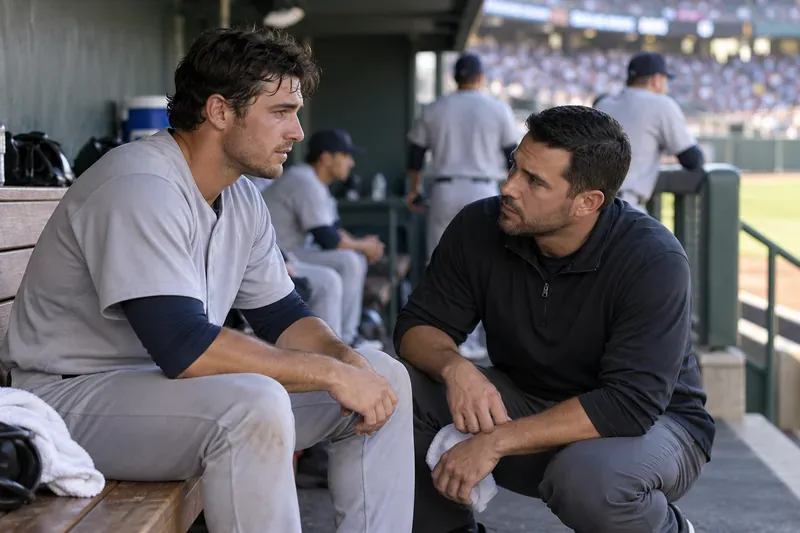
A player talks with a staff member in the dugout; a club must obtain approval before using the postseason injury-replacement rule.
This is a round-based restriction, not a fixed injured-list term such as 10 or 15 days. It also does not apply automatically every time a player feels sore, misses a game, or appears on a lineup card as unavailable. The key event is an approved postseason roster replacement. MLB’s current overview and postseason roster rules and eligibility guidance describe the process; no 2026 change to the replacement sit-out rule was identified in the current MLB materials reviewed.
How the postseason injury replacement works
Teams submit a 26-player roster before each postseason round, and they can submit a new roster before a later round. During a series, if a player becomes unable to play because of an injury, the club may ask the Commissioner’s Office for permission to replace that player. The request is not automatic: the office may approve or deny it based on the facts and circumstances. The player being replaced must be injured, and MLB can review the medical information.
There is also a position constraint: a pitcher can be replaced only by another pitcher, and a position player only by another position player. That prevents a club from using an injury request to make a broad tactical swap, such as replacing an injured outfielder with an extra reliever.
Once approved, the replacement can be used on the roster for the remaining games in that round, subject to the roster rules. The injured player is then unavailable for the rest of the round and the entire next round. If the replacement itself later gets hurt, the club would need to follow the applicable request process again; it cannot assume that an earlier approval makes every subsequent change automatic.
When can the injured player return?
Round in which the player is replaced
Rounds the player must miss
Earliest possible return
Wild Card Series
Rest of the Wild Card round and the Division Series
League Championship Series
Division Series
Rest of the Division Series and the League Championship Series
World Series
League Championship Series
Rest of the LCS and the World Series
No later round that postseason
World Series
Rest of the World Series
No later round that postseason
“Earliest possible” matters. The player does not automatically return when the required round has passed. The club must still believe the player can compete, satisfy any applicable roster and medical requirements, and select the player for the next 26-man roster. The club’s season may also end before another round begins.
For a concrete example, MLB approved the Dodgers’ 2025 NL Division Series request to replace pitcher Tanner Scott with pitcher Justin Wrobleski. MLB stated Scott would be ineligible for the NL Championship Series but eligible for the World Series if Los Angeles advanced. That example follows the same two-round calculation: miss the remainder of the current round, then miss the next one.
What does “replaced” mean for a player’s return?
A formal injury replacement changes postseason roster status; it is not the same as removing a player from one day’s starting lineup. If a player stays on the club’s series roster but is held out of a game, the special replacement penalty has not necessarily been triggered. The club could use that player later in the same round if the player is medically available and the roster remains unchanged. This distinction is why news reports often say that a player was “replaced on the roster” rather than simply “out of the lineup.”
The rule also differs from normal injured-list timing. An injured-list stint during the regular season has a minimum number of days, but postseason replacement eligibility is measured by rounds. A player could be medically ready well before the blocked round ends and still be ineligible because the team obtained approval to replace him. Conversely, a player who was merely rested and not formally replaced does not face this particular two-round restriction, though the club still has to follow roster rules.
Which replacement players are eligible?
For the 2026 postseason, MLB’s current rules overview says players on a club’s 40-man roster before September 1, along with players on the 60-day injured list at the stated cutoff, are generally eligible for postseason play. A player outside those categories may be added by petition to the Commissioner’s Office if the player was in the organization by August 31 and is replacing an injured player who has completed the minimum injured-list time needed for activation. Players acquired after August 31 are not eligible under the published overview.
This is a separate question from whether the injured player can return. The club first has to identify an eligible replacement or obtain the required eligibility approval; then, once the replacement is approved, the injured player’s return is governed by the round restriction. If a player’s eligibility depends on a specific transaction, injured-list date, suspension, or late-season move, check MLB’s rules for that season rather than relying on a generic summary.
What changes if the injury happens between rounds?
The in-series replacement rule is written for an injury during the course of a series. Because teams submit a roster for each round, they can make roster decisions before a later series begins. If a player was not formally replaced under the in-series procedure, being omitted from one round’s roster should not be casually treated as the same thing as an approved injury substitution. The club still has to meet roster eligibility and submission requirements before bringing that player back.
That distinction can matter when a player is injured after one round ends but before the next roster deadline. The exact timing of the injury, the team’s roster filing, and whether the Commissioner’s Office approved a replacement all affect the answer. The public MLB overview explains the standard rule, but unusual transaction timelines may require the club or league to clarify how it was applied.
A quick way to check a postseason return claim
Find the round and date. Determine whether the injury happened during a series or between rounds.
Look for a formal roster substitution. A player missing a game is not enough; check whether MLB approved a replacement.
Count rounds, not calendar days. A replacement during one round blocks the player for the remainder of that round and the following round.
Check whether the team advanced. The player can only return if there is another eligible round.
Confirm the new roster. Eligibility is not activation; the club must list the player on its roster for the later series.
For example, if a starting pitcher is replaced during Game 2 of the Division Series, the pitcher cannot come back for a later game in that series or pitch in the Championship Series. If the club reaches the World Series, the player may be eligible to return there, but only if healthy and selected. If the team is eliminated in the Division Series, there is no later roster on which to return.
The practical takeaway
An injured MLB player can return after an approved postseason injury replacement only once the rest of the current round and the next round have both passed. The player’s return is possible—not guaranteed—and depends on the club advancing, the player being medically ready, and the club adding him to its next series roster. For the latest season-specific eligibility details, consult MLB’s 2026 postseason roster rules explainer and compare a reported transaction with the official 2025 Dodgers roster-substitution announcement.