Rain in October creates a different kind of baseball problem. Fans may be deciding whether to stay at the ballpark, travelers may be weighing hotel or flight changes, and fantasy or betting-minded readers may be trying to work out whether the announced starting pitcher will still take the mound. The safest way to handle all three questions is to separate them: the game-status rule, the ticket rule, and the pitching decision do not operate the same way.
The explanations below use the 2026 Official Baseball Rules, MLB's official suspended-game glossary, official 2026 postseason ticket terms, and MLB's probable pitchers page. Rules and event-specific instructions can still be updated, so the final authority for a particular postseason game is MLB's announcement and the host club's official ticket communication.
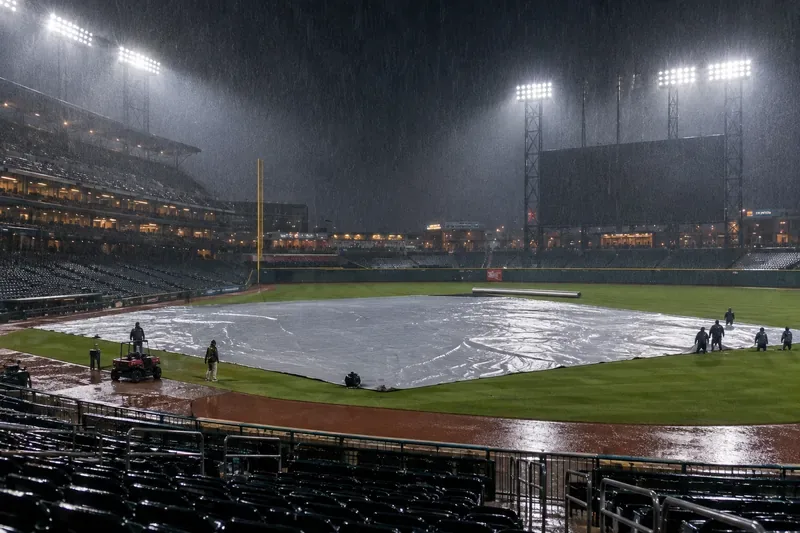
A tarp covers the infield during heavy rain at a baseball stadium. In a postseason delay, the important questions are whether play is merely delayed or formally suspended, what MLB announces for ticket holders, and whether the pitching plan changes.
A hypothetical playoff night: three decisions, three different answers
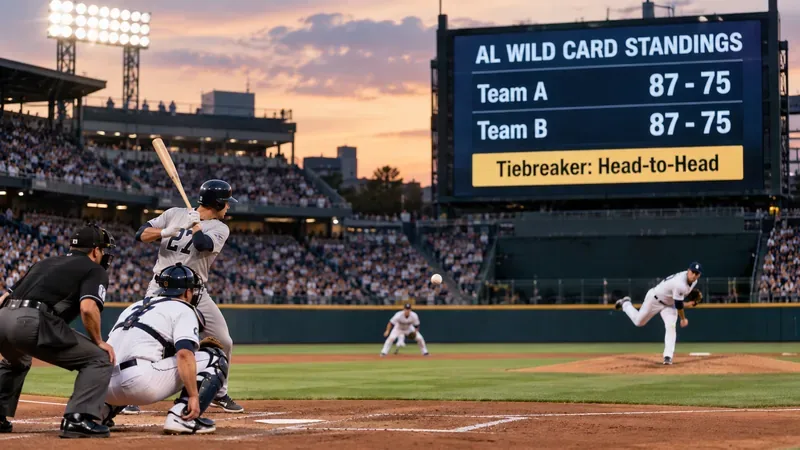
Illustrative example: imagine a best-of-five postseason series in which Game 2 starts at 7:08 p.m. The home starter throws three innings before heavy rain arrives. The score is 2-2, the tarp goes on, and the delay lasts long enough that MLB announces the game will not continue that night. A fan named Alex has a ticket for the game, a train reservation the next morning, and has also been following the listed probable starter for the next scheduled game.
Alex now has three separate questions:
Does Game 2 restart from the beginning, or resume from the exact point where it stopped?
Is the original ticket still valid when the game resumes?
Will the same pitcher necessarily return, and does the delay force a change to the next game's probable starter?
The practical answer is that each question depends on a different rule or decision process.
1. What happens to a postseason game stopped by rain?
For a suspended game, the core principle in the 2026 Official Baseball Rules is continuity. Rule 7.02(h) says a suspended game resumes at the exact point of suspension and is treated as a continuation of the original game. The lineup and batting order remain as they were at the moment play stopped, subject to normal substitution rules.
That matters in the hypothetical example. If Game 2 is suspended after three innings with the score tied 2-2, those three innings are not erased. The game does not become a fresh nine-inning contest the next day. It resumes from the same game state, with the same score and lineup structure, although managers may make substitutions that are legal under the rules.
MLB's official glossary also notes that postseason games have long been handled under completion-oriented rules: games stopped before becoming official are resumed rather than simply wiped out and restarted. The 2026 rulebook additionally gives Major League Baseball authority to adopt different procedures for postponing, suspending, resuming or completing Wild Card Series, Division Series, League Championship Series and World Series games.
Delay versus suspension: why the distinction matters
A rain delay means play has stopped but officials still expect that it may resume that day or night. A suspension means the unfinished game will continue later. For a fan making a transportation decision, that distinction is more useful than simply knowing that it is raining.
In the hypothetical example, Alex should not assume that a long delay automatically means the game is over for the night. The useful trigger is an official announcement that the game has been suspended, postponed or rescheduled. Before that announcement, leaving the stadium is a personal choice that may have consequences under the ballpark's re-entry rules.
2. Does the original postseason ticket remain valid?
For 2026 postseason tickets, MLB club terms provide a clear baseline. Official postseason ticket terms published by clubs such as the San Diego Padres and New York Yankees state that when a postseason game is not played or completed on its originally scheduled date, the ticket admits the holder on the date or dates when that same event is rescheduled or resumed, as announced by MLB.
So in the hypothetical Game 2, Alex should retain the ticket in the MLB Ballpark app or the original ticketing account. If MLB resumes that same Game 2 the following afternoon, the postseason ticket is generally tied to the resumed event rather than converted automatically into a ticket for a different game.
What should a ticket holder actually check?
The most useful hierarchy is:
Check the official MLB or host-club announcement for the new date and time.
Open the original ticket in the official ticketing account and look for updated event information.
Read the host club's postseason ticket terms for any venue-specific instructions, including entry, parking and mobile-ticket updates.
If the ticket came from an authorized resale marketplace, check the marketplace's instructions only after the official game status is clear.
One important tradeoff is that a ticket remaining valid does not mean every related expense is protected. Transportation, lodging and parking may have separate policies. Fans with inflexible travel should therefore make decisions based on the official resumption time rather than assuming the ticket itself solves the rest of the trip.
3. Will the same pitcher return after the rain delay?
Not necessarily. The rules preserve the game, but they do not force a manager to use the same pitcher in every resumed situation.
Rule 7.02(h) allows substitutions when a suspended game resumes. A player who was removed before the suspension cannot return, while an eligible player who had not yet appeared may enter as a substitute. The rulebook also addresses a special case involving the three-batter minimum: if a pitcher had not yet satisfied that minimum when the game was suspended, the pitcher may return when play resumes, but is not required to do so. If he does not return, he is treated as having been substituted for and cannot re-enter that game.
For Alex, this means that the starter who threw the first three innings could theoretically continue if he remains eligible and the manager chooses to use him. But after a long interruption or an overnight suspension, the baseball decision can change because of workload, recovery, bullpen availability and the timing of the next game.
A short same-night delay is different from an overnight resumption
This is the most useful practical distinction for pitcher expectations. After a brief delay, a starter may return if the club believes he can safely ramp back up. After a much longer delay, especially an overnight suspension, clubs have more reason to treat the resumed portion like a new pitching segment even though the game itself is not new.
That is a strategic choice, not an automatic rain-delay rule. A manager may prefer to protect the original starter's workload, save another starter for the next scheduled game, or use relievers to finish the suspended contest. The tradeoff is between winning the game currently in progress and preserving pitching resources for the rest of the series.
4. Does a rainout change the next game's probable pitcher?
It can. MLB labels its probable pitchers as subject to change. That wording is especially important after a postseason postponement because the schedule itself may move.
Suppose the hypothetical Game 2 is suspended on Tuesday and completed Wednesday afternoon. Game 3 might then be moved, remain at its original time, or be otherwise adjusted by MLB. A starter originally listed for Game 3 could stay on schedule, move back a day, be used in the resumed Game 2, or be replaced by another option. The answer depends on the club's rotation plan and MLB's revised schedule.
For readers who care most about the pitching matchup, the best practice is not to treat an earlier probable-pitcher listing as a commitment. Recheck MLB's probable pitchers page, the official game preview and the club's lineup announcement after the revised start time is confirmed.
5. What changes if the game never starts?
A game postponed before the first pitch is operationally simpler than a game suspended after several innings: there is no in-game state to preserve. MLB sets a new date and time, and clubs issue ticket instructions for the rescheduled event.
However, probable pitchers may still change. The pitcher who was scheduled for the washed-out date might start the makeup game, or the club might keep the rest of its rotation on schedule. In the postseason, where off-days and series travel are tightly controlled, a single postponement can affect both teams' pitching plans.
6. A practical decision table for fans
Situation
What is most likely to matter
Best action
Rain delay, no suspension announced
Play may still resume the same day
Follow official stadium and MLB updates before assuming the game is over
Postseason game formally suspended
The game resumes from the exact point of suspension
Keep the original ticket and wait for MLB's resumption announcement
Game postponed before first pitch
No game state exists yet; a new start time is needed
Check official ticket and schedule updates
Starter listed before a weather disruption
The listing is not guaranteed
Recheck probable pitchers after the revised schedule is posted
Long or overnight suspension
Managers may alter pitching plans
Do not assume the original pitcher will return
7. Applying the rules to the hypothetical example
Return to Alex and the tied Game 2 after three innings. Once MLB officially suspends the game, the score and game state are preserved. If MLB announces that play resumes the next afternoon, the same Game 2 ticket is generally the relevant admission credential under 2026 postseason ticket terms. Alex should verify the updated event details in the official ticketing account before changing travel plans.
On the baseball side, Alex should not assume that the starter who pitched the first three innings will automatically return. The manager may continue with him if rules and workload permit, or may make a legal pitching change. Alex also should not assume that the pitcher originally listed for Game 3 remains locked in, because the revised schedule can reshape the rotation.
The bottom line
MLB playoff rain delays are easiest to understand when three questions are kept separate. A suspended postseason game continues from the point where it stopped; it is not simply restarted from zero. The original postseason ticket generally follows that same rescheduled or resumed event under 2026 ticket terms. Probable pitchers, however, remain provisional and may change when weather alters rest, workload or the series schedule.
For a specific game, use the official MLB or host-club announcement as the final operational source. That is especially important for the resumption time, stadium entry instructions and pitching matchup, all of which can change after the first weather notice.