Home
» ⚾ Baseball
»
Does MLB Reseed Teams After the Wild Card Series? The 2026 Bracket Rule Explained
Does MLB Reseed Teams After the Wild Card Series? The 2026 Bracket Rule Explained
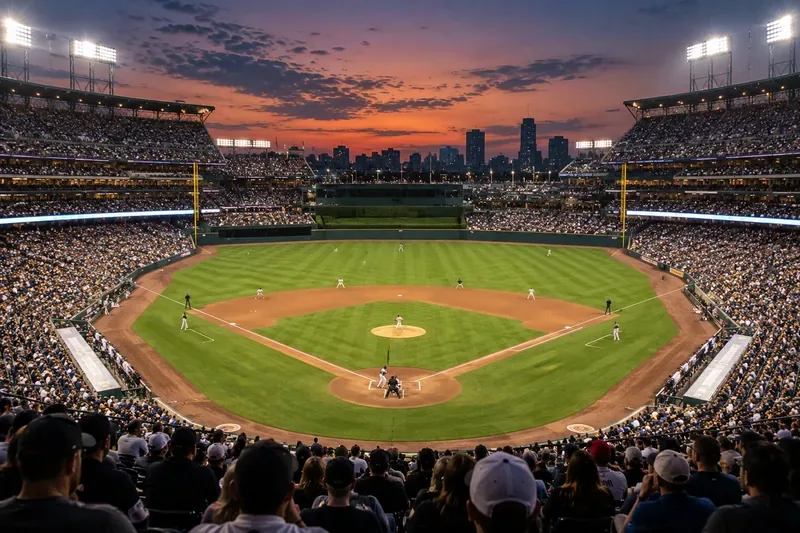
A postseason game unfolds beneath the lights as fans watch from a packed ballpark.
Short answer: no. MLB does not reseed teams after the Wild Card Series. Reseeding would mean ranking the teams that advance again and pairing the highest remaining seed with the lowest. MLB instead keeps its bracket fixed from the start: the winner of the No. 3-versus-No. 6 series goes to the No. 2 seed, and the winner of the No. 4-versus-No. 5 series goes to the No. 1 seed.
That distinction matters when an underdog wins. A No. 6 seed that knocks out No. 3 does not get redirected to No. 1, even if that seems like a fresh way to reward the best remaining team. It follows the existing No. 3/No. 6 branch and meets No. 2. This guide explains how to read the 2026 MLB bracket, what each seed means, and which assumptions can send a new fan down the wrong path.
Start with the six-team bracket in each league
The American League (AL) and National League (NL) each send six clubs to the postseason: three division winners and three Wild Card teams. A Wild Card is a playoff qualifier that did not win its division. Each league has its own bracket through the League Championship Series.
Seeds are the numbered positions assigned to qualifying clubs. The top three seeds are always the division winners, ordered by regular-season record: the best division winner is No. 1, the next is No. 2, and the third is No. 3. The Wild Card teams fill seeds No. 4, No. 5, and No. 6, in order of their records.
Division-winning status comes before record when assigning these groups. A Wild Card club with more regular-season wins than one or more division champions still receives a Wild Card seed, while the division winners occupy Nos. 1–3. That can affect the opening opponent, the bye, and home field.
How the bracket works, round by round
1. The top two seeds receive a bye
A bye is an automatic advance past a round without playing a series in that round. Seeds No. 1 and No. 2 skip the Wild Card Series and move directly to the Division Series (DS). The No. 3 division winner does not receive a bye; it plays the No. 6 seed.
2. The Wild Card Series has two fixed pairings
Each Wild Card Series is a best-of-three: the first team to win two games advances. No. 3 plays No. 6, and No. 4 plays No. 5. The higher seed hosts all games in its series, so No. 3 hosts No. 6 and No. 4 hosts No. 5. A loss ends the losing club’s postseason.
Wild Card matchup
Division Series destination
No. 3 vs. No. 6
Winner plays No. 2
No. 4 vs. No. 5
Winner plays No. 1
3. The Division Series follows the original bracket
The DS is a best-of-five series. The No. 2 seed faces the winner from the No. 3/No. 6 pairing. The No. 1 seed faces the winner from the No. 4/No. 5 pairing. In the 2026 format, the series uses a 2-2-1 home schedule, with the higher seed hosting Games 1 and 2 and, if necessary, Game 5.
The DS winners advance to their league’s best-of-seven League Championship Series (LCS). The AL and NL champions then meet in the best-of-seven World Series.
What “no reseeding” means in practice
Think of each league’s bracket as two lanes. One lane is fixed as No. 1 versus the No. 4/No. 5 winner. The other is fixed as No. 2 versus the No. 3/No. 6 winner. Once the Wild Card Series starts, wins and losses decide who moves forward, but they do not rearrange the lanes.
For example, if No. 5 beats No. 4, No. 5 advances to play No. 1. If No. 6 beats No. 3, No. 6 advances to play No. 2. The surprising result does not trigger a new ranking of the four remaining clubs. The bracket is a set of predetermined routes, not a fresh draw after each round.
In the LCS, the remaining clubs meet within their league, with the higher seed holding home-field advantage. The World Series has a separate home-field rule: the pennant winner with the better regular-season record hosts Games 1, 2, and—if needed—6 and 7. Do not assume a team’s seed within its own league automatically decides World Series home field.
The 2026 bracket: a current example
MLB’s final bracket published September 27, 2026, makes the fixed routes easy to see. In the AL, Tampa Bay is No. 1 and Cleveland No. 2, so both skip the Wild Card round. Houston is No. 3 and hosts No. 6 Chicago; No. 4 New York hosts No. 5 Boston. Houston–Chicago’s winner is assigned to Cleveland, while New York–Boston’s winner is assigned to Tampa Bay.
In the NL, Milwaukee is No. 1 and Los Angeles No. 2. Atlanta (No. 3) hosts Philadelphia (No. 6), and San Diego (No. 4) hosts Chicago (No. 5). Atlanta–Philadelphia’s winner goes to Los Angeles; San Diego–Chicago’s winner goes to Milwaukee. If a lower seed advances, it stays in its bracket lane; MLB does not compare all four survivors and send the top survivor to Milwaukee or the bottom survivor to Los Angeles.
These team names are a snapshot of the official 2026 field as announced on September 27. For any later change to dates, venues, or game status, use MLB’s live postseason bracket rather than an older preview.
How to follow a team’s route
Find its league and seed. Check whether it is the AL or NL and whether it is a division winner or Wild Card club. The seed number is the quickest key to the bracket.
Check for a bye. Seeds 1 and 2 wait for a Wild Card winner; seeds 3 through 6 have to win a best-of-three to continue.
Trace the lane, not the opponent’s rank. A 3/6 winner goes to No. 2. A 4/5 winner goes to No. 1. Do not re-sort survivors by record.
Check the next series schedule. The higher seed has home field in the DS; game dates and start times are posted separately and may be adjusted.
If you are following a club through multiple rounds, write down the route as “3/6 winner → 2” or “4/5 winner → 1.” This shorthand avoids a common mistake: reading the lines on a bracket as if they change whenever an upset happens.
Common bracket mistakes to avoid
Assuming the No. 1 seed automatically plays the lowest remaining seed. That would happen under a reseeding system. MLB’s bracket does not do that after the Wild Card round.
Assuming every division winner gets a bye. Only the top two division winners in each league do. The third division winner is No. 3 and plays in the Wild Card Series.
Assuming the team with the third-best overall record is No. 3. No. 3 is the third-ranked division winner. Wild Card teams are assigned Nos. 4–6.
Assuming a higher record always means a higher seed. Division champions are seeded ahead of Wild Card qualifiers, even if a Wild Card club has more wins than a division winner.
Confusing a bye with home-field advantage. A bye skips the Wild Card Series. Home field determines where a series is played. They are related to seeding but are not the same benefit.
Why MLB keeps the bracket fixed
A fixed bracket makes the postseason path knowable before the first pitch: No. 1 is assigned the 4/5 winner, and No. 2 is assigned the 3/6 winner. It preserves the value of winning a division and finishing ahead of other division champions. It also means the No. 1 seed can face a Wild Card qualifier in the DS rather than another division champion, as MLB’s current format FAQ describes.
The tradeoff is that an upset does not cause a new matchup assignment. A team that survives a tougher series does not get a different route based on its seed or record. Fans who prefer a bracket that rewards every new result may find reseeding more intuitive; fans who want fixed matchups can follow MLB’s present structure by tracking the seed lanes. Neither preference changes the rule for 2026.
Quick answer
For the 2026 MLB postseason, teams are not reseeded after the Wild Card Series. The No. 3/No. 6 winner plays No. 2, and the No. 4/No. 5 winner plays No. 1. To check the path, identify the seed, follow its fixed lane, and consult MLB’s current bracket for schedule updates.