Olympus Map in Apex Legends Explained: POIs and 2026 Changes
The Olympus map in Apex Legends is a floating city above Psamathe, built around wide sightlines, layered buildings, and a Phase Runner that cuts through the map. Its layout has changed enough that older guides can send players to retired POIs or promise a vehicle that is no longer there. This updated guide explains the map’s current landmarks, the Phase Runner, edge hazards, and practical ways to plan a drop and rotate.

What is Olympus in Apex Legends?
Respawn introduced Olympus with Season 7: Ascension in November 2020. The official launch notes describe it as a sky city floating above Psamathe, with gardens, agricultural towers, plazas, and a Phase-energy tunnel. Its bright architecture can make it look open and simple to read, but fights move between exposed outdoor lanes, elevated structures, and enclosed rooms. That mix is why a squad can be visible at long range one moment and trading close-range damage inside a building the next.
The setting remains recognizable, but the Apex Legends Olympus map has received multiple layout updates. The 2025 Amped update replaced several old POIs and added cover to open rotation areas; a March 2026 update moved Elysium again. The names shown in your in-game map are the best reference for the current build.
EA’s Season 7: Ascension patch notes explain Olympus’s original setting and the Phase Runner. Later changes are documented in the Amped patch notes and Aftershock midseason patch notes.
Olympus POIs: what changed and what to learn
If an older Olympus map labels Energy Depot, Docks, or Orbital Cannon, it is out of date. Respawn’s November 2025 update replaced those locations, added a new one, and adjusted cover across parts of the map.
| Current POI or landmark | Update to know | Useful landing or rotation note |
|---|---|---|
| Somers University | Replaced Orbital Cannon in the 2025 Olympus refresh. | Use the current map label when choosing a campus landing; avoid splitting the squad across separate building clusters before you have weapons. |
| Gravity Engine | Replaced Energy Depot. | Old guides that call this Energy Depot are referring to the former POI, not the current name. |
| Stabilizer | Replaced Docks. | Check the live map before setting a drop plan from an old route video. |
| Dockyard | Added as a new POI in the 2025 update. | Learn its current approaches in-game instead of relying on pre-update callouts. |
| Elysium | Moved to the northeast corner near Rift in March 2026. | Older landing guides may show it near its previous position. |
Other familiar landmarks include Estates, Hammond Labs, Bonsai Plaza, Solar Array, Gardens, Hydroponics, Oasis, Clinic, Phase Driver, and Terminal. Their exact routes and surrounding cover can change, so treat a POI name as a starting point, not a promise that an old screenshot still matches. For example, the Amped update added cover around Phase Driver, Oasis, Clinic, Hammond Labs, and Estates, and adjusted several local approaches.
How the Phase Runner works
The Phase Runner is a fast-travel tunnel of Phase energy running through Olympus. Entering it moves you quickly between linked parts of the map, which can shorten a rotation or help your squad cross a central lane. The Terminal is a large interior routing area built around an opening in the tube; Respawn’s Olympus update describes it as a connected combat and movement space, not a guaranteed safe room.

Use the tunnel with a plan. A fast route is also a predictable route: another team can watch an entrance or wait near an exit. Before committing, check the ring, listen for nearby fights, and decide where your squad will move after emerging. The Phase Runner can help with timing, but it does not make a bad ring route safe or protect you from a team holding the destination.
Are Tridents still on Olympus in 2026?
No. Tridents are not part of the current Olympus map rotation. They were a signature feature when Olympus launched, but Respawn removed Tridents from Olympus in the 2026 Overclocked update. Guides that recommend grabbing one for a rotation are describing an earlier version of the map. The update says the change was intended to put more of the map-traversal role back on Legend abilities and team composition. Check the Overclocked patch notes for that change.
How Olympus plays: sightlines, cover, and map edges
Olympus rewards squads that read both distance and elevation. Long outdoor sightlines make careless crossings risky, while buildings and large POIs create close-quarters fights. The later cover pass reduced some exposed transitions, but open ground still appears between landmarks. Move from cover to cover, avoid standing still to heal in a lane, and use doors, walls, terrain, and structures to break enemy sightlines.
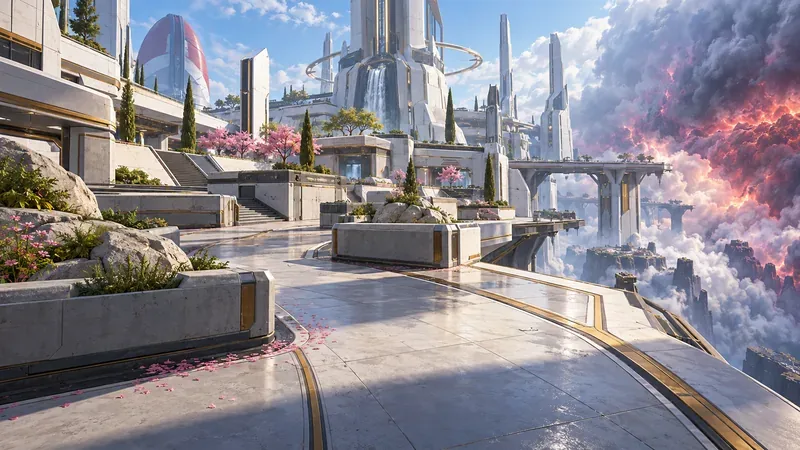
The map’s floating platforms create a second hazard: an outer edge can be a fatal drop. During a fight near the rim, keep the drop behind the enemy when you can, preserve room to strafe, and avoid using knockback or movement abilities without checking where they will send you. When driving is no longer an option, map awareness and Legend movement tools matter even more.
Practical Olympus landing and rotation tips
- Pick a primary and backup drop. Use the dropship path and visible enemy squads to decide whether your preferred POI is worth contesting.
- Land together. Large POIs can spread teammates across several structures. Stay close enough to help if another squad lands nearby.
- Leave before the ring forces you. Identify one covered route toward the next zone while looting, rather than crossing the most exposed lane at the last moment.
- Check both sides of a Phase Runner. Treat its entrance and exit as contested choke points; move through only after checking the map, audio, and team position.
- Use height with an exit plan. Elevated positions can provide useful sightlines, but do not climb into a spot that leaves your squad trapped by the ring or an approach from the map edge.
- Watch your footing near the rim. Keep the boundary in view during close fights and when using movement abilities that can carry you beyond a platform.
Is Olympus in rotation right now?
Map availability changes by playlist and season. Respawn’s September 14, 2026 Marked Midseason patch notes list Olympus in both the Pubs and Ranked rotations at that update. Because rotations can change, check the mode’s current map panel in the game before planning a session. The official Marked Midseason notes provide the latest dated rotation reference used for this guide.
Quick answers
When was Olympus added to Apex Legends?
Olympus launched with Season 7: Ascension in November 2020.
What is the most important 2026 Olympus change?
Several old POIs were replaced in the 2025 refresh, Elysium moved near Rift in March 2026, and Tridents were removed from Olympus in the 2026 Overclocked update. Older POI maps and vehicle tips may no longer match the live version.
What is the safest way to rotate through Olympus?
There is no route that is always safe. Check the ring and enemy positions, use available cover, avoid exposed crossings when a team has a clear angle, and treat the Phase Runner as a fast but predictable route.
To keep your callouts current, use Respawn’s official Apex Legends maps hub alongside the live in-game map. Olympus is still a floating city built for movement, but winning on its current version depends on knowing which POIs changed, rotating with cover, and respecting the edge.