Getting better at League of Legends is not about playing more hours — it is about building smarter habits. Whether you are stuck in Iron and Bronze or pushing through Gold, the five practices in this guide address the actual reasons most players stop climbing: champion overload, tunnel vision on their own lane, poor gold income, zero self-review, and playing like five strangers instead of a team.
Each section below is a concrete, actionable step you can apply starting from your very next game. No vague advice — just the specific changes that consistently move the needle for players at every rank.
What you need
- League of Legends installed and a Riot account (free to play — see the official League of Legends site)
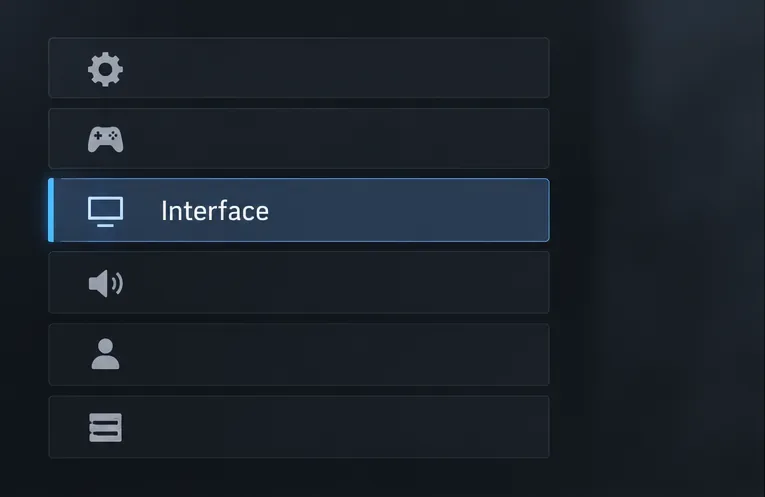
- Access to the in-game Replay system (Settings → Interface → Enable Replays)
- Roughly 20–30 minutes per session for deliberate practice
How to get better at League of Legends
-
Step 1: Narrow Your Champion Pool
The single fastest way to improve is to cut your champion pool down to two or three picks and commit to them for an entire ranked season. Most players lose games not because their champion is weak, but because they do not deeply understand the champion's strengths, power spikes, and matchup-specific item builds. Choose one primary role and one or two champions that suit your natural playstyle — whether that is a carry marksman in the bot lane, a roaming assassin in mid, or an engage tank in support. Play those champions on repeat until you could write their optimal build path from memory. The muscle memory and game sense you develop on a specific kit translates directly into better decisions every game.
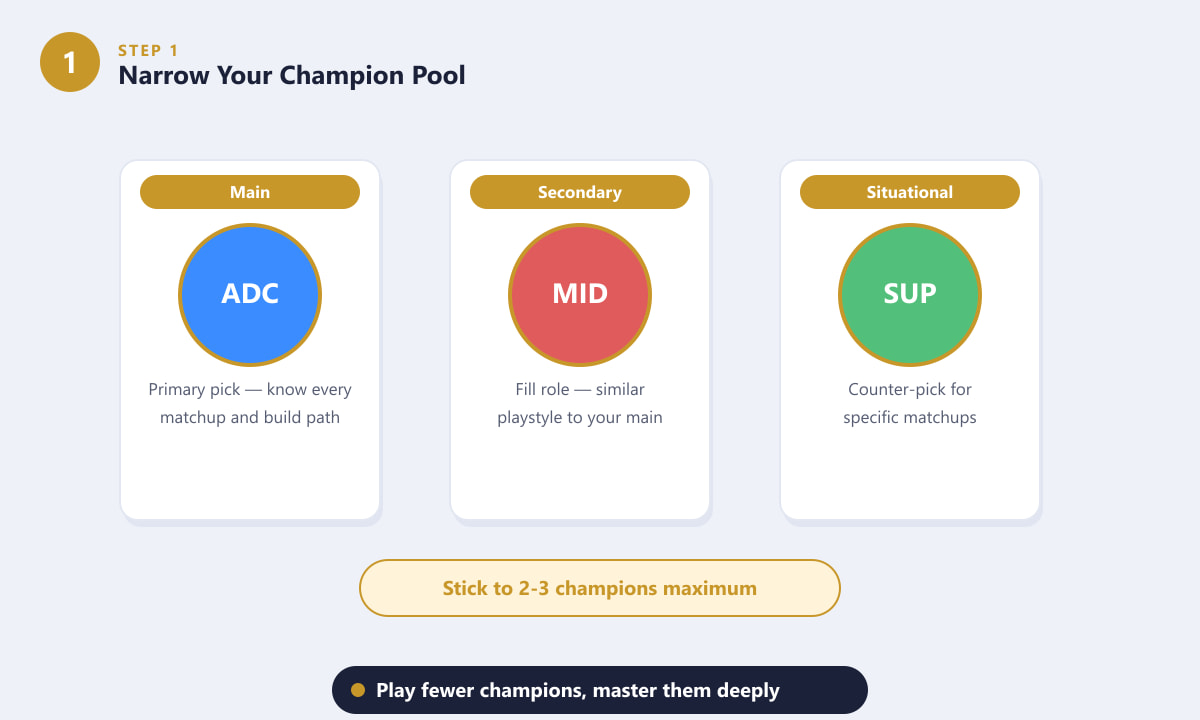
A focused champion pool of 2–3 picks lets you master matchups instead of relearning every game. -
Step 2: Check the Minimap Every Few Seconds
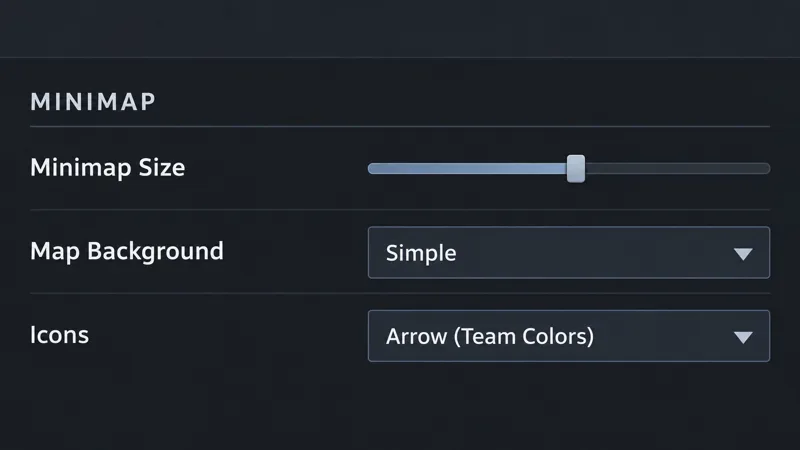
Map awareness is the stat that separates climbing players from stuck ones, and it costs zero mechanical skill to develop. Every five to seven seconds, glance at the minimap in the bottom corner of the screen. You are looking for two things: where your jungler is (so you know when a gank is coming and when you can play aggressively), and which enemy champions are missing from the map. The moment an enemy disappears from the minimap, press Ctrl+G to ping "Missing" so your teammates can react before the gank arrives. Equally important: track objective timers. Dragon respawns every five minutes; Baron Nashor respawns every seven. Start grouping your team near those pits 30 seconds before each timer, because winning objectives consistently beats any individual lane advantage.
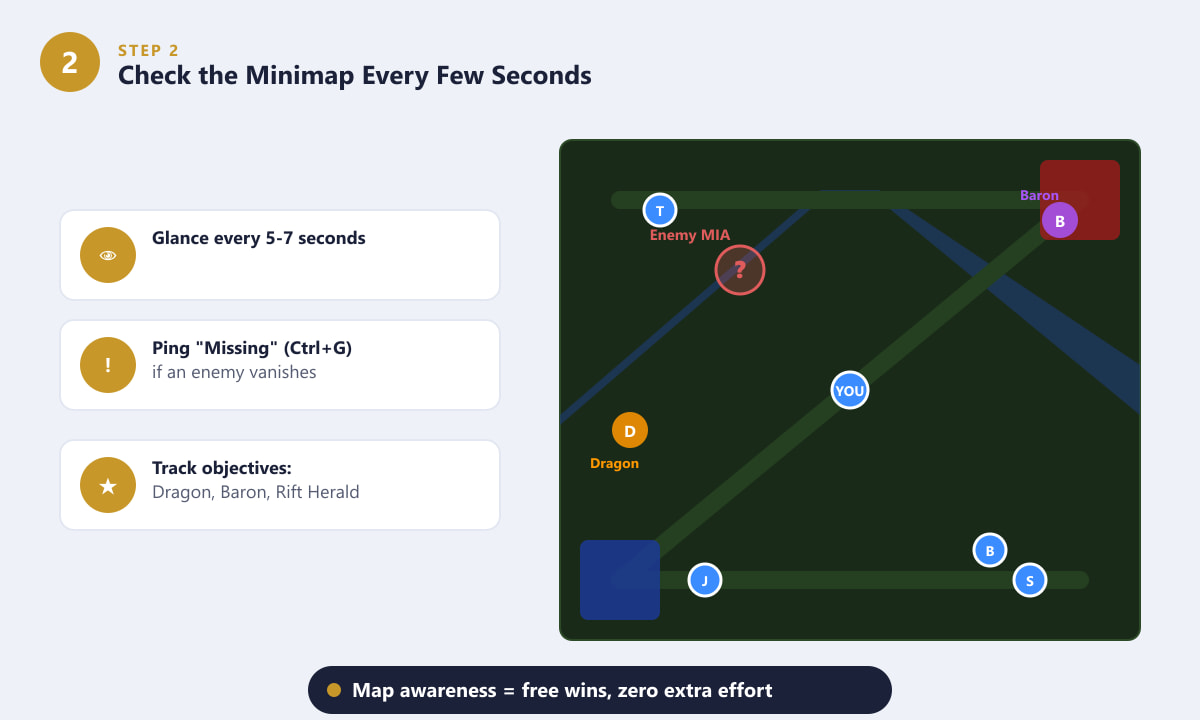
A quick glance at the minimap every few seconds reveals ganks before they happen and keeps objectives in view. -
Step 3: Improve Your CS (Creep Score)
Last-hitting minions — CS, or Creep Score — is the most reliable gold income in the game, yet it is one of the weakest skills in lower ranks. Six minions give you roughly as much gold as securing a kill, so missing 30 CS over the first ten minutes is like giving away five kills worth of gold. Aim for at least 70 CS per ten minutes as a baseline; high-Diamond and Masters players routinely hit 90 or above. To practice, open a custom game alone and spend 15 minutes doing nothing but last-hitting under the tower with no items. Focus on the timing: wait until the minion's health bar turns yellow-orange before clicking attack. Outside of trading with your opponent, every second in lane should be spent either moving for safety or preparing your next last-hit. Buying items in base should be timed around minion waves arriving at your tower, not mid-wave.
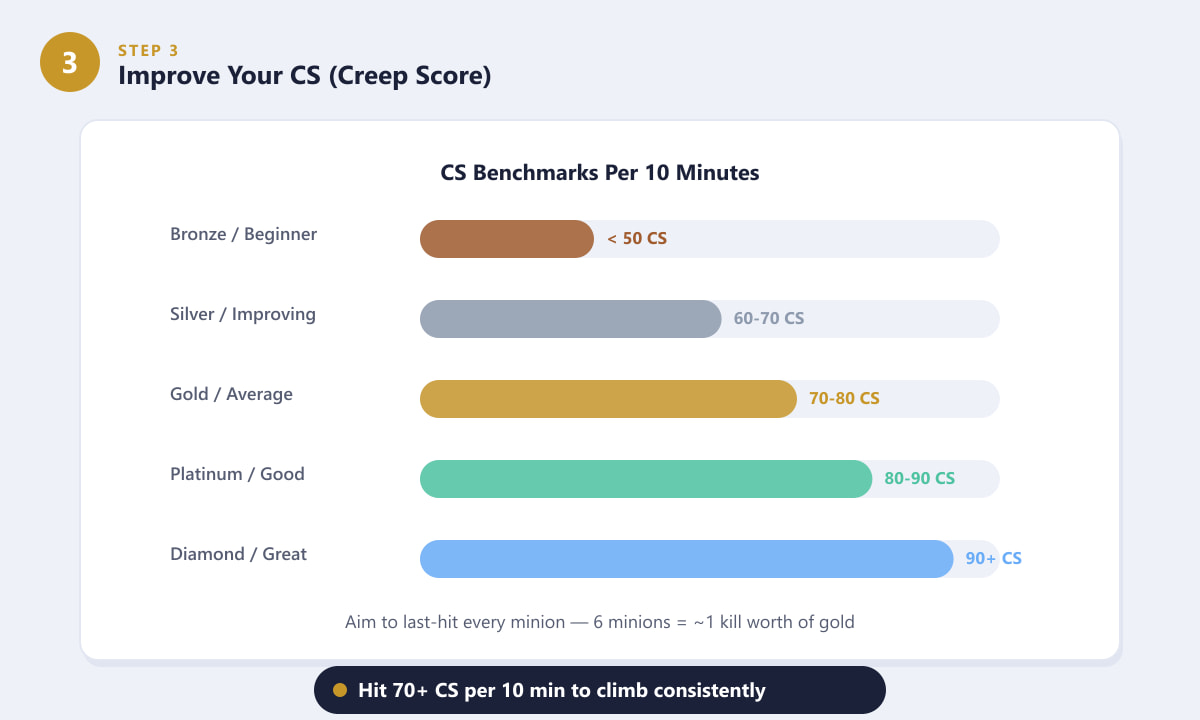
Aim for 70+ CS per 10 minutes — each tier of improvement translates directly into a consistent gold advantage. -
Step 4: Watch Your Own Replays and Identify Mistakes
One replay review session is worth more than five passive games. After a loss, go to Profiles → Match History, open the replay for that game, and use the timeline scrubber to jump to the moments where things went wrong. For each death, pause and ask: did I have vision? Was I over-extending without knowing where the enemy jungler was? Did I take a bad trade because I forgot the enemy's cooldowns? For each lost objective, ask: where was I and what was I doing instead? You do not need to watch the full 30 or 40 minutes — targeting the three or four biggest decision errors in a session and naming them out loud is enough to start breaking the habit. Over weeks, you will notice the same types of mistakes repeating, which tells you exactly where to focus practice.
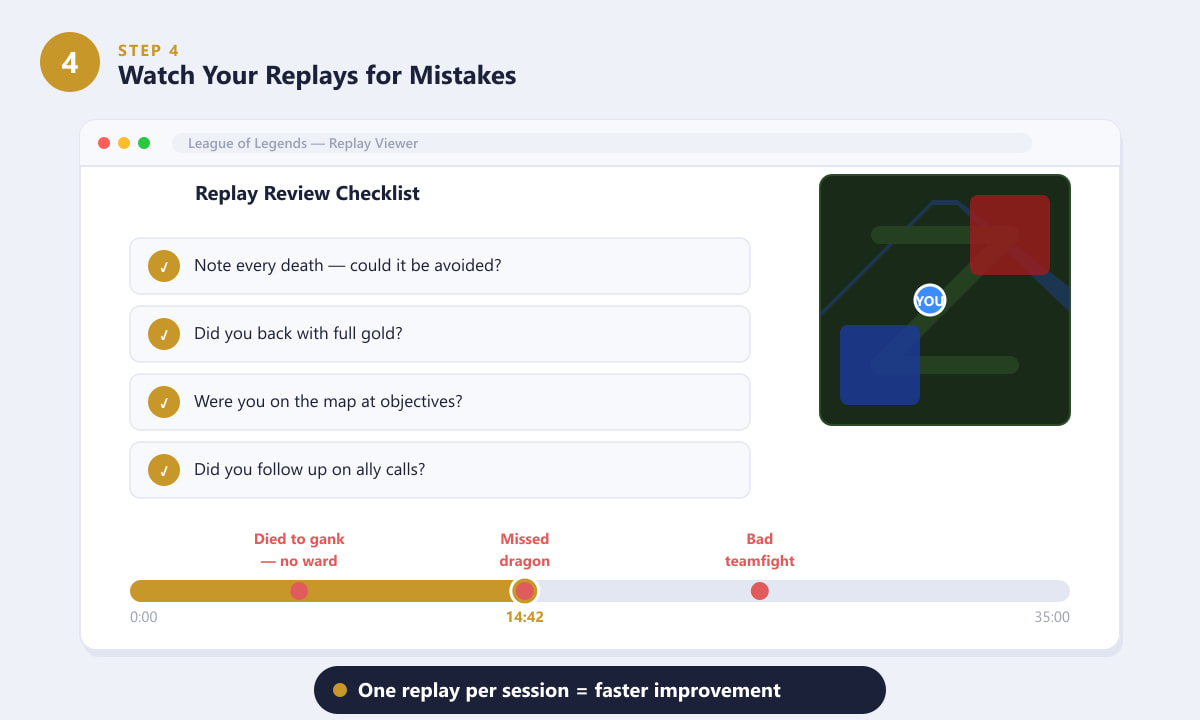
Jump to mistake moments on the replay timeline rather than watching the full game — one focused review beats passive re-watching. -
Step 5: Communicate Effectively and Play as a Team
League of Legends is a five-vs-five game, and the team that functions as a unit almost always beats five skilled players acting independently. The most efficient communication tool is the ping system — hold G to open the ping wheel and choose "On My Way," "Danger," "Missing," or "Assist Me." Pings are instant, never misread, and cannot tilt your teammates the way typed messages can. Beyond pings, follow these teamplay principles every game: group near Dragon or Baron at least 30 seconds before each timer; when one of your lanes is winning a 2v2 or pushing a tower, rotate to that pressure rather than split-farming elsewhere; mute players who are flaming immediately rather than arguing back — a tilted mind makes worse decisions; and avoid surrendering games that are genuinely winnable. A 5,000-gold deficit with all towers intact is frequently recoverable, especially if your team has stronger late-game champions.
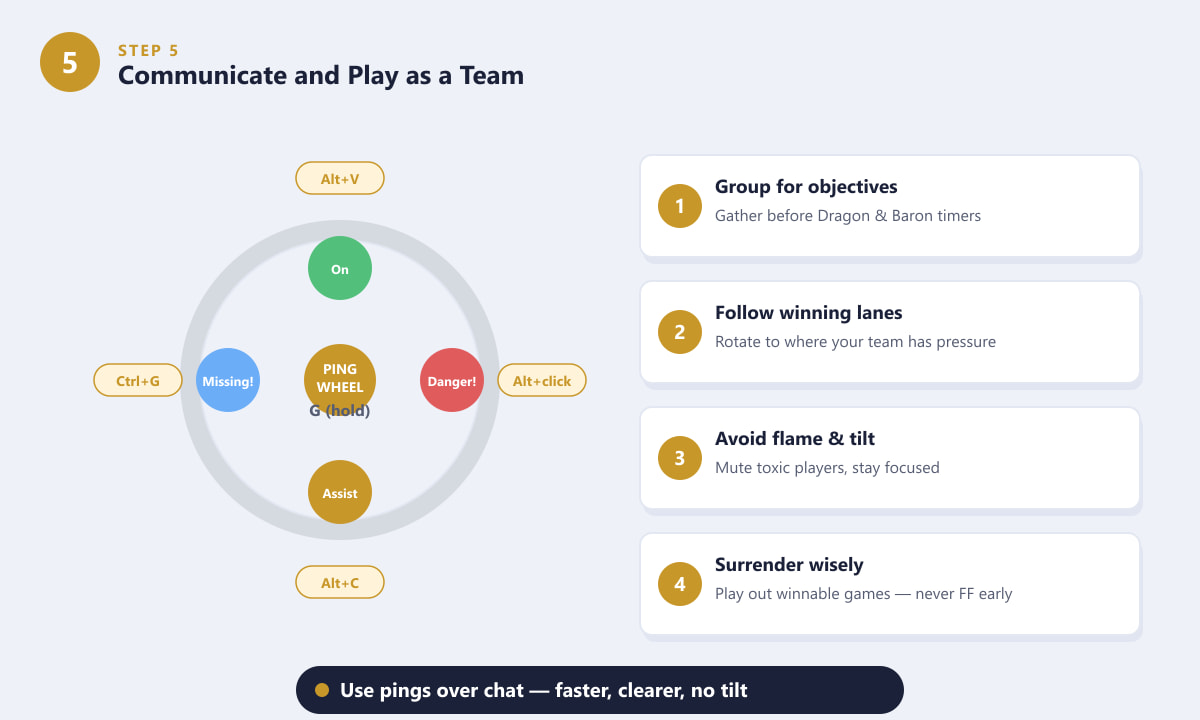
The ping wheel (hold G) lets you communicate instantly — use it instead of typing to stay focused and calm.
Extra tips for faster improvement
- Use Practice Tool. The in-game Practice Tool (accessible from the Play menu) lets you practice last-hitting, combo timing, and tower-diving scenarios without any queue wait time or ranked pressure.
- Warm up before ranked. Play one or two normal games or a Practice Tool session before queueing for ranked matches. Cold mechanics lead to sloppy early games.
- Lock in rune pages before champ select ends. Correct runes for your champion and matchup are a significant damage modifier. Prepare a default page for your main champion in advance.
- Take mental breaks. If you lose two ranked games in a row, close the client for 20 minutes. Tilt is the fastest way to drop LP, and stepping away resets your decision-making.
- Watch high-ranked streamers on your champion. Watch what they do between minion waves — are they trading, warding, roaming, or shoving the wave? That off-action behavior is often where the real skill gap lives.
Common mistakes and how to fix them
You keep dying in lane even when you seem safe
Check whether you are tracking the enemy jungler. Open your replay and find the moments just before each death — in most cases, a gank arrives when you did not know where the enemy jungler was. Ward the river bush at level 1 and stay near your tower whenever the jungler is missing from the minimap.
Your CS numbers look fine but you still feel behind
High CS with low kill participation often means you are farming safely but not converting that gold into map pressure. After you complete your core item (usually two items), look for roam opportunities: push your wave, then walk to help your jungler contest Dragon or gank a neighboring lane.
You win lane but lose the game
A lane lead means very little if you continue farming the side lane while your team loses objectives. When your lane opponent recalls or is dead, shove the wave under their tower and immediately rotate to the next available objective — Dragon, Baron, Rift Herald, or a tower that a teammate is threatening. Converting a lane lead into a map lead is the skill that differentiates Gold from Platinum players.
Frequently asked questions
How long does it take to get noticeably better at League of Legends?
Most players see a measurable rank improvement within two to four weeks of applying focused habits — particularly narrowing their champion pool and improving CS. Raw mechanics take longer (months of consistent play), but game sense and decision-making improve quickly with deliberate replay review.
Is playing more games the best way to improve?
Volume helps only when paired with deliberate intent. Playing 10 games with active minimap checks and post-game replay review will outperform 50 games of auto-piloting. Quality of practice matters far more than the number of games played.
Which role is the easiest to climb with?
Jungle and mid lane give you the most influence over the whole map and tend to be the strongest roles for solo queue climbing, since you can react to both sides of the map. That said, the best role to climb with is always the one you enjoy most and know most deeply — mastery of a role beats meta advantages at most ranks.
Should I play ranked or normal games to improve?
Both have a place. Ranked games provide more stakes and opponent effort, which sharpens decision-making. Normal games are better for experimenting with new champions or strategies without rank consequences. Use normals to try new picks and ranked to apply what you have already practiced.
How do I deal with toxic teammates?
Mute them immediately using the mute button next to their name in the scoreboard (Tab key). Pings still come through, so you keep communication without the tilt. Report at the end of the game and move on — arguing back wastes mental energy that should go into your next decision.
Final thoughts
Getting better at League of Legends comes down to five repeatable habits: mastering a small champion pool, glancing at the minimap constantly, farming minions efficiently, reviewing your own replays honestly, and playing as a coordinated team. None of these require extraordinary mechanical talent — they require consistency and the willingness to reflect between games. Start with whichever habit feels like your biggest weakness right now, build it into your routine over a few weeks, and then layer in the next one. Gradual, deliberate improvement is faster than it sounds.