Can My PC Run Fortnite? System Requirements for 2026
Can my PC run Fortnite? It probably can if it meets Epic Games’ current minimum requirements: an Intel Core i3-3225, 8 GB of RAM, and Intel HD 4000 or AMD Radeon Vega 8 graphics on a supported 64-bit version of Windows 10. Epic’s recommended tier raises that to 16 GB of RAM and a GTX 960, R9 280, or equivalent. For the Epic quality preset, Epic lists an RTX 3070 or RX 6700 XT, 16 GB of RAM, and a stronger processor. These are compatibility tiers, not a promise of a specific frame rate.
The fastest way to decide is to compare your CPU, graphics card, memory, and Windows version with the table below. Epic’s support requirements were checked on October 16, 2026; requirements and game downloads can change, so use the live Epic pages linked here if you are installing later.
Fortnite PC system requirements
| Component | Minimum | Recommended | Epic quality preset |
|---|---|---|---|
| Operating system | Windows 10, version 22H2 (64-bit), or Windows 10 Enterprise, version 21H2 (64-bit) | Windows 10/11 64-bit | Windows 10/11 64-bit |
| Processor | Intel Core i3-3225 at 3.3 GHz | Intel Core i5-7300U at 3.5 GHz, AMD Ryzen 3 3300U, or equivalent | Intel Core i7-8700, AMD Ryzen 7 3700X, or equivalent |
| Graphics | Intel HD 4000 or AMD Radeon Vega 8 | NVIDIA GeForce GTX 960, AMD Radeon R9 280, or equivalent DirectX 11 GPU | NVIDIA GeForce RTX 3070, AMD Radeon RX 6700 XT, or equivalent |
| Graphics memory | Not specified in Epic’s minimum list | 2 GB VRAM | 8 GB VRAM or more |
| System memory | 8 GB RAM | 16 GB RAM or more | 16 GB RAM or more |
| Storage | Not specified in Epic’s minimum list | NVMe solid-state drive | NVMe solid-state drive |
These specifications come from Epic’s Fortnite PC requirements page. “Equivalent” means a comparable part, not simply a newer model number: laptop and desktop versions of a GPU can perform differently, and a graphics card’s name alone does not tell you how well it will handle every setting. Epic does not promise a fixed resolution or FPS for each tier. If your PC only meets the minimum, expect to use lower graphics settings and treat performance as dependent on your full system, cooling, drivers, and the current game build.
Epic’s requirements page lists Windows 10/11 64-bit for the recommended and Epic quality tiers. Its minimum entry is more specific: Windows 10 22H2 64-bit or Windows 10 Enterprise 21H2 64-bit. Check the version as well as the Windows name if your PC is near the minimum.
How to check whether your PC meets the requirements
- Find your processor, RAM, and Windows version. Open Start, type System Information, and press Enter. Under System Summary, look for OS Name/Version, System Type, Processor, and Installed Physical Memory (RAM). Epic’s verification instructions use this same Windows tool.
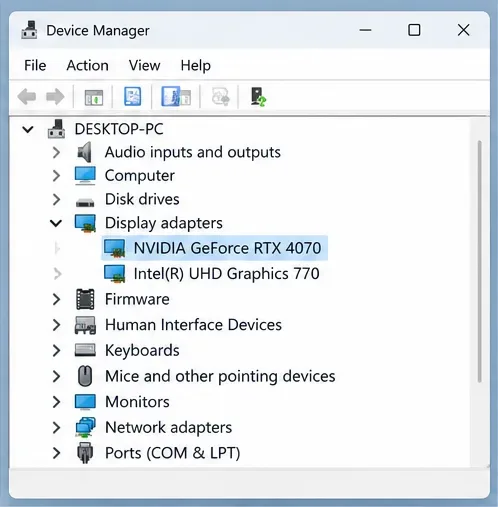
- Find your graphics card. In System Information, expand Components and select Display. Check the Name field for the GPU model. You can also press Win + R, enter dxdiag, and open the Display tab in the DirectX Diagnostic Tool. The System tab shows the DirectX version; the Display tab identifies the graphics device and driver. Microsoft explains how to check DirectX with dxdiag.
- Compare each part separately. Check the exact GPU, CPU, RAM, and Windows edition against the table. A PC can have plenty of memory but still fall short on graphics, or meet the GPU tier while having too little RAM. A laptop’s shared or integrated graphics also use system resources, so matching a GPU name does not guarantee identical performance.
- Check available storage before installing. Epic does not give a stable total install-size figure in its current requirements table, and optional high-resolution textures affect the installation. Leave room for updates and check the Epic Games Launcher’s current download requirement rather than relying on an old GB estimate.
Windows Settings can also show basic hardware details at Settings → System → About. Under Device specifications, check Processor, Installed RAM, and System type; under Windows specifications, check the edition and version. Use System Information or dxdiag when you need the GPU model. Microsoft’s Windows device information guide describes these locations.
What your result means
- Below minimum: Epic does not list your hardware as supported at the minimum tier. The game may fail to launch or run poorly; changing graphics settings cannot make unsupported hardware equivalent to the listed parts.
- At minimum: Your PC is around the entry point for running Fortnite, but Epic cautions that minimum-spec systems may not run at the highest settings. Start with Low quality and reduce visual effects if the game stutters.
- At recommended: This is Epic’s general recommended hardware tier. It is a more useful target for a smoother experience, but it still is not an FPS guarantee.
- At Epic quality: This is the most demanding tier in Epic’s current requirements table. It is intended for the Epic quality preset, not a universal requirement to play.
Fortnite can run on some integrated graphics, but compare the actual model with Epic’s listed Intel HD 4000 or AMD Radeon Vega 8 minimum examples. Do not assume every integrated GPU is supported just because it is newer or branded Intel Iris or AMD Radeon.
Settings that can help a borderline PC
First try Fortnite’s built-in Performance – Lower Graphical Fidelity rendering mode. Epic’s current instructions are: launch Fortnite, open the player menu and Settings, select the Video tab, find Rendering Mode under Display, choose Performance, select Apply, and restart the game. The label and menu layout can change with updates; follow the live Epic Performance Mode instructions if the options differ. Performance Mode may improve FPS on low-end systems, but it trades visual fidelity for performance and cannot replace a missing CPU, GPU, or memory requirement.
If you use Performance Mode, Epic also lets you remove High Resolution Textures from the installation: in the Epic Games Launcher, open Library, choose the three-dot menu beside Fortnite, select Options, uncheck High Resolution Textures, and apply the change. Epic says this can save more than 15 GB of drive space; the exact install size still varies.
For general low-FPS troubleshooting, Epic recommends starting with the Low quality preset and changing settings gradually. On a laptop with switchable graphics, you can set Fortnite to use the high-performance GPU through Windows Settings → System → Display → Graphics. Windows power options and Game Mode may also help some systems, but test one change at a time and restart when prompted. See Epic’s full low-FPS troubleshooting steps.
Frequently asked questions
Does meeting the minimum mean Fortnite will run at 60 FPS?
No. Epic publishes hardware tiers, not a guaranteed frame rate for every PC. Actual FPS varies with the exact parts, resolution, graphics settings, drivers, cooling, and what is happening in a match.
Is 8 GB of RAM enough for Fortnite?
Eight gigabytes is Epic’s listed minimum. The recommended tier is 16 GB or more. If you play with other programs open, available memory can be lower than the amount installed, so close applications you do not need.
Can I play Fortnite on an older PC with integrated graphics?
Possibly, if the graphics hardware meets Epic’s minimum examples, but older integrated GPUs may be unsupported or too slow. Check the GPU model in System Information or dxdiag, then compare it with the minimum row before downloading.
Is Fortnite free on PC?
Fortnite is listed as free on the Epic Games Store. Optional purchases are available, but they are not part of the PC hardware requirements.