Home
» 🏏 Cricket
»
Test Cricket Bad-Light Rules: Who Decides, When Play Resumes, and How Lost Time Is Recovered
Test Cricket Bad-Light Rules: Who Decides, When Play Resumes, and How Lost Time Is Recovered
Bad light in Test cricket often creates confusion because three separate questions get mixed together: who has the authority to stop play, what evidence the umpires use, and how the schedule is repaired afterward. Under the current ICC framework, those are related but distinct decisions.
As of September 30, 2026, the ICC's official playing-conditions index lists the men's Test Match Playing Conditions effective from June 2025 and the women's Test Match Playing Conditions effective from July 2026. The core bad-light decision process is the same in both: the umpires decide whether conditions are dangerous or unreasonable, light-meter readings are a guideline rather than an automatic trigger, and the umpires monitor conditions during a suspension and call the players back when they agree play can safely and reasonably resume. The detailed over calculations, however, are not identical between men's and women's Tests.
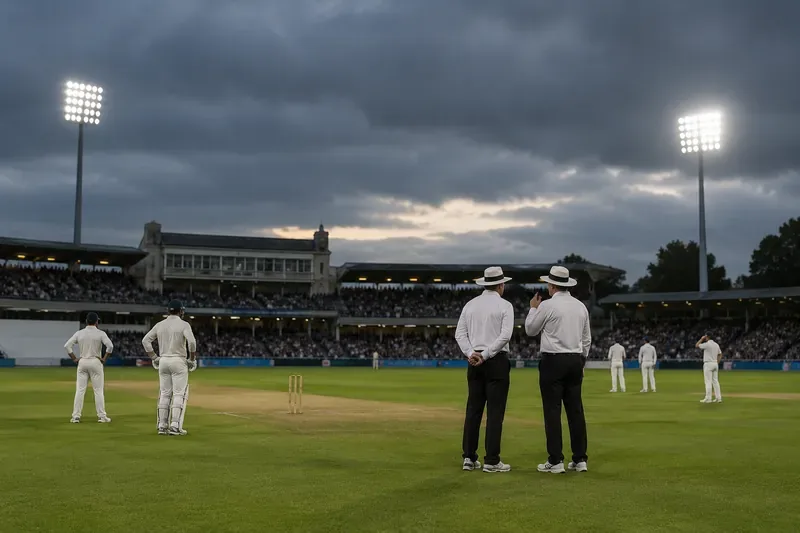
Umpires confer under floodlights as dark clouds reduce natural light; under ICC Test playing conditions, the decision to suspend or resume play rests with the umpires.
Who actually decides that the light is too bad?
Verified: the decision belongs to the umpires, not to the batting side, the fielding captain, the broadcaster, or the match referee. The ICC men's Test conditions say the umpires together decide whether ground, weather, light, or exceptional circumstances make play dangerous or unreasonable. If they agree that conditions meet that standard, they must suspend play or refuse to start or restart it. The ICC Match Referee may be consulted, but the bad-light judgment itself is for the umpires.
The same basic structure appears in the ICC women's Test conditions effective July 2026 and in MCC Law 2, which states that the umpires decide whether conditions are dangerous or unreasonable. This matters because older memories of batters being "offered the light" can mislead viewers about the current system.
What to do: if a broadcast says a captain "wants to go off," treat that as context, not as the decision. Look for the umpires' signal, official match commentary, or a confirmed suspension notice.
Common misconception: there is a fixed light-meter number that automatically stops play
Verified: ICC playing conditions allow light-meter readings to be used as a guideline. They can help the umpires determine whether light has deteriorated or improved and can serve as benchmarks later in the same match. The rules do not publish one universal lux reading at which every Test must stop.
That means the meter supports the judgment; it does not replace it. The governing test is whether conditions are dangerous or unreasonable. The ICC language also makes clear that conditions are not automatically unacceptable merely because they are less than ideal.
Context-dependent: the actual meter reading at a particular ground, the direction of the light, cloud cover, background visibility, and the type of bowling being faced can all affect the practical assessment. The published playing conditions do not provide fans with a single number that predicts every decision.
What to do: do not compare an unofficial light reading from one venue with another as though it were a universal threshold. The more useful question is whether the umpires say conditions have crossed the dangerous-or-unreasonable standard and whether later readings show sufficient improvement.
Do floodlights mean play has to continue?
No. Floodlights can help, but they do not guarantee that conditions will be acceptable.
Verified: the ICC men's and women's Test conditions state that if natural light is deteriorating to an unfit level, the umpires shall authorize available artificial lighting so the match can commence or continue in acceptable conditions. If there is a power failure or the lights malfunction, the normal bad-weather or bad-light interruption provisions apply. The rules also allow a Home Board, with ICC approval before a series, to amend the condition so artificial lights are not used at a specific venue.
Artificial lighting therefore solves only one part of the visibility problem. If the umpires still consider conditions dangerous or unreasonable, play remains suspended.
What to do: when the lights come on, read that as an attempt to preserve play, not proof that play must continue.
When does play resume after a bad-light stoppage?
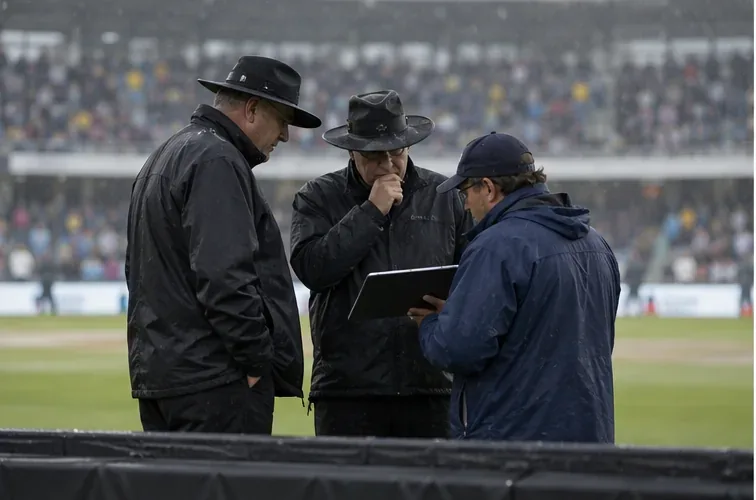
Verified: once play is suspended, the umpires are responsible for monitoring conditions. They make inspections as often as appropriate, without players or other officials accompanying them. As soon as the umpires together agree that conditions are no longer dangerous or unreasonable, they call the players back to resume.
There is no general ICC rule requiring a reinspection at a fixed interval such as every 10 or 15 minutes. Broadcast graphics may announce a planned inspection time, but that is operational information for that stoppage rather than a universal law.
What to do: use the official scorecard, venue announcements, or rights-holder commentary for the next inspection or restart time. If no time has been announced, that does not mean officials are inactive; the rules tell them to monitor conditions and inspect as often as appropriate.
How is lost time recovered in a men's Test?
The men's Test Match Playing Conditions effective June 2025 provide a layered recovery system rather than simply adding every lost minute to the end of the day.
Situation
Men's Test rule
Practical effect
Normal daily target
Minimum target of 90 overs, or 15 overs per hour, on days other than the last day
The scheduled close can move later, subject to the playing conditions
Lost time on the same day
Up to 1 hour may be added, subject to weather and light and excluding the special last-hour provisions
A bad-light delay may push stumps later if conditions improve
Time not recovered that day
Up to 30 minutes per day may be added on later days
Some lost time can be carried forward
Long interruption
If aggregate lost playing time exceeds 1 hour, minimum overs are reduced by 1 for each full 4 minutes lost, outside the last hour
Not every lost over is recoverable
Last hour of the match
Special minimum of 15 overs, with interruption calculations based on 1 over per full 4 minutes
The final hour has its own calculation
One detail is easy to miss: on days other than the last day, the men's conditions say play may continue until the later of the minimum 90-over target or the scheduled/rescheduled close, but not more than 30 minutes beyond that cessation time for the minimum-over requirement. If the minimum target is still incomplete after that permitted overtime, the remaining unbowled overs are not automatically carried into another day.
What to do: after a long bad-light stoppage, look for two updated figures rather than just a new close-of-play time: the rescheduled cessation time and the revised minimum overs remaining.
Women's Tests use different over arithmetic
Verified: the ICC women's Test Match Playing Conditions effective July 2026 use the same maximum make-up periods—up to 1 hour on the day and up to 30 minutes on subsequent days—but the over rate is different. On days other than the last day, the minimum target is 100 overs, or 16.67 overs per hour. When aggregate lost time exceeds 1 hour, the reduction is one over for each full 3.6 minutes lost. The final-day last hour uses a minimum of 17 overs, with 3.6-minute calculations.
This is why a generic statement such as "bad light costs one over every four minutes in Test cricket" is incomplete. That figure matches the current ICC men's Test conditions, not the current ICC women's Test conditions.
What to do: before calculating overs lost, confirm which Test playing conditions apply to the match.
What happens on the final day?
The final day is more complicated because the "last hour" has separate rules.
Under the current men's conditions, the last hour is built around a minimum of 15 overs. If an interruption begins before the last hour, available make-up time can shift when that last hour starts. But if an interruption begins after the last hour has started, the general same-day make-up provision does not simply restore that lost time. Appendix E contains the calculation template used when interruptions alter the final day's remaining overs and timing.
The women's conditions follow the same structural idea but use 17 overs and 3.6 minutes per over in the relevant calculations.
What to do: late on day five in a men's Test, or the final day of a women's Test, do not estimate the finish by adding the delay directly to the clock. Check the officially recalculated overs and last-hour start instead.
Can bad light end the day's play completely?
Yes. If conditions do not improve enough before the applicable rescheduled cessation time, stumps can be drawn. The men's playing conditions also state that if players are already off the field for a suspension at the most recently rescheduled cessation time, stumps are drawn at that time, except where final-day provisions apply.
Unknown until officials decide: when a stoppage begins, nobody can know with certainty whether the day is finished unless the officials announce stumps. Weather forecasts and sunset times can suggest whether a restart is plausible, but they do not replace the umpires' assessment.
What to do: distinguish "play suspended" from "stumps." A suspension means conditions are still being monitored; stumps means the day's play is over.
A quick way to read a bad-light situation correctly
First, identify the decision: has play actually been suspended, or are the umpires only checking the light?
Second, identify the rule set: men's Test, women's Test, World Test Championship, or another competition-specific set of conditions.
Third, check whether artificial lights are available and being used: they may allow play to continue, but only if conditions become acceptable.
Fourth, wait for the revised schedule: the restart time, minimum overs remaining, and rescheduled close are more reliable than a simple minutes-lost estimate.
Fifth, treat final-day calculations separately: the last hour has special rules.
One current development is worth separating from the existing rule. In June 2026, the ICC Board announced a trial permitting a pink ball in Tests with prior agreement from both teams to help maximize play when bad light is anticipated, alongside research into lighting technology. That announcement does not transfer the bad-light decision to teams; the umpire-led fitness-for-play framework remains the key rule to check. See the ICC Board meeting release of June 1, 2026.
Bottom line
Bad light in Test cricket is not decided by a captain's preference or by a single public light-meter threshold. The umpires judge whether conditions are dangerous or unreasonable, may use calibrated light readings as guidance, and keep inspecting until conditions are good enough to resume. Lost time is then handled through make-up time, revised minimum overs, and special final-day calculations. The key limit is that the arithmetic varies by the applicable Test playing conditions, so the safest way to follow a live match is to confirm the rule set first and then use the official rescheduled overs and times rather than applying a one-size-fits-all formula.