Home
» 🏏 Cricket
»
Rain in a T20I: DLS Targets and the Five-Over Rule, Explained
Rain in a T20I: DLS Targets and the Five-Over Rule, Explained
When rain interrupts a Twenty20 International (T20I), umpires first try to restart play; if lost time forces a shorter game, the Duckworth-Lewis-Stern (DLS) method recalculates the chase target. Under standard ICC T20I playing conditions, both teams generally need the opportunity to bat for at least five overs for the match to produce a result. If that minimum cannot be met, the game is usually a no result, subject to narrow exceptions such as a team being bowled out sooner or the chasing side reaching the target before five overs.
The five-over rule does not mean that five overs in the whole match are enough. It refers to each side’s opportunity to bat, with the rule focused on the second innings when rain interrupts a chase. A tournament’s own playing conditions can set a higher minimum, so the competition matters as well as the T20I format.
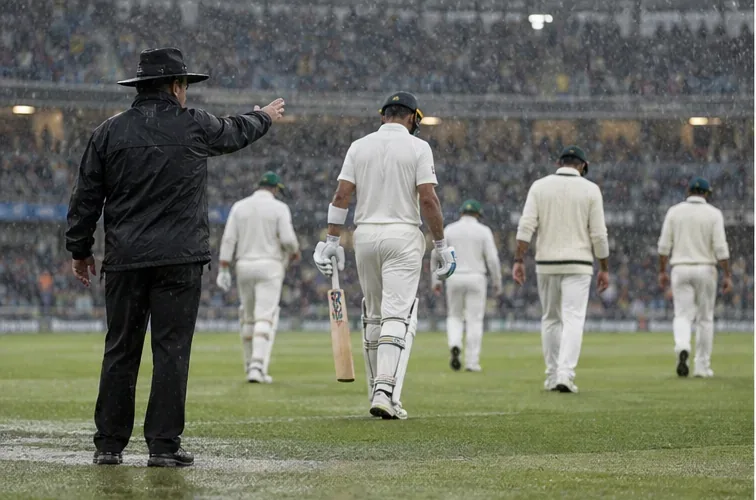
An umpire signals a pause while players leave the field in the rain.
What happens first when rain stops play?
The umpires suspend play when conditions make it unsafe or unreasonable to continue. Ground staff protect the pitch and playing area while officials monitor the weather and available playing time. A short shower may lead to a restart with the match unchanged. A longer interruption may delay the start, cut overs from one or both innings, or end the game.
There is no rule that every rain delay automatically changes the target. If no scheduled overs are lost, the original target remains. If time lost means an innings must be shortened after the match has started, the officials apply the competition’s playing conditions, including DLS where required, and tell teams the revised allocation and target.
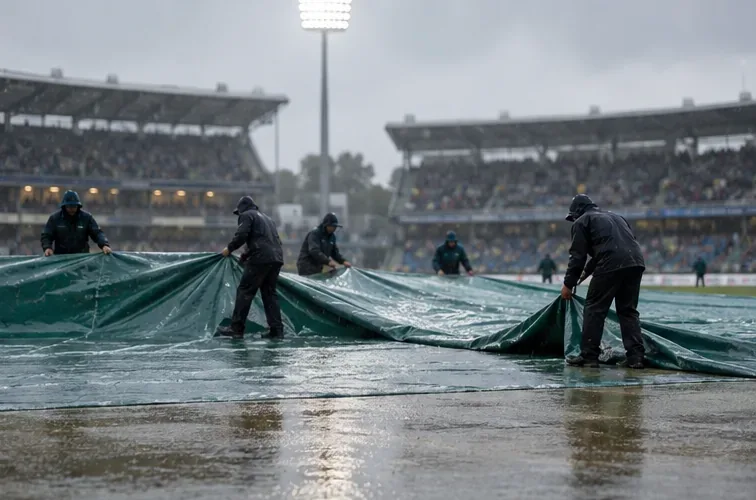
Ground staff cover the pitch while match officials wait for conditions to improve.
What does DLS change?
DLS is short for Duckworth-Lewis-Stern, the ICC’s method for adjusting targets in rain-interrupted limited-overs cricket. In plain language, it compares each team’s scoring opportunity, or “resources.” Resources depend on how many overs are available and how many wickets remain. More overs and more wickets give a batting side more capacity to score; losing overs or wickets reduces that opportunity.
DLS is not a simple “runs per over” calculation. Cutting a 20-over chase to 10 overs does not mean the target is automatically half of the original target. The official calculation uses the teams’ relative scoring resources at the point of the interruption. Depending on when rain affects the first innings, a revised target can move down or up. The ICC’s DLS explainer describes the method as a way to recalculate totals when time is lost.
A simple example
Imagine Team A scores 160 in its full 20 overs. Rain then leaves Team B with only 10 overs to chase. The officials will publish a DLS target for those 10 overs. Do not divide 160 by two and assume the answer is the target: DLS accounts for the relative resources available to both sides. If another shower interrupts the chase, officials may revise the overs and target again.
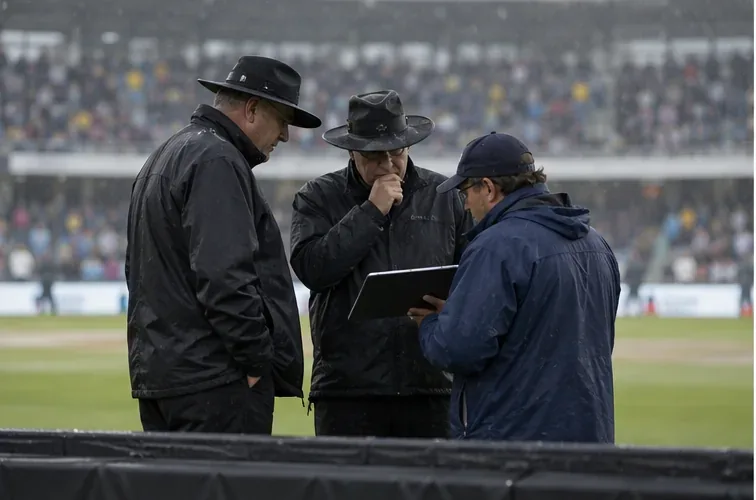
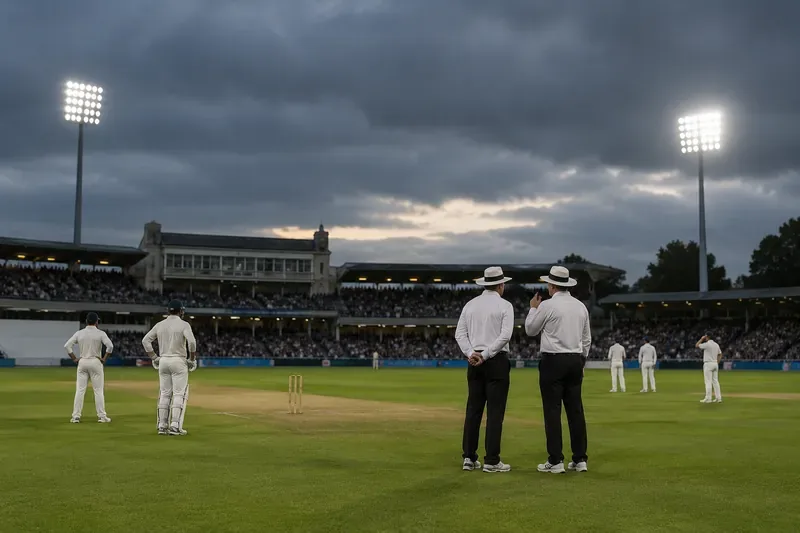
Match officials and a scorer confer beside the field during a rain interruption.
What is a DLS par score?
The target is the score the chasing team needs to win by the end of its revised innings. A par score is a checkpoint: it shows what the chasing side would be expected to have scored at a particular point under DLS. If rain ends a chase after the minimum overs have been completed and no restart is possible, officials compare the team’s actual score with the DLS par score at the stoppage.
If the chasing team is above par, it has scored enough for a DLS win.
If it is below par, the team batting first is ahead under DLS.
If it is exactly on par, the result is a tie under the standard conditions; a Super Over may be used to decide a winner if play and event rules allow.
The scoreboard or official match feed may show a revised target, the overs remaining, and a par score. These figures answer different questions: the target is what is required to win by the end, while par tells you whether the chase is ahead or behind at that moment.
How many overs are needed for a T20I result?
For standard ICC T20I matches, the usual minimum is five overs for each side. The regulation is framed as a minimum opportunity to bat, and it allows a result earlier if a side is all out before five overs or the team batting second reaches the target sooner. The ICC’s current men’s T20I playing conditions, effective July 2025, and women’s T20I playing conditions, effective July 2026, both set out the five-over minimum.
Misunderstanding: five overs means five overs total. That is not how the rule works. A team cannot normally claim a result after only five overs have been bowled in the entire match if the other side has not had its required batting opportunity. Check how many overs the second-innings team had the chance to face, not just the match’s total overs.
Misunderstanding: every T20I needs exactly five overs. Five is the standard minimum in ordinary T20Is, not a universal guarantee for every stage of every tournament. Specific events may set a higher threshold for knockout matches. For example, the ICC Men’s T20 World Cup 2026 playing conditions require a 10-over opportunity for the batting-second side in semi-finals and the final. Check the event regulations before treating five overs as decisive.
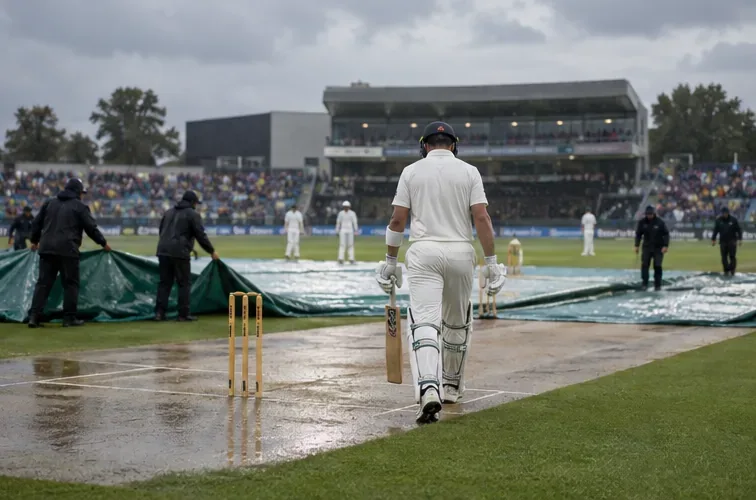
A batter returns as covers are pulled back and play prepares to resume.
When is a rain-affected match a no result?
A no result means the match does not produce a winner under the applicable conditions. In a standard T20I, if rain prevents both teams from having the minimum batting opportunity and the match cannot restart, the match is normally declared a no result. The sides do not receive a DLS win or loss merely because one team happened to be ahead on the original scoreboard before the minimum was reached.
A rain-affected match can still produce a result after five overs of the chase if DLS can compare the score to par when play ends. If the required overs have not been reached, officials may continue waiting, revise the allocation, or abandon the game, depending on the remaining time and conditions. An all-out innings or an early successful chase can also create a result before the normal minimum threshold.
A tie is different from a no result. A tie means a result was established but the scores are level, including a level DLS comparison when play stops. ICC T20I conditions provide for a Super Over in a tied match, with repeat Super Overs if needed to find a winner, subject to the event’s rules and the possibility of continuing play. A no result means the match never met the conditions needed to establish that result.
What should a viewer check during a rain delay?
Confirm the innings and overs. Note whether rain began before the first ball, during Team A’s innings, or during the chase. The stage affects what officials need to revise.
Read the official revised target. Look for the revised number of overs and DLS target after a restart. Do not calculate a target by scaling the first team’s total yourself.
Compare the score with par if the chase is stopped. Use the par score for the exact ball and wickets at the interruption. A par score from several overs earlier is no longer the correct comparison.
Check the minimum for this event. Standard T20Is generally use five overs per side; a specific tournament or knockout round may require more.
Wait for the official result. A delay is not itself an abandonment. The umpires and match referee determine whether play can resume and the scorer or broadcaster confirms the result category.
The simplest way to follow a rain-hit T20I is to keep three facts separate: how many overs remain, what target DLS has set, and whether the minimum batting opportunity has been met. Use the current event playing conditions for exceptions, since tournament rules can differ from the standard T20I baseline.