How to Check Real-Time Server Latency in the PUBG HUD

Enable PUBG’s network statistics HUD to monitor ping and packet loss in a match. See where to find it, what the numbers mean, and what they cannot diagnose.
If Minecraft Java Edition disconnects with “Failed to sync registries from server: java.lang.NullPointerException”, start by checking the exact Minecraft version, mod loader, and modpack release on the client and server. Then compare the logs around the first registry error. This message identifies a failed synchronization step; by itself, it does not name the mod or prove that Java, your network, or a cache is the cause.
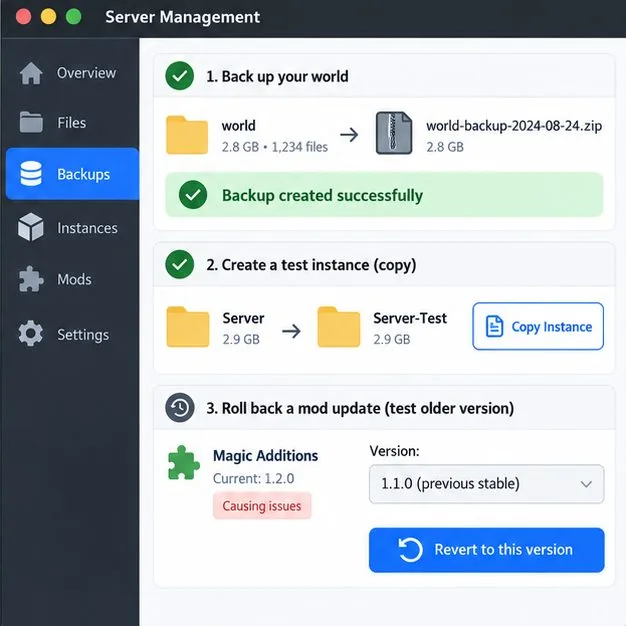
The safest first fix is to restore the client and server to the same supported modpack release and loader setup. Make a backup before changing server files or world data. Work through the checks below in order, and test changes in a copy when possible.
A Minecraft registry maps identifiers to game objects such as blocks, items, and entities. Some modded registry data is synchronized when a client joins a world. The Fabric registry documentation describes how a server can send synced registry data to clients. If that data cannot be applied as expected, the game may disconnect with a registry-sync message.
A NullPointerException means code encountered a missing value where it expected an object. The disconnect text is a summary, not a diagnosis: the useful clue is often an earlier exception, invalid registry entry, missing dependency, or mod ID in the client or server log. That is why deleting random folders, adding memory, or reinstalling the entire server is a poor first move.
| What you observe | Where to investigate first |
|---|---|
| Only one player cannot join | That player’s launcher profile, modpack release, mods, and local configuration. |
| Several players fail after a server update | The server’s loader, server-pack files, data packs, and update history. |
| The error started after adding or updating a mod | That mod, its required dependencies, and any registry data or scripts it supplies. |
| A modded single-player world fails too | The local modded instance or its loader; single-player still runs a local server. |
| The game fails before it opens or names an unsupported Java version | The Java runtime selected for that exact Minecraft version, launcher, or server process. |
Before troubleshooting, write down the Minecraft version, loader and loader build, modpack name and release, and whether the problem affects one player or everyone. If you administer the server, back up its world and current files before updating, removing, or rolling back anything.
Check the version selected in the client launcher and the version the server actually started. For a modded game, record the loader too: Fabric, Forge, and NeoForge are separate loader families. Use the versions required by the modpack or server owner; a matching Minecraft version alone is not enough if the client and server are using incompatible loader builds.
Check each mod’s supported Minecraft version and loader before replacing it. The Fabric mod installation guide specifically advises choosing mods for the intended Minecraft version, Fabric loader, and Java Edition. Do not switch a Forge profile to Fabric, or use a mod built for a different game release, as a test.
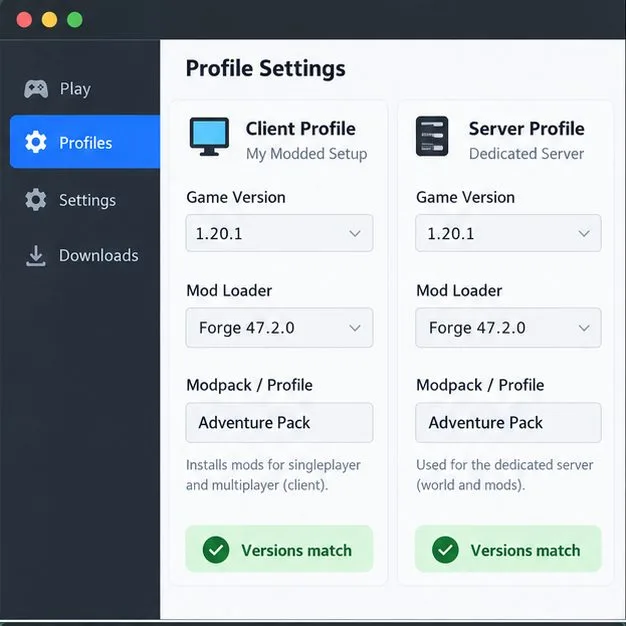
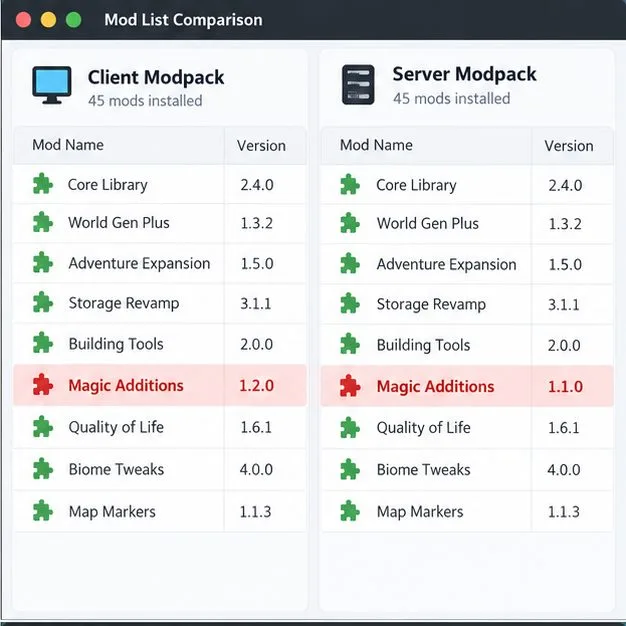
If you joined through a modpack, select or reinstall the exact pack release the server runs. Use the pack’s client profile and, for administrators, its matching server-pack download or deployment instructions. Compare the versions of mods that the pack requires on both sides. Some mods are client-only or server-only, so blindly copying every JAR from one folder to the other can create a different problem.
Also check pack-managed configuration, scripts, and data packs if the release instructions say they belong on the server. A mod update can change registry data even when the visible mod list looks almost identical. If the issue began directly after an update, restore a coherent previous pack release on a test copy and have the client use that same release.
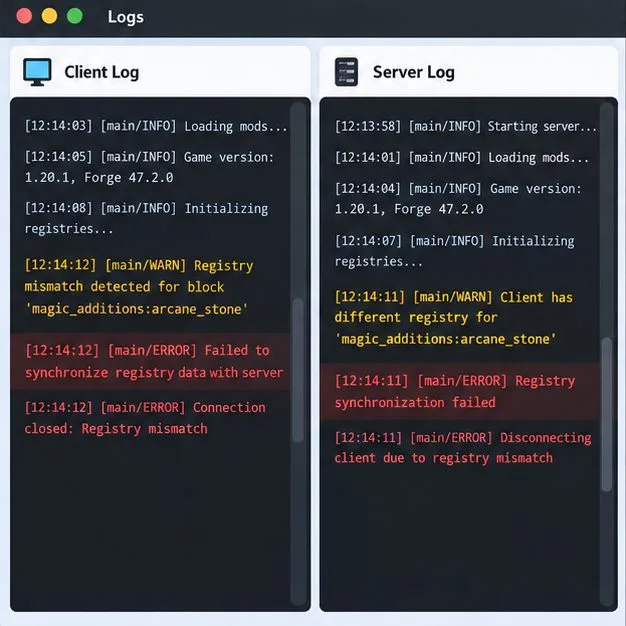
Find the client’s logs/latest.log and, if you can access it, the server’s logs/latest.log. With the default Minecraft game directory, logs are under %appdata%\.minecraft\logs on Windows, ~/Library/Application Support/minecraft/logs on macOS, and ~/.minecraft/logs on Linux. Third-party launchers often use a separate instance directory. Fabric’s log troubleshooting guide explains where to find logs and how to share them.
Search near the disconnect for terms such as registry, Caused by, unknown, missing, or a mod ID. Read upward from the final “failed to sync” line: the first specific warning or exception may identify the bad entry or dependency. Compare the client and server timestamps and report the Minecraft version, loader build, pack release, and relevant log section to the server owner or modpack support team. Redact server addresses, account names, or other private details before posting logs publicly.
Duplicate the launcher instance or copy the server to a test location before troubleshooting. Disable or roll back one recently added or updated mod at a time, keeping its required dependencies together, and retry the same join. If many mods changed, divide the recent changes into smaller groups to narrow the cause; do not remove half the pack from a live world.
If a clean test world in the copied instance triggers the same error, focus on the local mod or loader setup. If the client can open a test world but only fails on one dedicated server, compare that server’s pack, configurations, and data packs with the version the client was told to install.
Review the server startup log for registry, data-pack, or mod-loading errors before a player connects. Confirm that the server is using the intended server-pack files and loader build, not just the right Minecraft version. If the failure started after a pack update, test the previous complete server pack with a matching client release on a copy. Change one component at a time and keep the original world untouched until the test works.
If logs point to a specific mod or registry entry, send the exact error lines and version details to the modpack maintainer or mod author. Avoid deleting config, cache, world, or player-data folders as a general fix; those actions are not justified by the disconnect message alone and may remove settings or saved progress.
Only check Java when the selected runtime does not meet the requirement for the Minecraft release or when the game or server log reports a Java-version problem. The requirement depends on the game version: Mojang’s Minecraft 1.20.5 notes specify Java 21, while its Minecraft 26.1 notes specify Java 25. The official launcher includes its own Java runtime for these releases; dedicated servers, custom launchers, and some modpack launchers may use a separately selected runtime.
Therefore, “install Java 21” is not a universal fix, and it will be the wrong blanket advice for newer releases such as 26.1. If you use a custom Java path, verify the runtime used by the actual launcher or server process. A Java mismatch can stop a game from launching, but the registry-sync message alone does not establish Java as the cause.
No. It means the client could not finish handling registry data during the connection. If other players can join, start with the affected client’s pack and profile. If everyone fails after a server change, ask the server administrator to review the server log and update history.
They need to follow the same intended modpack release, including compatible versions of mods required on both sides. Client-only and server-only mods mean the two folders do not always need to contain identical files. Follow the pack’s server installation instructions rather than copying folders without checking mod-side requirements.
Not as the first response. The error does not prove that a cache is corrupted or that the world installation is broken. Preserve the world, compare versions, inspect both logs, and test a targeted change in a copy first.
Enable PUBG’s network statistics HUD to monitor ping and packet loss in a match. See where to find it, what the numbers mean, and what they cannot diagnose.
Learn how to import VALORANT crosshair codes, compare presets with manual settings and spectator copy, and fix common import issues.
Choose Dota 2 minimap size, hero icons, team colors, and background settings by readability, fewer misclicks, and clear results on your own display.
Fix Fortnite texture pop-in on PC with official steps for GPU drivers, file verification, DirectX 12, high-resolution textures, VRAM, SSDs, and stutter.
Learn what Heroes of the Storm minimap size and position options are verified, improve readability, and choose camera-click controls that suit you.
Set Super Smash Bros. Ultimate Quickplay to prefer hazards-off stages. Follow the Preferred Rules menu steps and learn why matchmaking may not always honor them.
Enable Server Latency and Packet Loss in Warzone to monitor connection quality, read the overlay, and use recurring spikes to guide troubleshooting.
Learn how to carry from mid lane in League of Legends by setting up waves, choosing safe roam windows, reading side lanes, and converting pressure into objectives.
Fix Minecraft Evoker spell problems with a safe vanilla test, version checks, log review, and a step-by-step way to isolate mod or datapack conflicts.
Fix PUBG stuck on Initializing on Steam with a focused checklist for PC service notices, launch options, game files, downloads, and connection issues.








