Home
» 🎾 Tennis
»
What Is a Lucky Loser in Tennis? How Replacement Players Are Actually Chosen
What Is a Lucky Loser in Tennis? How Replacement Players Are Actually Chosen
A player loses in qualifying, packs the racquets, and then appears in the main draw a day later. That can look like a clerical mistake if you do not know the term lucky loser. It is not a second chance awarded by fan vote, tournament preference, or a simple “highest-ranked loser gets in” rule. It is a formal replacement mechanism used when a main-draw place opens after qualifying has begun.
The practical problem is that the selection method is not identical across every professional circuit. ATP, WTA, Grand Slam, and ITF World Tennis Tour regulations use the same basic idea but can differ on ranking order, random draws, sign-in requirements, and what happens when several vacancies exist. The safest way to understand a specific replacement is to identify the governing rulebook first, then check when the withdrawal happened.
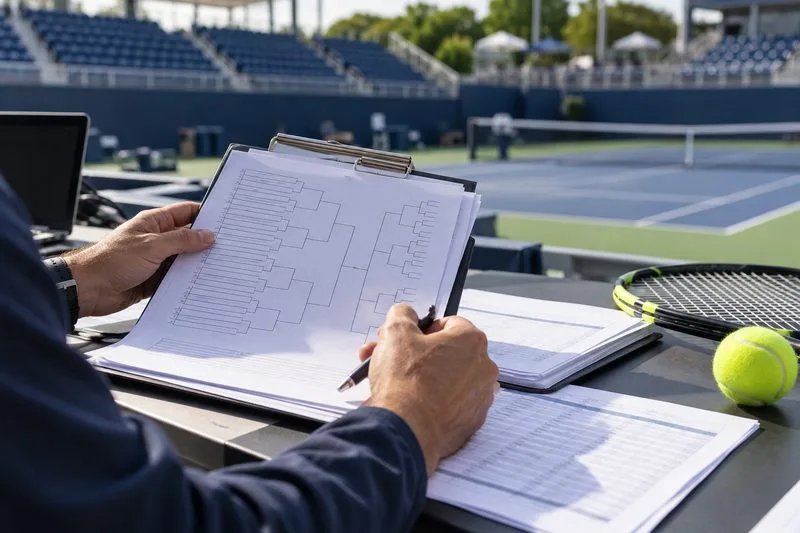
A player waiting near a tournament court illustrates the central lucky-loser requirement: an eligible qualifying loser may need to remain available and complete the required sign-in before a late main-draw vacancy can be filled.
What does “lucky loser” mean in tennis?
A lucky loser is a player who was eliminated from qualifying but later enters the main draw because another player withdraws or is removed before that replacement window closes. In the 2026 ATP Rulebook, eligible players normally come first from those who lost in the final qualifying round; players from earlier qualifying rounds can be used if more replacements are required. The 2026 Grand Slam rules use the same basic hierarchy.
The WTA definition is similarly based on players eliminated from qualifying, subject to eligibility requirements. The current 2026 WTA rules state that a player who did not enter and compete in qualifying cannot receive lucky-loser status.
Useful action: when you see “LL” next to a player’s name in a draw, read it as “entered the main draw after losing in qualifying,” not as a wildcard or direct acceptance.
Common misunderstanding: the highest-ranked qualifying loser always gets the spot
That is not always true. Ranking is important, but some major rulebooks deliberately add a random-draw step when vacancies already exist at the end of qualifying.
ATP Tour events
Under Section 7.20 of the 2026 ATP Rulebook, if qualifying finishes with no main-draw vacancy, the lucky-loser list is ordered by the PIF ATP Rankings used for qualifying seeding. If there is one vacancy when qualifying is completed, the two highest-ranked eligible players are randomly drawn to determine their order; the remaining players then follow by ranking. If two or more withdrawals already exist, the random-draw group becomes the number of withdrawals plus one.
This means the No. 1 ranked qualifying loser is not guaranteed to be first on the list when the randomization rule is triggered.
Useful action: if an ATP replacement looks “out of ranking order,” check whether a main-draw vacancy already existed when qualifying ended before assuming the tournament made an error.
WTA events
The 2026 WTA Rulebook uses a closely related structure. Lucky losers are ordered by the round reached in qualifying and the WTA Singles Rankings from the week before the tournament; Special Rankings are not used for this purpose. If there are no vacancies before qualifying is completed, ranking determines the order. If one vacancy exists before qualifying is completed, the top two ranked lucky losers are randomly drawn. With two or more withdrawals, the size of that random-draw group is the number of withdrawals plus one.
Useful action: for a WTA event, use the player’s actual WTA ranking specified by the rulebook rather than assuming a protected or Special Ranking determines lucky-loser priority.
Grand Slam events
Grand Slams use a different randomization formula. The 2026 Grand Slam Rule Book says the four highest-ranked eligible lucky losers are randomly drawn to establish the top part of the order, with the rest following the relevant rankings. If more than two main-draw withdrawals exist when qualifying finishes, the random-draw group expands to the number of withdrawals plus two.
So a Grand Slam can legitimately select a lower-ranked member of the top-four pool before the highest-ranked qualifying loser.
Useful action: do not apply the ATP Tour “top two” formula to a Grand Slam. Check the Grand Slam rulebook separately.
Why is there a random draw at all?
The random element reduces the incentive for a player to manipulate a final qualifying match after learning that a main-draw vacancy is already available. If the highest-ranked final-round loser automatically received an already-known opening, the competitive incentives around a qualifying loss could become distorted. The random pool preserves uncertainty among the highest-priority eligible players while still giving rankings an important role.
The exact size of that pool is a competition-rule choice, which is why ATP/WTA events and Grand Slams do not use identical numbers.
Useful action: when explaining a lucky-loser selection, separate two questions: “Who was eligible?” and “How was their priority order determined?” They are not the same question.
Does losing in the final qualifying round automatically make a player a lucky loser?
No. Reaching the final qualifying round generally places a player in the highest eligible group, but being eligible and actually receiving a main-draw place are different things.
The main draw must have a vacancy that can still be filled under the applicable rules.
The player must satisfy the event’s eligibility and sign-in requirements.
The player must be sufficiently high on the lucky-loser priority list when the vacancy is filled.
The player must remain available to play within the time required by that competition.
For ATP Tour events, the lucky-loser list is posted daily, and the sign-in deadline is normally one-half hour before the first scheduled match of the day. The 2026 Grand Slam rules likewise require daily sign-in at least one-half hour before the first match starts. WTA procedures also rely on the applicable daily sign-in and availability rules.
Useful action: if a higher-ranked player was skipped, check whether that player signed in and was available that day before concluding that ranking was ignored.
When can a lucky loser replace a main-draw player?
The timing of the withdrawal matters. ATP rules state that a lucky loser or alternate can replace a player who withdraws or is withdrawn before the first ball of that player’s first match is struck. The Grand Slam rule uses nearly the same concept: substitution is allowed before the first point is played in the withdrawing player’s first match.
Once a match has actually started, there is no mid-match insertion of a lucky loser. A retirement after play begins gives the opponent the result under the applicable match rules; it does not reopen the draw position for a replacement player.
Useful action: when a withdrawal happens close to match time, check whether the match had officially begun. That single timing fact can determine whether a replacement is possible.
What if several main-draw spots open at once?
There are two separate draws to keep straight. First, the rules may use a random process to establish priority among the top eligible lucky losers. Second, when multiple main-draw positions are available at the same time, the tournament may draw which lucky loser goes into which vacant line of the main draw.
The 2026 ATP rules explicitly provide that when two or more positions become available at the same time, the positions occupied by the eligible lucky losers are determined by drawing. Grand Slam regulations also use a draw to assign multiple lucky losers to open positions.
Useful action: distinguish “which player is next on the list?” from “which open draw line does that player receive?” Those can involve separate random procedures.
Are lucky-loser rules the same on the ITF World Tennis Tour?
No. The ITF World Tennis Tour has its own competition regulations. Under the 2026 rules, final-round qualifying losers receive priority over players who lost earlier, but the ordering mechanisms differ from the ATP and WTA Tour formulas. The regulations use categories based on ranking status and random draws within the applicable groups. They also set their own procedures for filling vacancies and signing in.
This is an important limitation when using a general explainer: the phrase “lucky loser” is universal enough to recognize, but the exact selection algorithm is competition-specific.
Useful action: for an ITF WTT event, consult the current World Tennis Tour regulations rather than copying an ATP or Grand Slam rule.
Quick reference: what is verified for 2026?
Question
Verified 2026 rule
Who is considered first?
Generally players eliminated in the final qualifying round; earlier-round losers may be used if more lucky losers are needed.
Does ranking matter?
Yes, but the way it interacts with random selection varies by circuit.
Is the highest-ranked player always chosen first?
No. ATP/WTA and Grand Slam rules can require a random draw among a top group.
Does a player need to remain available?
Yes. Daily sign-in and readiness requirements apply under major professional rulebooks.
Can a lucky loser replace someone after that main-draw match begins?
No under the cited ATP and Grand Slam substitution rules.
Are all tours identical?
No. ATP, WTA, Grand Slam, and ITF WTT procedures differ in important details.
What can depend on the tournament, and what may still be unknown?
Several details can depend on circumstances: the exact time a withdrawal is confirmed, whether qualifying has finished, how many vacancies exist simultaneously, whether the player completed the required sign-in, and whether the event operates under ATP, WTA, Grand Slam, or ITF World Tennis Tour regulations.
Before the official draw update or supervisor decision is published, it may also be impossible for an outside observer to know which eligible player will receive a late opening. A ranking list alone does not always answer the question because randomization can still be required.
Useful action: if a replacement has not yet been formally announced, treat social-media predictions as provisional. Wait for the updated official draw or order of play.
How to verify a lucky-loser replacement yourself
Use this short sequence when a draw changes unexpectedly:
Identify the governing competition: ATP, WTA, Grand Slam, or ITF World Tennis Tour.
Confirm that the replacement player competed in qualifying and note the round in which the player was eliminated.
Check when the main-draw withdrawal occurred relative to the completion of qualifying.
Check the ranking basis specified by that rulebook.
Look for the daily lucky-loser sign-in or official order of play.
Confirm the final main draw on the tournament or governing body’s official site.
If those six pieces line up, the selection will usually make sense even when the replacement is not the highest-ranked qualifying loser.