Home
» 🎾 Tennis
»
Final-Set Tiebreak Rules in 2026: Grand Slams vs. Regular ATP Tournaments
Final-Set Tiebreak Rules in 2026: Grand Slams vs. Regular ATP Tournaments
If you are watching a close men’s match in 2026 and the deciding set reaches 6-6, the key question is simple: is it a Grand Slam or a regular ATP tournament? At the Australian Open, Roland-Garros, Wimbledon and the US Open, the deciding set is settled by a 10-point tiebreak at 6-6. In regular ATP singles, including ATP Tour and ATP Challenger Tour events, a set tied 6-6 is decided by the standard 7-point tiebreak. In both formats, the winner must lead by at least two points.
That means a fifth set at Wimbledon tied 6-6 does not use the same tiebreak target as a third set at an ATP 500 event tied 6-6. The Grand Slam player must reach at least 10 points; the ATP player must reach at least seven. If the required two-point margin is not there, play continues beyond 10 or seven.
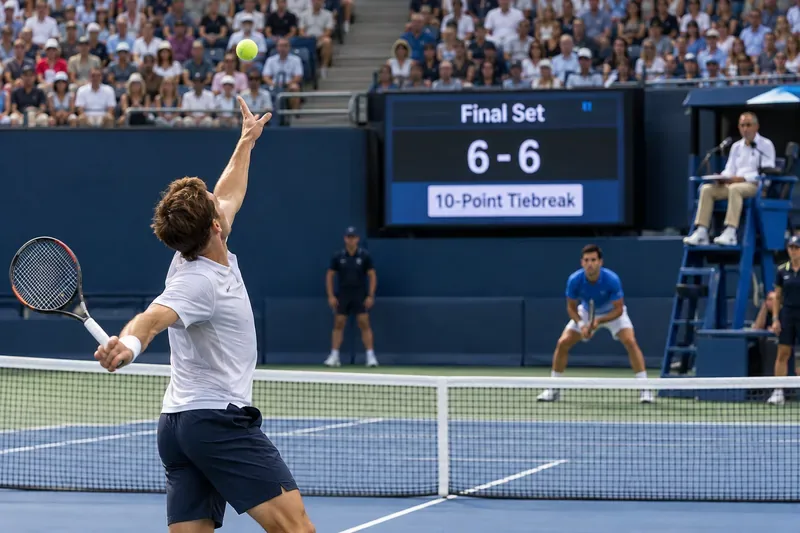
A deciding set at 6-6 can trigger different tiebreak targets: Grand Slam singles use a 10-point final-set tiebreak, while regular ATP singles use the standard 7-point tiebreak.
The 2026 rule in one table
Competition
Deciding-set situation
Tiebreak format
Win requirement
Grand Slam singles
Final set reaches 6-6
10-point tiebreak
First to at least 10, ahead by 2
Regular ATP singles
Any set, including the third, reaches 6-6
Standard tiebreak
First to at least 7, ahead by 2
Regular ATP doubles
Teams split the first two sets
10-point Match Tie-break instead of a full third set
First to at least 10, ahead by 2
The important distinction is that the 10-point format means two different things depending on the competition. At a Grand Slam, it can be a tiebreak inside the deciding set after the games reach 6-6. In regular ATP doubles, the 10-point Match Tie-break is generally played instead of an entire third set.
What happens at the four Grand Slams in 2026?
The 2026 Official Grand Slam Rule Book says that men’s singles main-draw matches are best of five sets and that other matches are generally best of three unless a Grand Slam determines otherwise. Crucially, its “Number of Sets, Tie-break” section states that the final set uses a 10-point tiebreak. The official ITF rules-and-regulations page links the current 2026 Grand Slam rule book. See the ITF rules and regulations page and the 2026 Official Grand Slam Rule Book.
The practical singles rule is therefore uniform across the Australian Open, Roland-Garros, Wimbledon and the US Open: when the deciding set reaches 6-6, the players contest a tiebreak to 10 points, and the winner must lead by two. The US Open’s official 2026 scoring guide likewise states that all four Grand Slams use this same final-set format. See the US Open 2026 scoring explanation.
Example: a Grand Slam men’s singles match
Suppose a best-of-five match is tied at two sets each, and the fifth set reaches 6-6. The players do not continue playing regular games until somebody leads 8-6 or 9-7. Instead, they begin a 10-point tiebreak. A 10-8 score ends it; 10-9 does not, because the margin is only one. The tiebreak could therefore end 12-10, 15-13 or any later score that produces a two-point lead.
This uniform system replaced the older situation in which the four majors used different deciding-set rules. The Australian Open’s official explanation notes that all Grand Slams had moved to the common system by Roland-Garros in 2022. See the Australian Open announcement on the joint Grand Slam rule.
What happens in regular ATP singles?
For ATP Tour and ATP Challenger Tour singles in 2026, the ATP rulebook states that all matches, including finals, are best of three tie-break sets. The ATP’s own scoring explainer says that when a set reaches 6-6, the tiebreak is played to seven points, with a two-point margin required. See the ATP Tennis Explained scoring guide.
So if an ATP Masters 1000, ATP 500 or ATP 250 singles match is tied one set each and the third set reaches 6-6, the deciding tiebreak is normally first to seven, win by two. A 7-5 tiebreak ends the match. A 7-6 score does not. At 6-6 in the tiebreak, play continues until someone has a two-point margin, such as 8-6, 9-7 or 12-10.
Example: a regular ATP singles match
Imagine a player wins the first set 6-4, loses the second 3-6 and reaches 6-6 in the third. The match then goes to the standard tiebreak. If Player A wins that tiebreak 7-4, the match score is recorded as a 7-6 deciding set, commonly with the tiebreak score shown in parentheses or separately depending on the scoreboard or results format.
The difference from a Grand Slam is not whether a tiebreak happens at 6-6; both formats use one. The difference is the target: seven points in standard ATP singles sets versus 10 points in a Grand Slam deciding set.
Why ATP doubles can look like the Grand Slam rule but is not the same
This is the most common source of confusion. In regular ATP doubles, the 2026 ATP rules specify two tie-break sets with No-Ad scoring, followed by a deciding 10-point Match Tie-break if the teams are one set all. There is no full third set in that standard format.
For example, if a doubles team wins the first set 6-4 and loses the second 4-6, the teams move directly to a Match Tie-break. They do not start a third set at 0-0 games and play until 6-6. A result such as 6-4, 4-6, 10-7 reflects a 10-point Match Tie-break replacing the third set. ATP reports from 2026 events repeatedly show this format in practice, consistent with the published rulebook.
Does “first to 10” mean exactly 10 points?
No. “First to 10” is shorthand. The player or team also needs a two-point lead. The same principle applies to a standard first-to-seven tiebreak.
A Grand Slam deciding tiebreak can end 10-6, 10-8 or 12-10, but not 10-9.
A regular ATP singles tiebreak can end 7-3, 7-5 or 9-7, but not 7-6.
An ATP doubles Match Tie-break can end 10-5, 11-9, 14-12 and so on.
This matters when following live scores. Reaching the nominal target does not automatically end the match if the margin is only one point.
Are all Grand Slam events identical?
For the central question in this article—singles deciding sets—the four majors use the same 10-point final-set tiebreak at 6-6 in 2026. However, Grand Slam programs include men’s and women’s singles, doubles, mixed doubles, juniors and wheelchair events, and not every event uses the same full-set structure. Some doubles categories may use a Match Tie-break instead of a full deciding set.
That is why a viewer should identify both the tournament and the event. “US Open” alone tells you the tournament, but “men’s singles” or “mixed doubles” tells you which match format applies. For unusual draws or specialist events, check the current tournament regulations rather than assuming the singles rule automatically carries over.
A quick way to identify the correct rule while watching
Start with the event name. If it is Australian Open, Roland-Garros, Wimbledon or US Open singles and the match has reached the deciding set at 6-6, expect a first-to-10 tiebreak, win by two. If it is a normal ATP singles event and the third set reaches 6-6, expect the standard first-to-seven tiebreak, win by two. If it is regular ATP doubles and the teams are tied one set each, expect a first-to-10 Match Tie-break instead of a complete third set.
There is one more useful clue: the set score. In Grand Slam singles, the players actually play the deciding set through six games all before the 10-point tiebreak begins. In regular ATP doubles, the 10-point Match Tie-break normally begins immediately after the teams split two sets, so there is no 6-6 third-set game score.
Bottom line for 2026
The rule to remember is straightforward. Grand Slam singles deciding set at 6-6: 10-point tiebreak, win by two. Regular ATP singles set at 6-6: 7-point tiebreak, win by two. Regular ATP doubles at one set all: 10-point Match Tie-break instead of a full third set.
If you are comparing a specific match, confirm whether it is singles or doubles and whether it belongs to a Grand Slam or an ATP Tour/Challenger event. Those two details are enough to resolve most apparent contradictions in 2026 tennis scoring.