Home
» ⚽ Football
»
Which Stadium Hosted the 2024 Champions League Final? Wembley’s Capacity and Legacy
Which Stadium Hosted the 2024 Champions League Final? Wembley’s Capacity and Legacy
Which Stadium Hosted the 2024 Champions League Final? Wembley’s Capacity and Legacy
Wembley Stadium in London hosted the 2024 UEFA Champions League Final. The match took place on Saturday, June 1, 2024, with kickoff at 8:00 p.m. in London—BST (UTC+01:00), or 7:00 p.m. UTC. Real Madrid beat Borussia Dortmund 2–0. That means the old future-tense question has a clear answer: the final has already been played, and Wembley was the venue.
UEFA’s official host list names Wembley for the 2024 final, and its published schedule confirms the date and 20:00 local kickoff. London was observing British Summer Time on June 1: 20:00 BST (UTC+01:00) equals 19:00 UTC, consistent with the UK’s summer clock change.
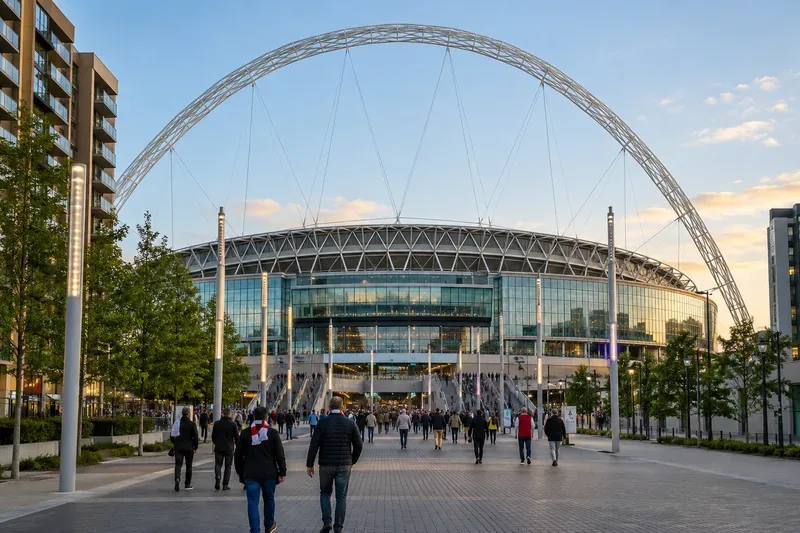
Wembley’s arch stands above the stadium approach in north-west London.
2024 Champions League Final: venue, date, and result
Detail
Confirmed information
Stadium
Wembley Stadium
Location
London, England
Match date
Saturday, June 1, 2024
Kickoff
8:00 p.m. BST (UTC+01:00) / 19:00 UTC
Final score
Real Madrid 2–0 Borussia Dortmund
Stadium capacity
90,000 seats
UEFA’s host list describes 2024 as the eighth European Cup or Champions League final staged at Wembley. In the Champions League era, the venue had most recently hosted the finals in 2011 and 2013, won by Barcelona and Bayern Munich respectively. The 2024 match therefore returned the competition’s showpiece to a familiar London setting.
Wembley Stadium capacity: what does 90,000 mean?
The current Wembley Stadium capacity is 90,000, and the venue is an all-seater stadium. That figure is the venue’s stated maximum seating capacity, as noted in Wembley’s stadium facts; it does not promise that every event will have 90,000 tickets available or that every seat will be sold. Event layouts, operational requirements, and ticket allocations can affect the number used for a particular match.
That distinction mattered for the 2024 final. UEFA’s ticket information listed 86,600 as the total ticket figure for the event, below Wembley’s general 90,000-seat capacity. The numbers answer different questions: 90,000 describes the venue, while the event figure describes the match’s ticket configuration. The old claim that the final would use all 90,000 seats should not be treated as an attendance or ticket-sales record.
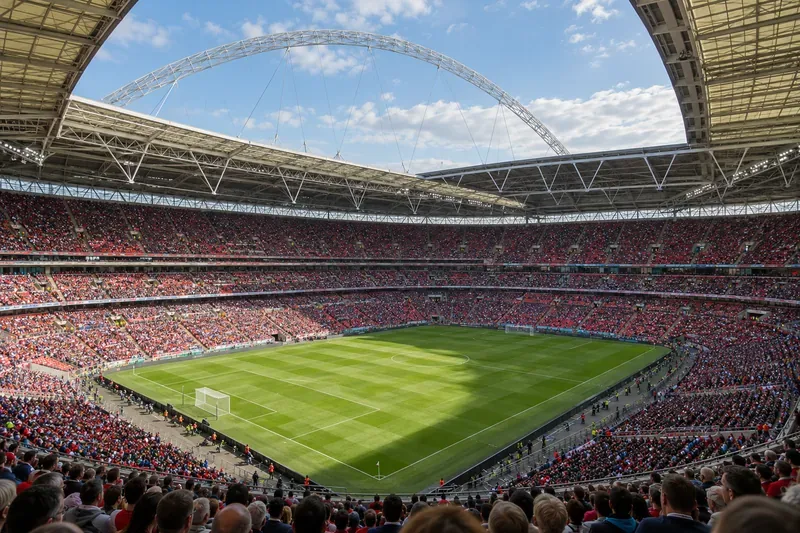
From inside, the scale is easiest to understand in the continuous seating bowl around the pitch. The stadium’s tiers bring spectators close to the field at the lower level and provide broad views from higher seats. Wembley does not publish the lower-, middle-, and upper-tier seat estimates as a simple fixed split for every event, so a detailed tier-by-tier capacity table would imply more certainty than the venue’s headline figure supports.
The full seating bowl surrounds the pitch beneath Wembley’s roof and arch.
A century of Wembley history and a modern landmark
The original Wembley Stadium dates to 1923 on the same north-west London site. Its first major event was the FA Cup Final on April 28, 1923, when Bolton Wanderers played West Ham United. The old ground became known around the world for its Twin Towers and for moments such as England’s 1966 FIFA World Cup victory, the 1948 Olympic Games, and the 1996 European Championship.
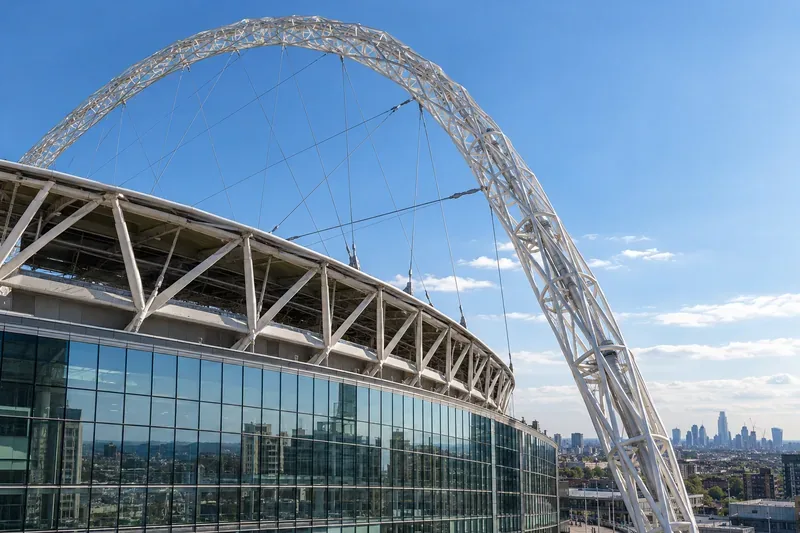
The old stadium closed in 2000 and was replaced by the current venue, which opened in 2007. The new building kept Wembley’s place on the sporting map while giving it a different silhouette: the famous Twin Towers made way for a sweeping arch above the roof. Wembley describes the arch as 133 meters tall and 315 meters long; it supports the north roof and a substantial portion of the south roof. Its scale is part of why the stadium is recognizable in the London skyline.
Wembley’s legacy extends beyond football. The venue has hosted major rugby, athletics, boxing, NFL, and music events, including Live Aid in 1985 at the original stadium. The current stadium’s 90,000-seat capacity and record of hosting major finals help explain why UEFA returned to the site for the 2024 decider. For the full venue timeline, consult Wembley Stadium’s official history.
The 133-meter arch is the defining feature of the current Wembley Stadium.
What happened in the final at Wembley?
Borussia Dortmund and Real Madrid met in the 2024 final. Dortmund created dangerous first-half chances, but Madrid scored twice after the break. Dani Carvajal headed in Toni Kroos’s corner in the 74th minute, and Vinícius Júnior added the second in the 83rd. Madrid’s 2–0 win secured its 15th European Cup title. UEFA’s official match report records the result and the goals.
The match is also the clearest way to distinguish the event from generic descriptions of the venue. Wembley’s long history and 90,000-seat scale set the stage, but the 2024 final itself was a specific one-night fixture: Dortmund against Madrid, played on June 1, with the trophy lifted by the Spanish club.
Quick answers
Was the 2024 Champions League Final on May 31 or June 1?
It was played on Saturday, June 1, 2024, in London. UEFA’s published schedule gives a 20:00 local kickoff; on that date London was observing BST (UTC+01:00), making kickoff 19:00 UTC.
Does Wembley’s 90,000 capacity mean 90,000 tickets were sold for the final?
No. Ninety thousand is the stadium’s general seating capacity. UEFA listed a different event ticket figure for the 2024 final, so capacity should not be confused with attendance, tickets made available, or tickets sold.
For readers looking up the stadium that hosted the 2024 Champions League Final, the answer is Wembley Stadium, London. Its 90,000-seat scale, arch, and long record of major football moments made the venue an apt setting for the 2024 final, while the scoreline and kickoff details now form part of its history.