Home
» 🏀 Basketball
»
What Does a Preseason DNP Mean? Coach Decision, Injury and Rest Labels Explained
What Does a Preseason DNP Mean? Coach Decision, Injury and Rest Labels Explained
A player can be healthy, dressed, and still finish an NBA preseason game with a DNP. Another player may sit because of an injury, while a veteran may be held out to manage workload. Those situations look similar from a distance—zero minutes—but they do not mean the same thing.
The safest way to read a preseason absence is to separate three questions: Did the player enter the game?What reason did the official box score attach to the absence?Was there a separate injury or rest designation before the game? That approach matters because preseason rotations are unusually fluid, coaches test combinations, and teams may protect established players while giving evaluation minutes to roster hopefuls.
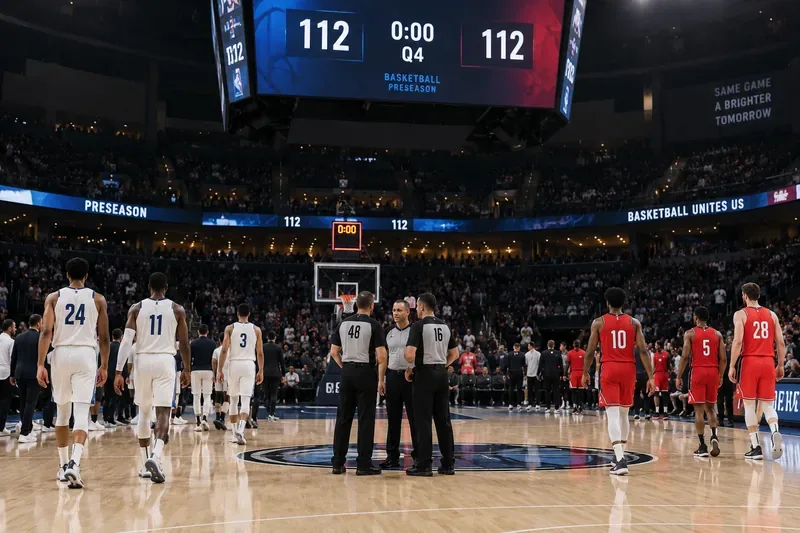
Preseason benches can include healthy players who never enter the game as coaches evaluate different lineups, manage workloads, and distribute minutes across a larger roster.
What does DNP mean in a preseason box score?
DNP means “did not play.” It tells you that the player recorded no playing time. By itself, it does not tell you why.
The reason attached to the notation is more useful than the three-letter abbreviation. On official NBA.com box scores, you may see labels such as “DNP - Coach's Decision,” while players unavailable for medical reasons can appear with “DND - Injury/Illness.” Official box-score terminology is not perfectly uniform across every game, however. A 2025 preseason box score between Boston and Toronto, for example, listed several players as “DND - Coach's Decision,” showing why the reason text should be read together with the participation code rather than treating DNP and DND as rigid medical categories.
Coach's decision, injury and rest: what is the practical difference?
Label or context
What it usually tells you
What it does not prove
Best source to check next
Coach's Decision
The coaching staff chose not to use the player in that game.
It does not automatically mean the player is out of the rotation, being punished, or likely to sit in the next game.
Official box score, coach comments, team game notes.
Injury/Illness
A medical condition affected availability.
It does not by itself establish severity, recovery time, or availability for the next game.
Official NBA injury report and team medical/status updates.
Rest
The team held the player out for workload or recovery rather than listing a specific injury.
It does not guarantee the player will return in the next preseason game.
Official injury report, team announcement, pregame coach comments.
No minutes with unclear notation
The player did not appear.
It does not safely distinguish rotation choice, late scratch, medical issue, or administrative situation.
Cross-check the official box score and pregame/postgame team information.
When “Coach's Decision” is the most useful explanation
For a fringe roster player, rookie, two-way candidate, or camp invitee, a coach's-decision absence is often best interpreted as a rotation choice for that specific game. Preseason coaches have more players to evaluate than they can realistically use in meaningful minutes. One night may emphasize veterans and projected rotation groups; another may be designed to test young players or a particular lineup.
The trade-off is simple: coaches cannot simultaneously maximize evaluation time for every player and maintain coherent lineups. Sitting one healthy player can create a longer look at another player competing for a roster spot. That makes a single preseason DNP a weak signal about long-term role.
For fans tracking roster battles: look at a sequence of games rather than one box score. Repeated coach-decision absences, especially when comparable players are consistently receiving minutes, can become more informative. Still, roster decisions also depend on practice performance, contract status, positional need, and team strategy—factors a public box score cannot fully reveal.
When an injury or illness label matters more than the DNP
If the player appears on an official injury report or is listed in the box score with “Injury/Illness,” the medical designation should take priority over speculation about rotation status. The NBA's official reporting page says teams must report injuries, illnesses, other medical conditions, and rest when those factors may affect participation, and that reports are updated throughout the day.
The official source is the NBA Injury Report page. That page is especially useful because it separates a player's participation status from the reason affecting availability.
For fantasy players and bettors: do not use a preseason DNP alone as evidence of an injury. Check the latest official status close to game time. A player can have no minutes for strategic reasons, while another can be medically unavailable despite both appearing as non-participants in a simple game log.
What does “Rest” mean in preseason?
Rest generally signals that the team is choosing recovery or workload management rather than identifying a specific injury as the reason for the absence. In preseason, that can be especially common for established veterans because the competitive value of an exhibition game is different from a regular-season game.
The trade-off for teams is between live-game preparation and reducing unnecessary workload. A veteran may benefit from real possessions with teammates, but the coaching and medical staffs may decide that practice work is enough for that stage of camp. Younger players, meanwhile, may need the same game to earn evaluation minutes.
For a real example of how official box scores distinguish reasons, the NBA.com Philadelphia-Toronto box score from March 12, 2025 lists one Toronto player as “DND - Rest,” while others are separately labeled “DND - Injury/Illness” or “DNP - Coach's Decision.” It is a useful reminder that the reason field carries the interpretive weight.
Why preseason makes DNPs harder to interpret
Regular-season playing time is usually tied more directly to winning that night's game. Preseason has additional objectives: conditioning, lineup experimentation, tactical testing, rookie development, contract evaluation, and managing veteran workload. Those goals can conflict.
Evaluation versus continuity: giving a camp player 20 minutes may reduce time for a projected regular-season unit to build chemistry.
Repetition versus health: a veteran may gain rhythm from playing but also accumulate avoidable workload.
Depth testing versus role clarity: a coach may deliberately use unusual combinations that will not survive into the regular season.
One-game information versus trend information: a single DNP can be noise; repeated usage patterns are more meaningful.
That is why “DNP - Coach's Decision” should not automatically be translated into “benched,” “injured,” “cut candidate,” or “out of the rotation.” Those are stronger conclusions than the label supports.
How should you interpret a preseason DNP for different needs?
If you are following a star or established veteran
Prioritize official injury/rest reporting and team comments. A coach-decision absence in preseason can simply reflect workload planning. The next useful question is whether the player is practicing normally and whether the team has announced a plan for the next exhibition game.
If you are following a rookie or roster-bubble player
Track opportunity over multiple games. Minutes, position competition, who plays ahead of the player, and late-game usage can be more informative than one DNP. A single coach's decision is not enough to conclude that a player has lost a roster battle.
If you are making a fantasy or wagering decision
Use the newest official availability information, not yesterday's box-score label. A DNP explains what happened in the completed game; it is not a forward-looking status. Injury reports, team announcements, and confirmed lineups are more relevant to the next game.
If you are simply trying to understand the box score
Read the full suffix. “Coach's Decision,” “Injury/Illness,” and “Rest” answer different questions. If the code and wording look inconsistent, treat the reason text and official pregame reporting as the stronger context.
A quick verification checklist
Open the official NBA.com box score and confirm the exact participation notation.
Read the reason after the dash; do not stop at DNP or DND.
Check the official injury report for a medical or rest designation.
Look for an official team update or coach comment if the reason is still unclear.
For roster-role conclusions, compare several preseason games rather than one night.
What you can and cannot conclude
A preseason DNP reliably tells you one thing: the player did not enter that game. A coach-decision label points toward a basketball or workload choice, while injury/illness and rest labels provide different availability context. None of those labels, standing alone, predicts the player's next-game status, final roster position, or regular-season role.
The most useful interpretation depends on your goal. For medical availability, favor the official injury report. For roster evaluation, watch multi-game usage. For veteran workload, look for rest language and team comments. For a simple box-score read, use the reason attached to the participation code rather than assuming every zero-minute night means the same thing.
Source note
This article was checked against official NBA.com box scores and the NBA's official injury-report page. As of September 30, 2026, the most recent season-specific injury-report page I could independently verify through official NBA search results was labeled 2025-26; I did not find a separately indexed 2026-27 page. The examples above therefore use verified official pages and avoid assuming an unverified change in terminology or reporting practice.