Home
» 🏉 Rugby
»
France vs Argentina: Nations Championship Kickoff, Lineups and Final Stakes — November 21, 2026
France vs Argentina: Nations Championship Kickoff, Lineups and Final Stakes — November 21, 2026
Information checked: November 21, 2026, at 6:19 p.m. UTC (7:19 p.m. CET in Saint-Denis, France; UTC+01:00). France faces Argentina in Round 6 of the inaugural Nations Championship at Stade de France in Saint-Denis on Saturday, November 21. Kickoff remains scheduled for 9:10 p.m. Central European Time (CET, UTC+01:00), equivalent to 20:10 UTC. At this verification time, the game had not started and no final score could be reported. The outcome will shape France’s place in the November 27–29 Finals Weekend in London.
England’s 37–12 victory over New Zealand earlier on Saturday, with a bonus point, raised the stakes in the Northern Hemisphere standings. France entered the final round on 21 competition points, while England began on 20; England’s five-point haul takes it to 25. France therefore needs to respond against Argentina and pay attention to Ireland’s result as the race for the hemisphere’s top spot unfolds. The confirmed team sheets put Antoine Dupont and Julián Montoya in charge of their respective teams.
Destaques
France vs Argentina is scheduled for Saturday, November 21, 2026, at 9:10 p.m. CET (20:10 UTC) at Stade de France, Saint-Denis.
No match result was available at the November 21, 18:19 UTC information check; this is a pre-match report, not a final-score recap.
France captain Antoine Dupont starts at scrumhalf alongside flyhalf Matthieu Jalibert; Julián Montoya captains Argentina from hooker.
The final Northern and Southern Hemisphere rankings determine the pairings for Finals Weekend, November 27–29, at Allianz Stadium, Twickenham.
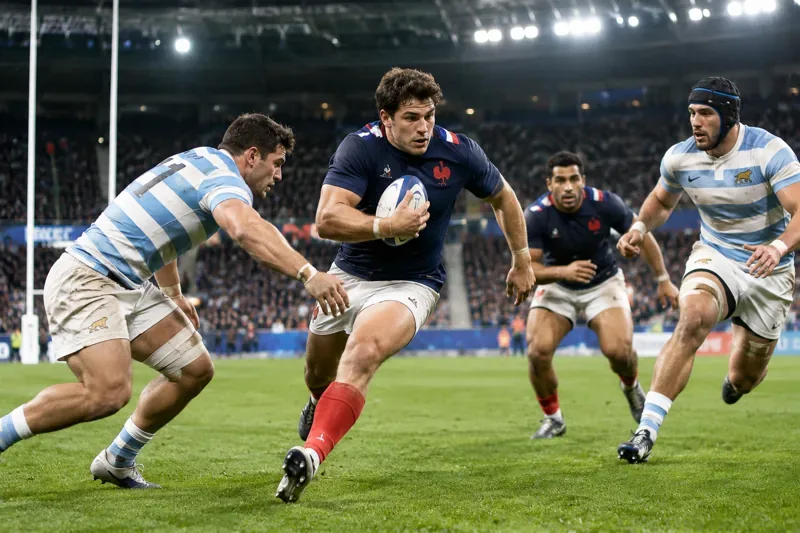
Illustrative, AI-generated rugby scene representing the France–Argentina matchup; it is not a photograph of the November 21, 2026, match.
What time is France vs Argentina, and where is it being played?
The French Rugby Federation lists Saturday, November 21, 2026, as the match date and Stade de France in Saint-Denis, just north of Paris, as the venue. Kickoff is 21:10 CET (UTC+01:00) in Saint-Denis, or 20:10 UTC. France had returned to standard time after the October daylight-saving change, so the one-hour difference between CET and UTC applies on match day. The meeting is part of Round 6, the concluding round before the inaugural Nations Championship’s Finals Weekend.
Scottish referee Hollie Davidson is appointed to lead the game, with Matthew Carley and Sam Grove-White as assistant referees and Mike Adamson as television match official, according to rugby officiating appointments published by SA Rugby.
What is the latest France vs Argentina result?
No final score was verified as of 18:19 UTC on November 21, 2026. That is approximately one hour and 51 minutes before the scheduled kickoff. A listing that displays a blank score, a “scheduled” status or a zero-zero placeholder should not be interpreted as a completed draw. Confirmed scoring, tries, cards and the final winner must come from an updated official match record after the game. This article therefore does not attribute any match incidents or a final result to either side.
What are the official France and Argentina starting lineups?
France’s announced selection is led by Antoine Dupont at scrumhalf, with Matthieu Jalibert at flyhalf. Argentina has Julián Montoya as captain and Tomás Albornoz at flyhalf. The following lists reproduce the announced matchday squads in jersey-number order, rather than suggesting that every replacement will necessarily appear on the field.
Replacements: 16 Maxime Lamothe; 17 Jefferson Poirot; 18 Régis Montagne; 19 Tyler Duguid; 20 Cameron Woki; 21 Grégory Alldritt; 22 Maxime Lucu; 23 Émilien Gailleton.
Argentina starting XV and replacements
Starting XV: 1 Boris Wenger; 2 Julián Montoya (captain); 3 Francisco Moreno; 4 Guido Petti; 5 Tomás Lavanini; 6 Juan Martín González; 7 Juan Martín Scelzo; 8 Facundo Isa; 9 Simón Benítez Cruz; 10 Tomás Albornoz; 11 Ignacio Mendy; 12 Santiago Chocobares; 13 Lucio Cinti; 14 Bautista Delguy; 15 Gerónimo Prisciantelli.
Replacements: 16 Facundo Bosch; 17 Mayco Vivas; 18 Joel Sclavi; 19 Efraín Elías; 20 Pedro Rubiolo; 21 Pablo Matera; 22 Agustín Moyano; 23 Rodrigo Isgró.
What does France vs Argentina mean for the Nations Championship final?
The tournament separates six Northern Hemisphere and six Southern Hemisphere sides into their respective standings. After six cross-hemisphere rounds, each side meets the team finishing in the corresponding position in the opposite table. The two group leaders contest the Grand Final on Sunday, November 29, at Allianz Stadium, Twickenham; the other ranking matches take place across November 27–29.
Before Saturday’s fixtures, France led the Northern Hemisphere table with 21 points, ahead of England and Ireland on 20 each. England subsequently beat New Zealand 37–12 and collected a bonus point, moving to 25 points. France can reach 26 by beating Argentina with a try-scoring bonus point, which would put it above England. The precise qualification outcome also depends on results elsewhere, including Ireland’s match against South Africa, and any applicable ranking tiebreakers. A France win without a bonus point is not automatically a guaranteed Grand Final berth.
Argentina entered the round on 11 points in the Southern Hemisphere standings, behind New Zealand and South Africa. Its finishing position will dictate which Northern Hemisphere opponent it meets in London. The Pumas’ game can thus influence the final ranking even if they are not in the contest for first place. None of the London pairings should be treated as settled until the Round 6 standings are final.
Which players and tactical matchups matter most?
The most prominent backline question for France is how Dupont and Jalibert control tempo and territory. With Louis Bielle-Biarrey and Aaron Grandidier-Nkanang among the outside backs, the hosts have options to move the ball wide if they earn quick possession. Argentina can test those ambitions through defensive line speed, physical breakdown contests and accurate kicking. These are tactical possibilities based on the named squads, not claims about events that have already occurred.
The starting forward packs also carry major responsibility. Mauvaka and Montoya lead the hooker matchups, while the back rows feature Ollivon and Jelonch for France and González and Isa for Argentina. A close set-piece contest or repeated penalties could change each team’s attacking opportunities. Selection announcements give an indication of the intended setup, but late changes remain possible until kickoff.
Where can fans verify the match and Finals Weekend schedule?