Home
» 🏏 Cricket
»
New Zealand vs. India: Bumrah Strikes Early as Hosts Reach 60/4 at Lunch — November 19
New Zealand vs. India: Bumrah Strikes Early as Hosts Reach 60/4 at Lunch — November 19
Updated November 19, 2026, 1:27 p.m. New Zealand Daylight Time (NZDT, UTC+13:00; 00:27 UTC)
New Zealand were 60 for 4 at lunch on Day 1 of the first Test against India at Cello Basin Reserve in Wellington, after India captain Shubman Gill won the toss and chose to bowl. Reuters reported Jasprit Bumrah took a wicket with the third delivery of the match, giving India an immediate breakthrough in the opening game of the 2025–27 ICC World Test Championship cycle.
The five-day Test is scheduled for November 19–23, with play beginning at 11:00 a.m. NZDT on November 19 (10:00 p.m. UTC on November 18). The lunch score is the latest verified match milestone available at the time of this check; live score feeds reviewed for this update did not agree on a later total. The next session will show whether New Zealand can rebuild through the middle order or India’s seamers can keep the pressure on.
Highlights
New Zealand reached 60/4 at lunch on Day 1, according to Reuters.
India won the toss and elected to field at Cello Basin Reserve.
Jasprit Bumrah struck with the third ball of the Test.
Mitchell Santner is out of the two-Test series with a fractured right hand; Dean Foxcroft was called into New Zealand’s squad.
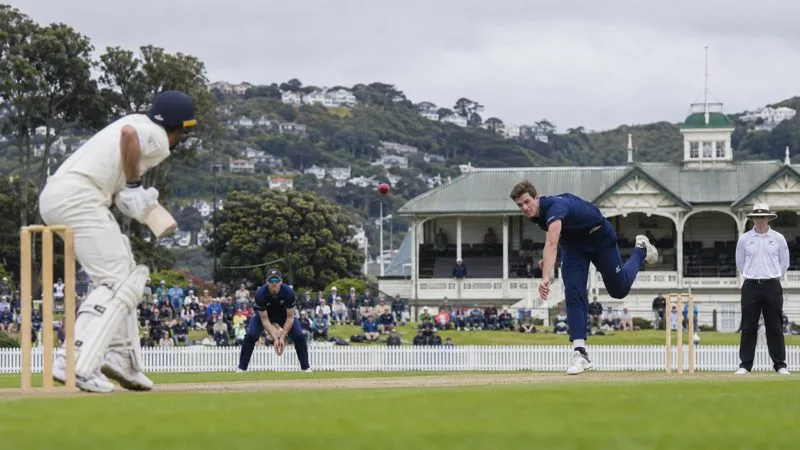
Illustrative image of a Test match at a Wellington cricket ground; it is not a photograph of the New Zealand–India match.
What happened in the opening session at Basin Reserve?
India’s decision to bowl put New Zealand’s top order under immediate pressure. Reuters’ lunch report said the hosts had lost four wickets for 60 runs and identified Bumrah’s first-over strike as the opening blow. The score leaves New Zealand needing a measured response from the batters still at the crease, while India will look to maintain accuracy and make the most of the new ball.
The lunch figure should be treated as a session checkpoint, not a final result or a live ball-by-ball total. A Test match can shift quickly: a partnership can stabilize the innings, while another cluster of wickets can give the bowling side control. No outcome is settled after one session.
Who won the toss, and what are the confirmed teams?
The BCCI match center confirms India won the toss and chose to field. Published playing XIs list Tom Latham as New Zealand captain and Shubman Gill as India captain. New Zealand’s XI is Tom Latham, Devon Conway, Henry Nicholls, Rachin Ravindra, Daryl Mitchell, Tom Blundell, Glenn Phillips, Nathan Smith, Kyle Jamieson, Matt Henry and Jacob Duffy. India’s XI is KL Rahul, Yashasvi Jaiswal, Devdutt Padikkal, Shubman Gill, Rishabh Pant, Washington Sundar, Dhruv Jurel, Akash Deep, Anshul Kamboj, Jasprit Bumrah and Prasidh Krishna.
India’s choice to field gives its pace attack first use of the conditions. Bumrah, Akash Deep, Anshul Kamboj and Prasidh Krishna provide four seam options, with Washington Sundar included as the spin-bowling all-rounder. For New Zealand, the top-order batters’ task is to manage the early movement, preserve wickets and create a platform for the middle order.
Why is Mitchell Santner missing from New Zealand’s lineup?
New Zealand Cricket announced that Santner fractured his right hand after being struck while batting during the fifth ODI against India. He has been ruled out of the two-Test series, and Dean Foxcroft was called into the squad as his replacement. Foxcroft was not named in the reported playing XI for this first Test.
Santner’s absence removes an experienced left-arm spin option and an all-rounder from New Zealand’s plans. The impact will depend on the match situation and how the selected bowlers share the workload over five days. His replacement’s inclusion in the squad gives the team another option, but does not by itself confirm a role in this match.
What does the first Test mean for the World Test Championship?
This two-match series counts toward the 2025–27 ICC World Test Championship. Each Test can influence the teams’ points percentage and their position in a cycle that runs through multiple series. New Zealand entered the series near the top of the standings, according to the ICC’s pre-match coverage; India will aim to earn valuable points away from home. A single result matters, but the wider table will depend on each side’s remaining matches and results elsewhere.
The first Test is scheduled to run through November 23 at Cello Basin Reserve. The second is set for Hagley Oval in Christchurch, beginning November 27. The series therefore gives both sides a short window to adjust: tactics and workloads from Wellington may shape selection and approach for the next match.
What should fans watch after lunch?
New Zealand’s immediate priority is to rebuild without surrendering scoring opportunities. India will try to keep the fielding side’s intensity high and force the batters to play at deliveries outside their comfort zones. If New Zealand can carry a partnership into the afternoon, the match can reset; if India takes more wickets early in the session, the visitors will have a chance to press for a modest first-innings total.
Conditions can evolve as the day warms and the pitch wears. The toss decision reflects India’s preference to use the earlier assistance, but it does not guarantee that the surface will favor one side throughout the match. Weather interruptions, batting discipline and the ability to sustain pressure across long spells will all affect the next phase.
FAQ
What is the latest verified score?
Reuters reported New Zealand at 60/4 at lunch on Day 1. A later live total was not consistently confirmed by the score pages checked for this update.
Where and when is the first Test?
At Cello Basin Reserve in Wellington, scheduled for November 19–23, 2026. The match began at 11:00 a.m. NZDT (UTC+13:00) on November 19, equivalent to 10:00 p.m. UTC on November 18.