Home
» 🎾 Tennis
»
Tokyo vs. Beijing Tennis Tournaments 2026: Dates, Time Zones, and Draw Sizes
Tokyo vs. Beijing Tennis Tournaments 2026: Dates, Time Zones, and Draw Sizes
“Tokyo versus Beijing” can mean two different comparisons in the 2026 tennis calendar. On the men’s ATP Tour, the Kinoshita Group Japan Open in Tokyo and the China Open in Beijing are both ATP 500 events scheduled for September 30 through October 6. On the women’s WTA Tour, Beijing’s China Open is a WTA 1000 event from September 30 through October 11, while Tokyo’s Toray Pan Pacific Open is a WTA 500 event from October 26 through November 1. The women’s events are not held in the same week, and their draws are very different.
That distinction matters if you are choosing which tournament to follow, comparing the size of the fields, or converting match times for a broadcast. The quick comparison below separates the tours first, then explains the one-hour time difference and what each draw size means.
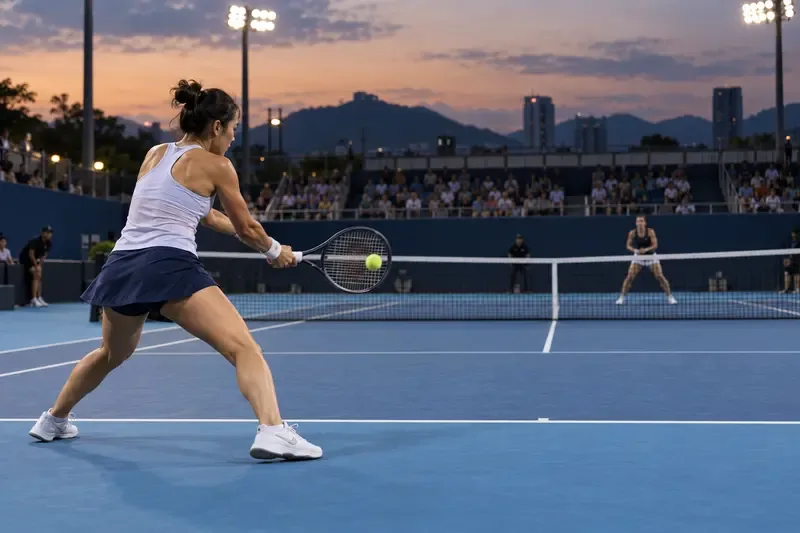
A player returns a shot on an outdoor hard court beneath tournament lights, the surface used at both cities’ 2026 tour events.
Quick comparison: which Tokyo and Beijing events overlap?
Tour and event
2026 dates
Level and surface
Singles / doubles draw
ATP: Kinoshita Group Japan Open, Tokyo
September 30–October 6
ATP 500; hard court
32 / 16
ATP: China Open, Beijing
September 30–October 6
ATP 500; hard court
32 / 16
WTA: China Open, Beijing
September 30–October 11
WTA 1000; outdoor hard court
96 / 32
WTA: Toray Pan Pacific Open, Tokyo
October 26–November 1
WTA 500; outdoor hard court
28 / 16
Draw sizes count the number of singles players or doubles teams in the main draw. Qualifying is separate. The ATP tournament pages list the Tokyo and Beijing men’s events on the same dates; the WTA’s 2026 event pages list Beijing and Tokyo on different dates and at different levels. The official tournament pages are ATP Tokyo, ATP Beijing, WTA Beijing, and WTA Tokyo.
If you mean the men’s ATP tournaments
The comparison is unusually straightforward: Tokyo and Beijing are both ATP 500 stops on outdoor hard courts, and both are scheduled for September 30–October 6, 2026. Each main draw has 32 singles players and 16 doubles teams. For a viewer, that means the two events offer the same category of ranking-point opportunity and the same listed draw dimensions. Their shared dates make them direct alternatives for tracking the men’s Asian swing, not successive stops.
The practical tradeoff is therefore less about the bracket and more about the matches and schedule you care about. Compare the official draw, player list, and daily order of play for the specific day. A tournament overview gives the date range; the order of play gives the scheduled court and local start time, which can change as matches run long or weather affects play. The ATP’s 2026 calendar announcement lists the Tokyo and Beijing ATP 500 events together in this week.
If you mean the women’s WTA tournaments
Beijing offers the larger and longer event. The China Open is a WTA 1000 tournament scheduled for September 30–October 11, with a 96-player singles draw and a 32-team doubles draw. The top 32 seeds receive first-round byes, so a seeded player can enter at the second round while other players begin earlier. The WTA’s round-by-round schedule runs from first-round singles matches on September 30–October 1 through the final on October 11.
Tokyo’s WTA event is the Toray Pan Pacific Open, scheduled for October 26–November 1. It is a WTA 500 with 28 singles players and 16 doubles teams. The smaller singles field means a shorter route through the bracket than Beijing’s 96-player draw, while the 500 level distinguishes its ranking-point stakes from Beijing’s 1000 level. For someone who wants a larger field and more match days, Beijing is the better fit; for a compact WTA 500 tournament later in the month, Tokyo is the relevant choice.
Do not confuse the WTA Tokyo Pan Pacific Open with the WTA Kinoshita Group Japan Open in Osaka. The WTA calendar places the Osaka Japan Open on October 19–25, while Tokyo’s Pan Pacific Open follows on October 26–November 1. The name “Japan Open” is used for events in different cities and on different tour schedules, so check the city and tour before setting a reminder.
How to convert Tokyo and Beijing match times
Tokyo uses Japan Standard Time (JST), UTC+9. Beijing uses China Standard Time, UTC+8. Tokyo is one hour ahead of Beijing: if a match begins at 7 p.m. in Beijing, the same moment is 8 p.m. in Tokyo. Japan’s National Institute of Information and Communications Technology maintains Japan Standard Time at UTC+9, and China’s government describes China Standard Time as UTC+8.
For a U.S. viewer, convert from the host city’s local time on the match date rather than relying on a fixed “Asia is 12 hours ahead” rule. During the Beijing WTA final on October 11, U.S. Eastern time is still on daylight saving time. The WTA lists the singles final for 7 p.m. Beijing time, which is 7 a.m. Eastern Daylight Time on October 11. The WTA Tokyo final is scheduled for noon JST on November 1; because U.S. daylight saving time ends that morning, that start converts to 11 p.m. Eastern Daylight Time on October 31. Viewers elsewhere in the United States should use their own time zone and the date-specific clock change.
Japan and China do not shift their clocks for daylight saving time, but U.S. clocks do. The National Institute of Standards and Technology says U.S. daylight saving time in 2026 runs through November 1 at 2 a.m. local time. That creates a particularly easy date error for the Tokyo final: it is Sunday at noon in Japan but Saturday night in U.S. Eastern time. Always check the official order of play close to the match.
Which event should you follow?
Choose Tokyo or Beijing for a same-week men’s comparison: the ATP events run concurrently, share ATP 500 status, and each has a 32-player singles and 16-team doubles main draw. Let the matchups and daily schedule guide your choice.
Choose Beijing for the larger women’s field: the WTA China Open has 96 singles players, 32 doubles teams, and an 11-day date range. Its 1000 level and first-round byes for the top 32 seeds make the bracket structure notably different.
Choose Tokyo for the later women’s event: the WTA Pan Pacific Open runs October 26–November 1 as a 500 with a 28-player singles draw and 16 doubles teams.
Choose based on your viewing hours: Tokyo is one hour ahead of Beijing, but match start times vary by court and day. A local start time cannot be converted accurately until you know the scheduled match and date.
In short, the men’s ATP events are parallel, closely matched options in the same week. The women’s WTA comparison is a choice between Beijing’s larger 1000 draw in late September and early October and Tokyo’s smaller 500 draw at the end of October. Confirm the tour, city, date, and order of play together; that four-part check avoids the most common calendar and time-zone mix-ups.