Opening a Shanghai Masters draw can be confusing even if you follow tennis regularly. A 96-player field does not look like a normal 64-player or 128-player bracket, some names appear to skip the opening round, and the ranking-points table uses round labels that can make a first-match loss look more valuable than it actually is.
The simplest way to read the 2026 Rolex Shanghai Masters is to separate three questions: how many players are in the singles draw, who receives a first-round bye, and how ATP ranking points are assigned after each round. Once those pieces are clear, the bracket becomes much easier to follow.
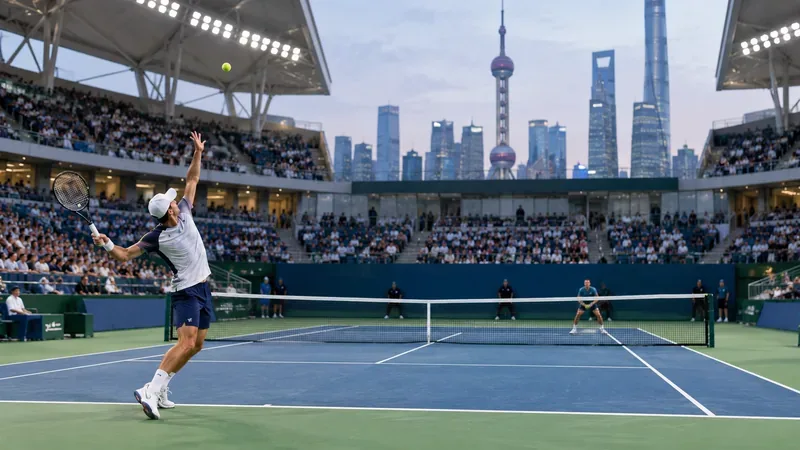
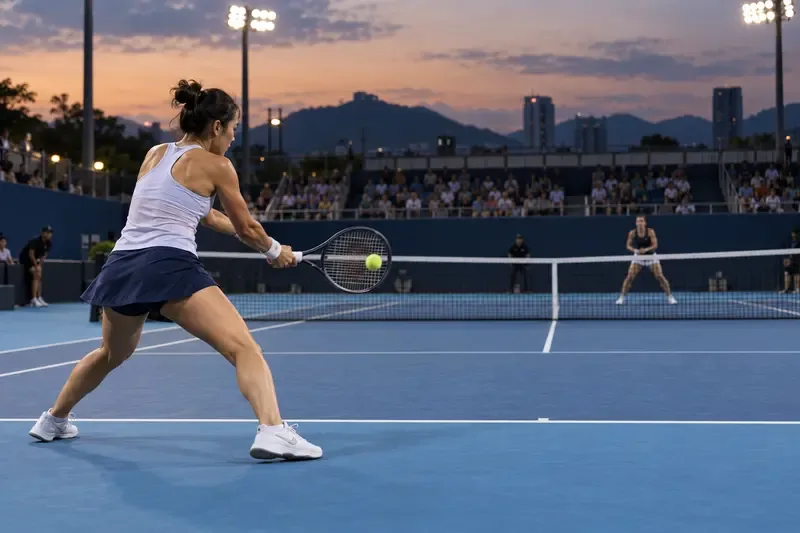
A hard-court tennis match in a large Shanghai stadium setting. The 2026 Shanghai Masters uses a 96-player singles draw, which creates first-round byes for all 32 seeded players.
The quick answer: Shanghai uses a 96-player singles draw
ATP lists the 2026 Rolex Shanghai Masters as an ATP Masters 1000 event with a 96-player singles draw and a 32-team doubles draw. The event is played on hard courts in Shanghai. The official ATP tournament page currently lists competition dates of October 7–18, 2026, while the tournament’s own website describes the broader 2026 event window as October 5–18. That scheduling difference does not change the draw mechanics explained here.
For the singles draw, the important number is 96. ATP rules specify that a 96-player field is placed into a 128-line bracket. Thirty-two of those 128 lines are occupied by byes, leaving 96 actual players.
This is the part that solves most of the confusion. Under the 2026 ATP Rulebook, a 96-player singles draw has 32 seeds. The same rules state that in a 96-player main draw, each seed receives a bye.
That means the 32 seeded players do not play in the opening round. The other 64 players compete in 32 first-round matches. The 32 winners then join the 32 seeded players in the next round, producing a standard field of 64.
Stage
Players involved
What happens
Start of main draw
96 players
32 seeds receive byes; 64 unseeded players are placed into first-round matches
Opening round
64 players
32 matches produce 32 winners
Next round
64 players total
32 opening-round winners are joined by the 32 seeded players
This is why a top seed may appear to “start in the second round.” The player has not won a match yet; the bracket simply advances that seed past the opening round by rule.
If a player is seeded from No. 1 through No. 32, expect a first-round bye in Shanghai’s 96-player format. If a seeded player’s name appears next to “Bye,” that is normal bracket construction rather than a late withdrawal or special exemption.
2. Do not count a bye as a match win
A bye advances a player in the draw, but it is not a played match. This matters when checking win-loss records and ranking points. A player who receives a bye and then loses in his first played match has not earned the same points as an unseeded player who won an opening-round match before losing at the same bracket stage.
3. Use the round reached, but apply the bye rule
ATP’s 2026 ranking rules contain a specific provision for this situation: a player who reaches the second round through a bye and then loses is treated as a first-round loser for ranking-point purposes. That prevents a seeded player from receiving full second-round-loser points without winning a match.
Shanghai Masters 2026 ranking points by round
The 2026 ATP singles point table for a 96-draw Masters 1000 event assigns the following points:
Result
ATP ranking points
Champion
1,000
Finalist
650
Semifinalist
400
Quarterfinalist
200
Round of 16
100
Round of 32
50
Round of 64
30
Opening-round loss in the 96-player main draw
10
Qualifies for the main draw
20 qualifying points, in addition to main-draw points earned
The champion therefore earns the full 1,000 points associated with the Masters 1000 label. The finalist earns 650, and the totals step down from there.
The most common points mistake: a seeded player loses his first match
Suppose the No. 12 seed receives a first-round bye and then loses in the Round of 64. It is tempting to look at the table, see “Round of 64 = 30 points,” and assign 30 points.
That is not how ATP handles the bye. Because the seed reached that round without winning a match, the ATP rule treats him as a first-round loser for points purposes. In a 96-draw Masters 1000 event, that means 10 ranking points.
Now compare that with an unseeded player who wins an opening-round match and then loses in the Round of 64. That player did win a match, so he receives the normal 30 points for losing in the Round of 64.
This distinction is one of the best ways to check whether a ranking-points calculation is being read correctly.
What about qualifiers?
Qualifiers add another layer. ATP’s 2026 rules state that players who reach the main draw through qualifying receive qualifying points in addition to any main-draw points they earn.
For a 96-draw Masters 1000 event, the point table lists 20 points for successfully qualifying. If that player then wins matches in the main draw, the appropriate main-draw points are added under ATP rules.
That is why two players eliminated at a similar stage may finish the week with different totals if one came through qualifying and the other entered the main draw directly.
Why 96 players instead of 64 or 128?
A 96-player field is a compromise between a smaller one-week Masters format and a full 128-player Grand Slam-style field. Structurally, it lets the event accommodate more players while still giving seeded players a protected opening round.
For fans, the practical effect is more early-round matches than a 56-player Masters event, but not a full 128-player field. For players, all 32 seeds receive a first-round bye rather than having only a smaller group of top seeds skip the opening round.
The 2026 ATP rulebook explicitly defines both the 32-seed structure and the bye assignment for a 96-player draw, so this is not an informal tournament convention.
A simple way to verify any Shanghai 2026 result
When you see a player’s result and want to check whether the draw position or ranking points make sense, use this sequence:
Check whether the player was seeded. Seeds 1–32 receive first-round byes.
Count actual matches won, not bracket rounds advanced. A bye is not a victory.
Identify the round in which the player lost.
Apply the ATP bye rule if the player lost immediately after a bye.
Add qualifying points only if the player came through qualifying.
If those five checks line up, the bracket and ranking total will usually make sense.
What is confirmed for 2026, and what can still change?
As of September 30, 2026, ATP’s official tournament page confirms the Shanghai singles draw size as 96. The 2026 ATP Rulebook confirms 32 seeds in a 96-player draw and states that every seed receives a bye. The 2026 ATP rankings table confirms the Masters 1000 point scale used above.
The exact player placements, seed order, qualifiers, lucky losers, and any withdrawals depend on the finalized draw and tournament entry updates. Those details should be checked against the official draw once posted rather than inferred from an earlier entry list.
The 2026 Shanghai Masters singles draw has 96 players, but it is organized on a 128-line bracket. All 32 seeds receive first-round byes, while the other 64 players contest the opening round. The main ATP points ladder runs from 10 points for an opening-round loss to 1,000 for the champion, with an important exception: a seeded player who receives a bye and then loses his first played match receives first-round-loser points rather than the standard points shown for that later bracket round.
Once you separate draw position from actual matches won, Shanghai’s format becomes straightforward to read.