Home
» 🎾 Tennis
»
How Tennis Doubles Alternates Enter a Draw After a Late Withdrawal
How Tennis Doubles Alternates Enter a Draw After a Late Withdrawal
A doubles alternate does not enter a tournament simply because a team withdraws. The replacement depends on when the withdrawal is recorded, which ATP event category is being played, and whether the doubles draw has already been made. In many cases, a team waiting on the original acceptance list has priority. Later, the tournament may rely on a separate on-site alternate list or, at ATP 500 events, teams that lost in doubles qualifying.
The steps below describe the 2026 ATP Tour framework. They help you read an entry list and draw accurately, but the event’s category matters: Masters 1000, ATP 500, ATP 250, and Challenger procedures are not identical. The relevant rules are in Chapter 7 of the 2026 ATP Official Rulebook, checked September 30, 2026.
Step 1: Identify which alternate list the team is on
Two players review entry paperwork with tournament staff, representing the advance-entry stage before an alternate position opens.
For an ATP Tour doubles main draw, teams enter together. The 2026 rulebook sets the advance-entry deadline at noon Eastern Time 14 days before the Monday of tournament week. Teams accepted directly form the main draw field; other entered teams may be listed as alternates. The alternate order follows the same system of merit used to determine entries, so it is not necessarily a simple queue based on when a team submitted its paperwork.
That first list is different from the later on-site alternate list. A team can be on the advance alternate list before the withdrawal cutoff, then the tournament can open a separate on-site process for later vacancies. At ATP Tour events, on-site doubles entries open at 12:01 a.m. Eastern Time on the Friday before tournament week and close at 3:00 p.m. Eastern Time that Friday. The online sign-in is blind, meaning no preliminary list is published while entries are being collected.
Check: Look at the event category and the exact label on the page. “Advance alternate” and “on-site alternate” describe different stages. A team shown below direct acceptances is not yet in the draw.
Step 2: If a team withdraws before Friday’s 10 a.m. cutoff, follow the advance list
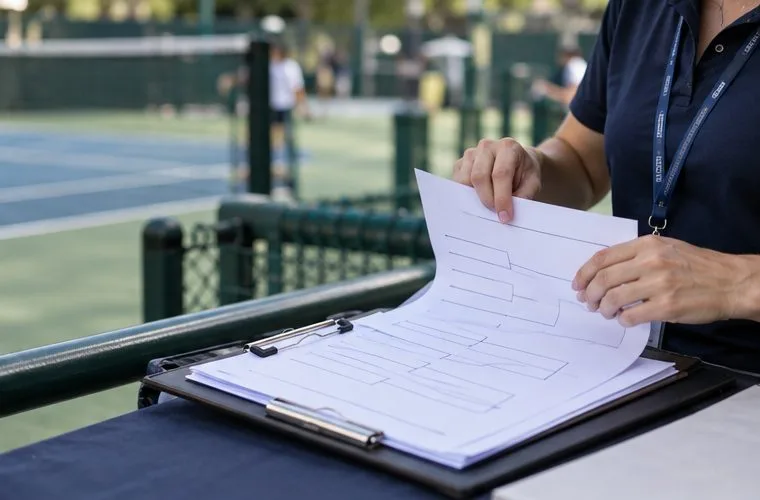
A staff member checks a doubles bracket, illustrating how a vacancy can be processed against the applicable alternate order.
For an ATP Tour event, the deadline for a team to withdraw from the advanced doubles entry list is 10 a.m. Eastern Time on the Friday before tournament week. If an accepted team withdraws before that deadline, the next team on the alternate list moves into the main draw as a direct acceptance. The player positions and team ranking rules determine who is next; a team does not jump the line just because it is physically at the venue.
There is a limited re-pairing exception. If one player must withdraw for a medical reason or another unavoidable circumstance after the entry deadline but before the Friday cutoff, the partner may be able to enter again with a different player who has not already been accepted into that doubles event. The new team’s combined entry position must satisfy the rulebook’s conditions to keep a direct-acceptance place. This is a specific exception, not a general right for any player to change partners.
Check: If an announcement says a pair is “out,” verify whether the replacement is named as a direct acceptance. Do not infer that the withdrawing player’s partner automatically keeps the spot.
Step 3: After the cutoff, check the on-site alternate process
Players wait courtside as an official checks a clipboard, a reminder that on-site alternates may need to be available when a vacancy opens.
For withdrawals from the ATP Tour advance-acceptance list after 10 a.m. Eastern on Friday, the rulebook creates an additional on-site entry position for each withdrawal. The resulting alternate process is tied to on-site sign-in; it is not just an automatic promotion of the next team from the original advance list. The withdrawing player’s partner may also have defined options to enter doubles or another qualifying event through the on-site method, subject to the rules.
Practical availability matters. A team that has signed in as an alternate may need to be reachable and ready when the tournament calls. For post-draw vacancies at some categories, a team that did not use the online on-site alternate procedure can still be eligible to sign the daily alternate sheet, but the rules place it behind teams that entered through the online process. One player from each team must sign the daily sheet to be eligible.
Check: An alternate listing is not a guarantee of a match. Confirm that both players are eligible under the event’s procedure, have completed the required sign-in, and can be ready at the time required.
Step 4: After the draw, use the event-specific replacement order
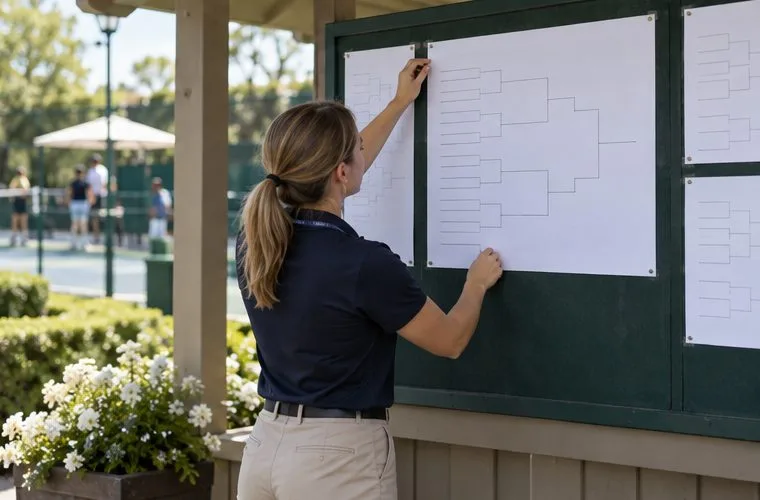
A staff member updates a posted bracket beside the court, where the replacement order can differ after the draw is made.
Once a doubles draw exists, the replacement method depends on the event type. At ATP Masters 1000 and ATP Tour 250 events, a vacancy after the draw is filled first from teams that were not accepted into the main draw through the on-site alternate sign-in list. The rulebook then provides for eligible daily alternates, including qualifying re-pair situations, in a lower position. This is why the posted draw and the daily alternate sign-in can matter more than an older advance-entry list.
ATP Tour 500 doubles has its own order because those events have a doubles qualifying draw. The team that loses in the final qualifying round is the first lucky loser. The two teams that lose in the first qualifying round follow as second and third lucky losers, ordered by the ranking used for seeding. Teams from the on-site alternate list follow them. A lucky loser here is a team that lost in qualifying but may enter the main draw if a vacancy opens; it is not simply any team listed as an alternate.
Challenger doubles vacancies also use an on-site alternate procedure, but the tournament’s sign-in timing and entry method differ from ATP Tour events. Grand Slam events publish separate regulations. Always identify the category before applying one event’s replacement sequence to another.
Check: Read the official draw after the withdrawal. Look for the incoming pair and any designation such as alternate or lucky loser, then compare the update with the event’s published rules. The ATP live scores and draws page is a useful starting point for Tour events.
What does a reliable update look like?
A useful update names the event, identifies the doubles draw, and shows the incoming team in the bracket or on the official alternate list. Its timestamp should be newer than the earlier draw image you may have saved. A social post can alert you to a withdrawal, but the official tournament or ATP draw confirms how the vacancy was resolved.
If the page is unchanged, do not assume the alternate was skipped. The organizer may still be verifying eligibility or completing the sign-in sequence, and public pages can lag behind a confirmed withdrawal. Refresh the event’s official draw and schedule before making plans based on a specific matchup.
Limits to keep in mind
The 2026 rulebook gives the framework, but individual event category and timing control the details. ATP 500 qualifying creates a different lucky-loser order from Masters 1000 and ATP 250 events. Challenger and Grand Slam procedures can differ again. If an event page and a general summary appear inconsistent, use the current event information and the relevant section of the official rulebook rather than assuming that every doubles draw follows one universal alternate queue.
A confirmed place in the draw is the clearest sign that an alternate has entered. Before that update, “next alternate” means a team is eligible to be considered under the applicable order—not that it is certain to play.