Home
» ⚽ Football
»
Association Football Explained: Rules, Positions, Tactics, and How to Read a Match
Association Football Explained: Rules, Positions, Tactics, and How to Read a Match
Association football—usually called soccer in the United States—is the 11-a-side sport in which two teams try to score by putting the whole ball over the opponent’s goal line, between the posts and under the crossbar. That simple objective creates a game of space, timing, technique, risk management, and constant tactical adjustment.
To make the ideas concrete, this article follows a clearly labeled hypothetical example: Harbor City FC is playing Riverside United. Harbor City starts in a 4-3-3, Riverside in a 4-2-3-1. The score is 0-0 after 20 minutes. Nothing about those fictional teams is presented as a real match result; they are only a teaching device for understanding what you see in an actual game.
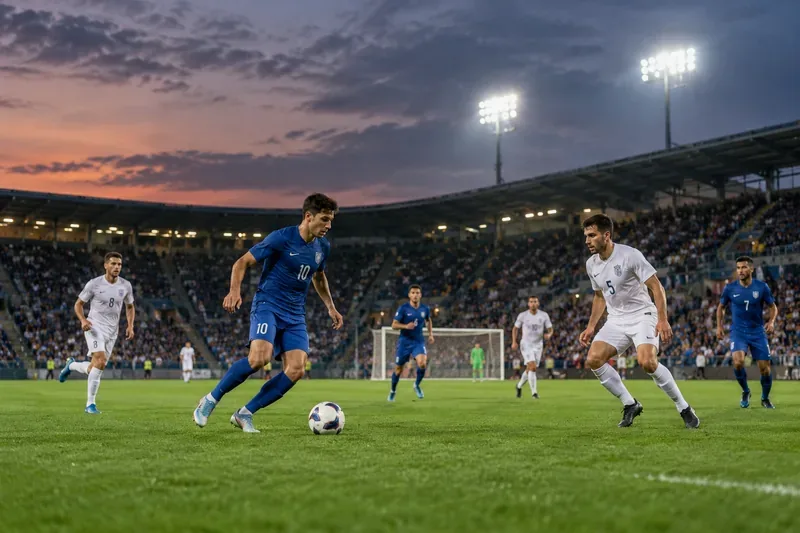
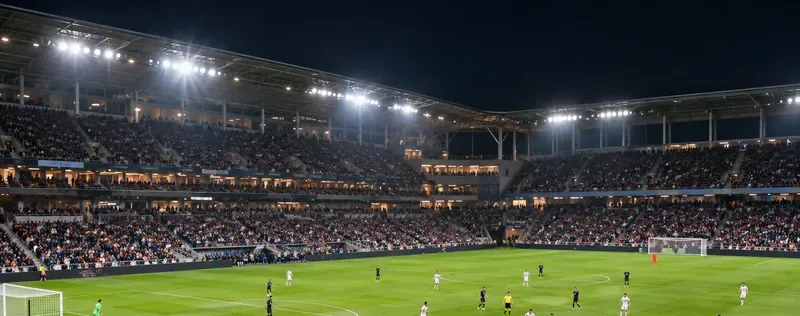
A midfielder carries the ball toward a defender in a floodlit stadium, illustrating the constant contest for space that defines association football.
What makes association football different from other forms of football?
The defining feature is that outfield players normally play the ball with their feet, head, chest, and other legal parts of the body rather than carrying it in their hands. The goalkeeper has special handling privileges inside the team’s own penalty area. The sport is governed internationally by the Laws of the Game maintained by The IFAB. Under Law 3, a match is played by two teams with a maximum of 11 players each, and one player on each team must be the goalkeeper.
In our hypothetical Harbor City–Riverside match, that means each side has 10 outfield players plus a goalkeeper. The labels “defender,” “midfielder,” and “forward” describe tactical roles, not separate legal classes. A center back can score, a striker can defend deep, and a fullback can move into midfield when the team has possession.
How is a match won?
A goal counts when the whole ball crosses the goal line between the posts and under the crossbar, provided the scoring team has not committed an offense that invalidates the goal. In ordinary league play, the team with more goals wins; an equal score is a draw. Some knockout competitions require a winner and may use extra time and a penalty shoot-out under the competition rules.
Imagine Harbor City’s right winger cuts inside and shoots. The goalkeeper gets a hand to the ball, but it continues toward goal. If part of the ball is still above the line, play continues. Only when the whole ball has crossed the line can a goal be awarded. That detail is easy to miss on television and explains why goal-line decisions can be so close.
The goalkeeper protects the goal, claims crosses, starts attacks with throws or passes, and increasingly acts as an extra passing option when a team builds from the back. A goalkeeper’s positioning can change the entire shape of a team because defenders may stand higher when they trust the keeper to cover space behind them.
Defenders
Center backs protect central areas, challenge for aerial balls, track runs, and often begin possession. Fullbacks or wingbacks defend wide zones but may also overlap, underlap, or move inside. In our hypothetical match, Harbor City’s left back pushes forward. Riverside’s right winger now has a choice: follow the run and defend, or stay high and offer a counterattacking threat.
Midfielders
Midfielders connect defense and attack. A holding midfielder may screen the back line, a box-to-box player may cover large distances, and an attacking midfielder may receive between the opponent’s midfield and defense. These roles frequently overlap. The most important question is not the player’s label but where the player is positioned when the team has and does not have the ball.
Forwards
Forwards stretch the defense, attack the penalty area, combine with teammates, and press opponents. A center forward can play on the shoulder of the last defender, drop into midfield, or act as a target for direct passes. Wingers may stay wide or cut inside onto a stronger foot.
Formations are starting maps, not fixed diagrams
A formation such as 4-3-3 describes a team’s broad arrangement, but real matches constantly reshape it. Harbor City’s 4-3-3 might become a 2-3-5 in possession if both fullbacks move high and the holding midfielder stays near the center backs. Without the ball, the same team may defend in a compact 4-5-1.
That is why reading football purely from a formation graphic can be misleading. Watch three things instead:
Width: which players stretch the field toward the touchlines?
Depth: who threatens space behind the defense, and who offers a safe pass behind the ball?
Numbers around the ball: does one team create local 2-v-1 or 3-v-2 advantages?
In the hypothetical example, Riverside’s two deeper midfielders initially outnumber Harbor City’s lone central attacking midfielder. Harbor City responds by moving a winger inside, creating an extra passing option. That small positional change can matter more than the nominal formation.
Why is offside so important?
Offside prevents attackers from simply waiting next to the opponent’s goal. The law is more precise than the common phrase “behind the last defender.” An attacker can be in an offside position without committing an offense; the offense occurs only when that player becomes involved in active play under the law.
Suppose Harbor City’s striker is beyond the second-last opponent when a teammate passes forward. If the striker then receives the ball and meets the law’s conditions for offside, the assistant referee may signal an offense. But if the striker stays uninvolved while an onside teammate reaches the pass, play may continue. This distinction is one of the most useful concepts for new viewers to learn.
Technology can assist some competitions with offside and other reviewable decisions, but the availability and exact implementation depend on the competition. The 2026/27 Law changes also expanded some permitted technology and VAR assistance options. See The IFAB’s 2026/27 Law changes.
Fouls, cards, free kicks, and penalties
Football is a contact sport, but not every contact is legal. Challenges can be penalized for offenses such as tripping, pushing, holding, handball under the law, or careless, reckless, or excessively forceful play. Depending on the offense and location, the restart may be a direct free kick, indirect free kick, or penalty kick.
Yellow cards caution players for misconduct; red cards send players off. A team that loses a player to a red card normally continues with fewer players. This creates a large tactical problem: the coach must decide which spaces to sacrifice and whether to keep enough attacking threat to prevent the opponent from committing everyone forward.
In the Harbor City example, imagine the right back is cautioned after stopping a dangerous transition. Riverside may now deliberately attack that side, hoping the defender becomes less aggressive for fear of a second caution.
How substitutions change a match
Substitutions are not merely fresh legs. They can change pressing intensity, aerial strength, ball retention, pace, or the team’s shape. Under The IFAB framework, the number of substitutes permitted in official competitions is set by the relevant competition authority within the laws. The current rules also contain procedures governing how substitutions are made.
Our hypothetical game is still 0-0 after 65 minutes. Harbor City replaces a holding midfielder with a second striker. The team now attacks more aggressively but protects the center less well. That is the central trade-off of in-game tactics: every extra player committed forward usually creates some new defensive risk.
A verified real-world example: Newcastle Jets 1–3 Gamba Osaka
The hypothetical example above explains the concepts. A real match on October 13, 2026 shows how those concepts can unfold in competition. Newcastle Jets FC hosted Gamba Osaka in East-region League Stage Matchday 2 of the AFC Champions League Elite 2026/27. The official J.League record lists the match at Newcastle International Sports Centre and a 16:45 Japan Standard Time kickoff. The match finished Newcastle Jets 1–3 Gamba Osaka.
Newcastle took the lead through Nikolaos Vergos in the 32nd minute. Gamba equalized through Yusei Toshida in the 40th minute, then substitutes Deniz Hummet and Welton scored in the 73rd and 86th minutes. The AFC’s official report describes Gamba as coming from behind and highlights the impact of those second-half substitutes. That makes the game a useful real example of why a football match is not explained by the starting formation alone: changes from the bench can alter the contest.
The verified starting lineups also show the standard 11-player structure. Newcastle Jets started James Delianov; Joseph Shaughnessy, Joel Bertolissio, Daniel Wilmering, Thomas Aquilina; Zane Schreiber, Zach Clough, Max Burgess, Will Dobson; Nikolaos Vergos and Xavier Bertoncello. Gamba Osaka started Jun Ichimori; Shota Fukuoka, Shinnosuke Nakatani, Takeru Kishimoto, Shinya Nakano; Shuto Abe, Tokuma Suzuki, Eli Adams; Ryotaro Meshino, Issam Jebali and Yusei Toshida.
Official sources for the result and lineups are the J.League match record and the AFC match report. Gamba Osaka’s official match information also listed DAZN as the viewing service for the match; broadcast availability can differ by country and territory, so viewers should check the rights holder for their location.
How to read a match more intelligently
If you are new to association football, do not try to track all 22 players at once. Start with the ball, then widen your attention. Ask where the next pass is likely to go and which defender would have to move to stop it. After a few minutes, patterns emerge.
A practical viewing sequence is:
Identify each team’s broad defensive shape.
Watch how the team in possession creates width and depth.
Notice which midfielder receives the ball with time to turn.
Track runs behind the defense, even when the runner does not receive the pass.
After a turnover, watch the first five seconds: does the team press immediately or retreat?
When a substitution happens, compare the team’s shape before and after it.
Return to Harbor City versus Riverside. If Harbor City ends the fictional match with more possession but fewer dangerous chances, possession alone has not explained performance. Perhaps Riverside allowed safe passes in non-threatening areas while protecting the center. Football analysis improves when you distinguish having the ball from using the ball to create high-value situations.
What matters most for a new fan?
You do not need to memorize every law or tactical term to enjoy association football. Learn the scoring rule, the basic idea of offside, the difference between open play and set pieces, and how team shape changes with possession. Then watch how space opens and closes.
The fictional Harbor City–Riverside scenario shows the logic: formations provide an initial structure, player movement changes that structure, substitutions change the available tools, and goals reward the team that converts opportunities. The verified Newcastle Jets–Gamba Osaka result shows the same principle in a real 2026 continental match: Newcastle scored first, but Gamba responded before halftime and then used second-half substitutes to pull away.
That combination of simple rules and complex decisions is the core appeal of association football. The ball is the obvious focus, but the deeper game is the movement happening before the ball arrives.